
The hard truth is that most VPNs don’t work in China. Beijing’s censorship algorithms are incredibly sophisticated, meaning an average VPN app will get blocked by the Great Firewall within seconds of you trying to connect.
Imagine landing in China for work or vacation, opening your phone, and discovering your favorite apps, social platforms, and work tools are blocked. It’s a reality that millions of people face every day. To stay connected, you need a VPN built to bypass the Great Firewall using advanced stealth technology that defeats deep packet inspection (DPI).
I spent months testing stealth protocols and real-world server performance to separate the marketing from what works. In this updated 2026 guide, I’ll show you the few VPNs that reliably bypass internet censorship, plus the settings I recommend before yodu travel to China.
Best VPNs for China: Our hand-tested top picks
My team and I tested dozens of VPNs in China to see which ones can bypass the country’s strict digital boundaries. Many claim to work, but only a handful offer the stealth technology and reliability needed for consistent access.
Here are my top recommended VPNs that are working right now:
- NordVPN – Best overall VPN for China with super-fast speeds, reliable apps, great streaming access, and extra security layers – get 75% off.
- Surfshark – Best budget choice packing fast speeds and great privacy tools – get 75% off with a 7-day free trial.
- VPN.ac – Lightweight software specifically engineered to bypass aggressive network blocks – get 62% off.
- ExpressVPN – Incredibly user-friendly apps that connect smoothly, but with a more expensive price tag – get 84% off.
- Astrill VPN – A solid traditional tool with decent speeds and highly durable anti-detection protocols.
NordVPN: Best VPN for China that consistently works
| VPN | NordVPN |
| Based in | Panama |
| Logs | No logs (audited) |
| Price | $3.49/mo. |
| Support | 24/7 live chat |
| Refund | 30 days |
| Website | NordVPN.com |

NordVPN is the best overall VPN for getting around internet restrictions. Since it has no infrastructure tied to mainland China, it offers fast, private, and reliable access.
Behind NordVPN’s performance is a network of more than 9,300+ servers spread across 135 countries, giving you advantages such as:
- Military-grade obfuscated servers: Special stealth servers that disguise your VPN traffic as regular HTTPS traffic, helping it slip past the Great Firewall.
- Blazing network throughput: Consistent real-world speed performance topping 755 Mbps on unblocked, high-bandwidth server pathways.
- Advanced data security: Full integration of RAM-only server nodes and post-quantum encryption keys to protect your data from future tracking threats.
- Total leak shielding: Built-in automated kill switches and encrypted private DNS routing networks to stop tracking exposures before they start.
- Threat Protection mod: Advanced app features that automatically block intrusive scripts, trackers, malicious download packages, and web ads at the connection source.
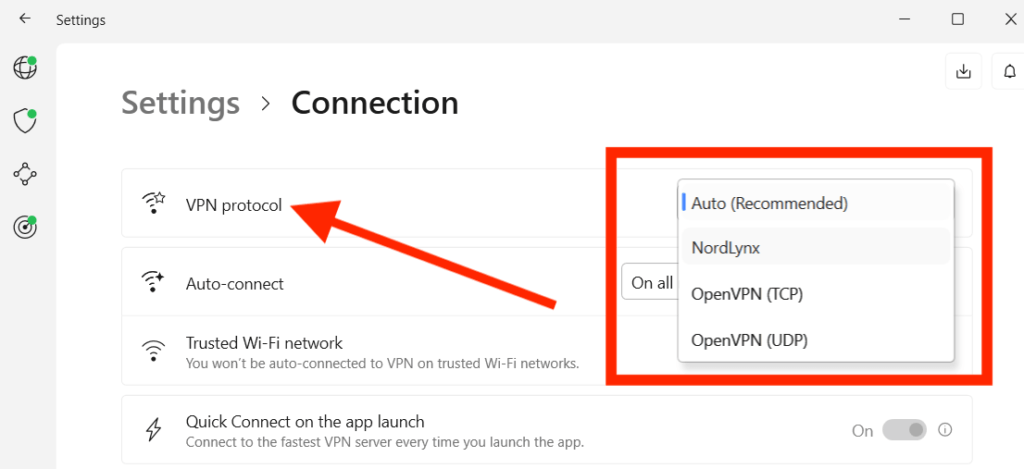
NordVPN consistently ranked among the top performers in all of our China VPN tests. Here’s the desktop app we used throughout our testing:
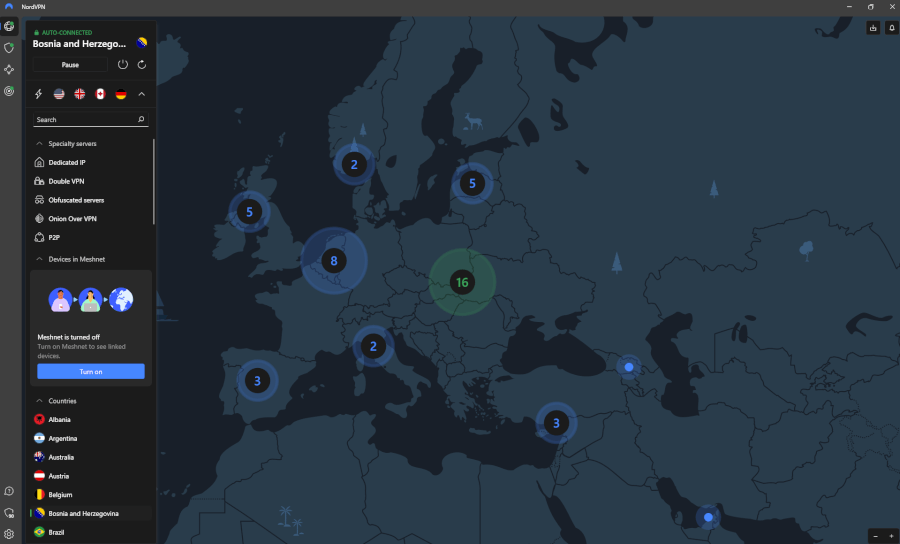
How to connect NordVPN in China
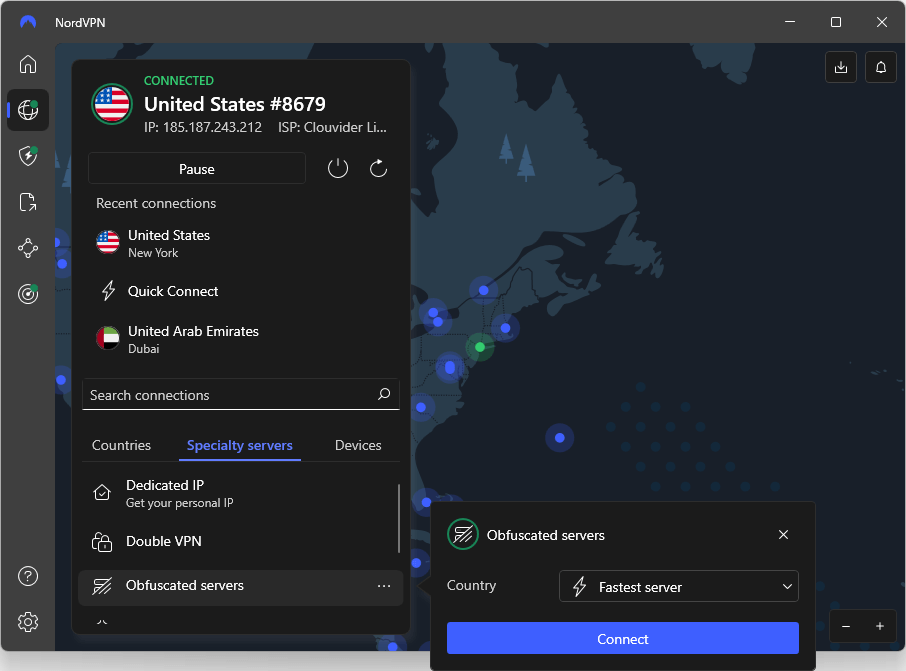
To punch through DPI blocks, you must configure the app using specialized obfuscated mode steps before you cross the border:
- Visit the official website, secure your discounted plan subscription, and download the software app for your active devices.
- Launch the app interface and open your main user Settings (the gear wheel icon).
- Navigate to the Connection settings page.
- Locate the VPN Protocol dropdown menu. Switch your setting from automatic/NordLynx to OpenVPN (TCP).
- Return to the main dashboard interface. Locate the Specialty Servers menu section.
- Select Obfuscated Servers. The app will automatically connect you to the optimal nearby stealth node for maximum censorship resilience.
NordVPN pros and cons
+ Pros
- User-friendly and reliable apps
- Double VPN and Onion Over VPN servers
- Passed numerous 3rd-party audits
- Strong encryption standards with full support for WireGuard
- Works with Netflix and many streaming sites
- Threat Protection feature to block ads, trackers, and malware
- Professional 24/7 live chat support
- Consistently fast speeds
- Dedicated RAM-only servers with 10 Gbps bandwidth channels
- Post-quantum encryption
– Cons
- Best discounts only available with 2-year plans
Looking for a better NordVPN deal? Right now, you can get 75% off NordVPN, dropping the price to just $3.49/month:
NordVPN Cyber Deal is Live:
Get 75% Off NordVPN (drops the price to $3.49 per month) plus 3 months FREE:
(Coupon is applied automatically.)
Surfshark: Fast, budget-friendly VPN for China with unlimited connections
| Website | Surfshark.com |
| Based in | The Netherlands |
| Logs | No logs (audited) |
| Price | $2.49/mo. |
| Support | 24/7 live chat |
| Refund | 30 days |
| Deal | 85% Off Coupon |

Surfshark VPN is the next service on our list of the best VPNs for China. This virtual private network offers a robust set of features, user-friendly and reliable VPN apps, a highly secure server network, and incredible connection speeds powered by the WireGuard VPN protocol.
Surfshark is a budget-friendly VPN service that offers plenty of solid features, including:
- Swift speeds and dependable performance for accessing restricted content in China.
- Unlimited device connections on a single subscription.
- Audited no-logs policy verifying total data privacy.
- Full support for the lightning-fast WireGuard VPN protocol.
- Automatic kill switch and private DNS leak protection.
- Secure integration for P2P filesharing and torrenting traffic.
- Proven ability to unblock Netflix, YouTube, and global streaming media sites.
- CleanWeb 2.0 built-in VPN ad blocker and tracker shield.
Priced at just $2.49/month with its long-term plan and offering unlimited simultaneous connections, Surfshark delivers tremendous bang for the buck. Like our top pick NordVPN, Surfshark gives you a risk-free 30-day money-back guarantee and professional 24/7 live chat support.
Surfshark’s NoBorders feature
Surfshark features a specialized tool called NoBorders that allows this virtual private network to work in China when other VPNs get blocked by the Great Firewall.
When your Surfshark app detects active restrictions or network throttling, it can automatically trigger NoBorders mode. This provides you with a curated list of obfuscated servers engineered to handle strict regional internet restrictions.
Because China aggressively blocks VPN traffic, I recommend turning on NoBorders mode before you connect. It disguises your VPN traffic as regular HTTPS browsing, making it harder for the Great Firewall and deep packet inspection to detect.
How to use Surfshark VPN in China
1. Go to the Surfshark website and sign up for a subscription.
2. Download and install the Surfshark apps for the devices you want to use before arriving in China.
3. Enter your login credentials into the VPN app interface.
4. Before you connect to a server, enable NoBorders mode.
5. In the Surfshark app, select the Settings icon (the gear wheel).
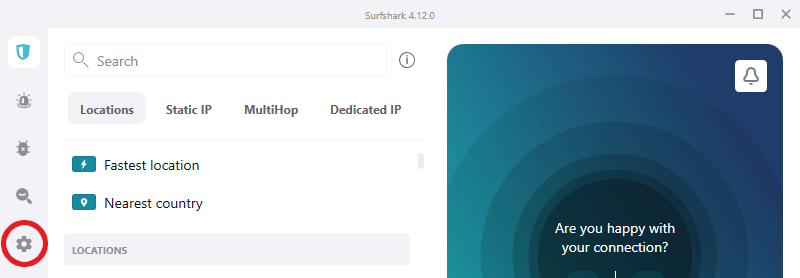
6. On the Settings page, select VPN Settings. Scroll down until you see the NoBorders option and toggle it to On.
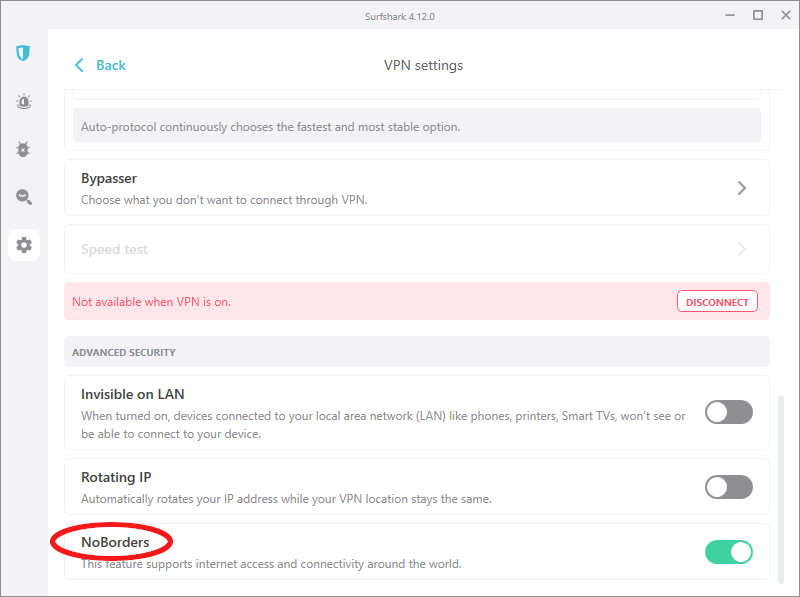
7. Go to your Protocol settings and switch to OpenVPN (UDP or TCP) to ensure maximum stability against Chinese censorship algorithms.
8. Once you activate NoBorders mode, return to the main dashboard, connect to a recommended nearby location like Hong Kong, Japan, or Singapore, and browse normally.
All Surfshark subscriptions support an unlimited number of simultaneous connections and include a 30-day money-back guarantee. At under $3 per month, it remains one of the best cheap VPNs on the market.
Surfshark pros and cons
+ Pros
- Unlimited connections
- User-friendly apps for all devices and operating systems
- CleanWeb feature to block ads, trackers, and malware
- Works great with Netflix and many other streaming services
- 24/7 live chat support
- Strong encryption and security features (audited)
– Cons
- Limited support for VPN routers
- Above-average monthly prices
Get 85% off Surfshark VPN plus an additional 3 months extra with the coupon below:
Surfshark VPN Coupon:
Get 85% off Surfshark VPN plus an additional 3 months extra with the coupon below:
(Coupon is applied automatically; 30-day money-back guarantee)
VPN.ac: Advanced features for defeating restrictions in China
| Name | VPN.ac |
| Location | Romania |
| Price | $3.75/mo. |
| Logs | No logs |
| Support | |
| Website | VPN.ac |

VPN.ac is a strong choice for bypassing strict network restrictions in China, thanks to its anti-censorship tools, strong encryption, and specialized server options. As a reliable China VPN, it helps users maintain secure access, avoid DPI, and handle high-bandwidth activities like torrenting.
The service includes essential privacy features like a VPN kill switch, DNS leak protection, and multi-hop (double VPN) connections.
While VPN.ac isn’t the best choice for streaming, with limited success in unblocking services like Netflix, its technical strengths are hard to ignore. With fast performance, strong security, and competitive pricing, it remains one of the best VPNs for China.
How to use VPN.ac in China
To bypass the Great Firewall using VPN.ac, configure these settings before crossing the border:
- Go to the official VPN.ac website and choose a subscription plan.
- Download and install the client apps for your devices, then log in using your account credentials.
- Within the application dashboard, open the Advanced settings menu.
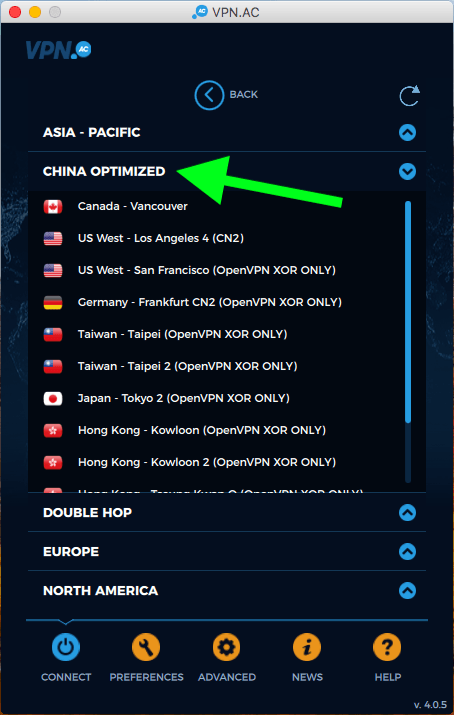
- Locate and toggle on the feature labeled: “I am in China or other censored country.”
- Return to the connection screen, click Connect, and choose a server node from the specialized “China Optimized” location list.
- Toggle the main VPN connection switch to ON to secure your traffic VPN tunnel.
VPN.ac pros and cons
+ Pros
- Dedicated bare-metal servers with self-hosted encrypted DNS
- Excellent speeds with plenty of available bandwidth
- Multi-hop (double VPN) server configurations
- Obfuscation features with many different encryption options
- Secure proxy browser extensions
- WireGuard VPN support
Cons
- Does not work well for streaming
- Fewer features than other leading VPNs
- Limited refund window (7 days)
ExpressVPN: Powerful anti-censorship features made simple for China
| Website | ExpressVPN.com |
| Based in | British Virgin Islands |
| Logs | No logs (audited) |
| Price | $2.49/mo. |
| Support | 24/7 live chat |
| Refund | 30 days |
| Deal | 84% Off Coupon |

ExpressVPN remains one of the best VPNs for China, offering fast, reliable access to blocked websites and services. While it costs more than many competitors, it continues to deliver consistent performance behind China’s censorship.
ExpressVPN is one of the best stealth VPNs for China, offering:
- Simple and automated access to blocked content, apps, and streaming media platforms.
- An extensive network spanning 113 countries worldwide for broad location choices.
- Military-grade encryption protocols to safeguard sensitive data transfers.
- Proprietary Lightway protocol infrastructure, ensuring rapid connection handshakes and an uninterrupted browsing experience.
- Sleek, intuitive VPN applications engineered for all major devices and desktop operating systems.
- Network Lock kill switch paired with secure private DNS leak shielding.
You also get 24/7 live chat support whenever you need help. While some VPNs are faster, ExpressVPN remains one of the most reliable and beginner-friendly VPNs for China.
Every ExpressVPN plan includes a 30-day money-back guarantee, so you can test it risk-free before committing.
How to use ExpressVPN in China
To use ExpressVPN in China, just follow these steps:
1. Go to the official ExpressVPN website and complete your subscription setup.
2. Log in to your dashboard and download the applications for the devices you want to use with the VPN.
3. Open the client app and paste in your unique account activation code.
4. Select the three-bar menu icon located in the top-left corner of the interface and click Options (or Settings).
5. Navigate to the Protocol tab and select the Automatic setting. This allows the app to automatically deploy specialized obfuscation layers when it detects Chinese network restrictions.
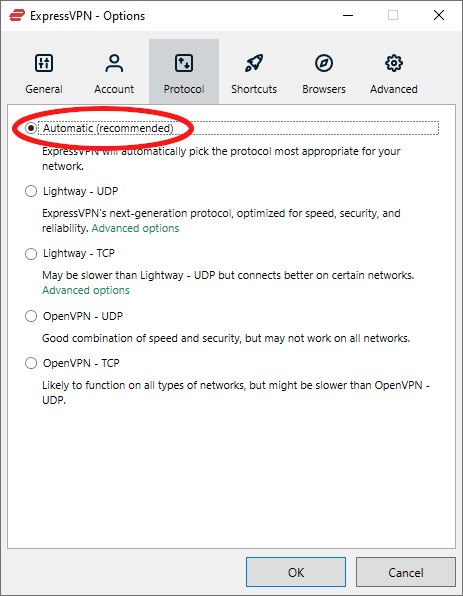
6. Click OK to save your configurations. You are now prepared to route through specialized anti-censorship nodes.

7. Check the recommended location directory inside your app to connect to optimal regional pathways (such as Hong Kong, Japan, or Singapore).
8. Toggle the main power button to secure your data tunnel and freely browse the unblocked global web.
ExpressVPN pros and cons
+ Pros
- User-friendly and secure apps for virtually any operating system or device
- Proprietary Lightway VPN protocol for advanced performance
- Post-quantum version of the WireGuard protocol for enhanced privacy and security
- Split tunneling feature (for macOS, Windows, and routers)
- Works with Netflix and most streaming services
- 24/7 live chat support
- Passed independent third-party audits for security and no-logs
- Extensive network of diskless servers
– Cons
- Fewer features than other leading VPNs
Get 84% off ExpressVPN plus an additional 3 months extra with the coupon link below:
ExpressVPN Coupon:
Sign up for the 2-year plan and get 4 months added to your subscription for free.
(Coupon is applied automatically)
Astrill VPN: Industrial-grade anti-censorship protocols for China
| VPN | Astrill VPN |
| Based in | Liechtenstein |
| Logs | No logs |
| Price | $15.00/mo. |
| Support | Live chat; Email |
| Refund | None! |
| Website | Astrill.com |

Astrill VPN is a popular choice for users in mainland China, with dedicated tools designed to bypass strict censorship. Its features include ad blocking, split tunneling, and an automatic kill switch. Astrill has been protecting user data since 2009, making it one of the longest-running VPN services.
This heavy-duty VPN service offers the following advantages:
- Proprietary StealthVPN protocol uniquely engineered to scramble data packet headers and easily bypass deep packet inspection (DPI).
- Smart Mode feature that automatically routes local Chinese traffic normally while passing blocked global sites through the encrypted tunnel.
- Dedicated bare-metal servers offering stable bandwidth channels across specialized, low-latency Asian routing pathways.
- Advanced security tools including a native ad-blocker, app-specific split tunneling, and a highly reliable internet kill switch.
- Comprehensive support channels with expert assistance available 24/7 via live chat, email, and telephone lines.
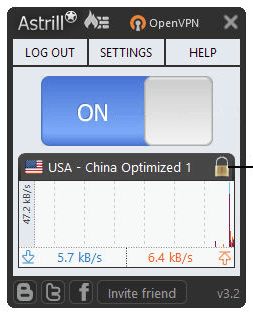
Astrill’s interface isn’t the most modern, but its performance in China more than makes up for it.
At $12.50 per month on a two-year plan, Astrill is the most expensive VPN in this guide. It also has no money-back guarantee, making it a better fit for long-term expats, businesses, and journalists who value reliability over price.
How to use Astrill VPN in China
To improve VPN performance in China, configure your protocol settings before you travel:
- Go to the official Astrill VPN website and secure an active plan subscription.
- Log into your account dashboard and download the native software client for your device hardware.
- Open the Astrill app interface and enter your user registration credentials.
- Locate the main protocol dropdown menu situated at the top of the interface window.
- Select StealthVPN or OpenWeb to activate specialized data obfuscation layers.
- Open the server location directory list and select a node specifically marked as “China Optimized” or a nearby regional gateway like Hong Kong or Tokyo.
- Click the main connection toggle button to set your status to ON and browse the web without restrictions.
Astrill VPN pros and cons
+ Pros
- Stealth VPN feature
- Extra security features such as ad-blocking, split tunneling, and a kill switch
- 24/7 customer support
– Cons
- Far more expensive than other VPNs
- Limited server network
- No refunds
Other popular VPNs we tested (but didn’t pick)
During our testing, we found that several popular VPNs simply lack the stealth technology needed to maintain reliable connections.
Here are three well-known providers that didn’t make our final list:
- Proton VPN: We regularly recommend Proton VPN for privacy, and its free plan is one of the best available. However, even Proton acknowledges that its standard connections can struggle in China. It can work as a backup option, but its limited servers and lack of dedicated obfuscation make it a poor primary choice.
- TunnelBear VPN: TunnelBear is easy to use, but its servers were blocked quickly during our tests. It doesn’t have the infrastructure needed for reliable connections on heavily restricted networks.
- Private Internet Access: PIA offers excellent customization and a large server network, but it isn’t a good fit for China. Without built-in protection against DPI, connections were blocked almost immediately.
If you want the best chance of staying connected, choose one of the five VPNs above. They performed the most consistently in our hands-on tests.
To see how these restrictions affect real users, check out recent Reddit discussions where travelers share their experiences trying to connect to popular services. Threads like the active r/chinatravel VPN updates show how quickly standard, un-obfuscated apps get blocked, proving why a specialized stealth provider is so vital.
How to choose the right VPN for China
When selecting a virtual private network to use behind the Great Firewall, look for these key features:
- Stealth obfuscation: The VPN must disguise your traffic as normal HTTPS web browsing. This is essential to defeat deep packet inspection and prevent blocks.
- Audited privacy: A strict, independently audited no-logs policy ensures your data is never recorded or exposed.
- Nearby server locations: Servers in Asian hubs like Hong Kong, Japan, and Singapore provide the lowest latency and fastest speeds.
- Essential security tools: An automatic kill switch and private DNS leak protection are mandatory to prevent accidental data leaks.
- Reliable support: Because censorship algorithms change constantly, 24/7 customer support is vital for finding working servers on any given day.
While Astrill is built for maximum reliability, NordVPN, Surfshark, and ExpressVPN offer the best balance of obfuscation technology, ease of use, and affordable pricing.
How to select the right VPN server for China
Choosing the right server location is key to getting fast speeds and reliable access behind state-controlled boundaries. For the fastest speeds on local networks, target close server hubs like:
Hong Kong and Taiwan: Best for localized web services and low-latency routing.
Japan and South Korea: Excellent for high-speed bandwidth and global streaming apps.
Singapore: The most stable infrastructure hub for Southeast Asian data routing.
Connecting to these nearby gateway locations reduces physical data travel distances. This dramatically lowers your latency, speeds up connection handshakes, and provides a much more stable browsing experience.
VPN protocols to use in China
VPN protocols are the methods by which your device connects to a VPN server. Different protocols use different encryption standards and speeds, which can have a significant impact on the performance and security of your VPN connection.
Standard VPN protocols are easy for China’s DPI systems to detect and block. To stay connected, you’ll need a VPN with stealth or obfuscation technology:
- OpenVPN (with scrambled obfuscation): The industry standard for defeating censorship. When paired with TCP port 443, it disguises your traffic to look exactly like standard, secure HTTPS banking web traffic.
- ExpressVPN Lightway: A proprietary, lightweight protocol engineered to instantly recover connections during heavy network throttling and server handshakes.
- WireGuard (with stealth wrappers): Standard WireGuard traffic is blocked quickly by Chinese ISPs. However, custom integrations, like Surfshark’s NoBorders or VPN.ac’s WireGuard over Shadowsocks proxy, allow you to enjoy WireGuard’s speeds behind a stealth shield.
Standard WireGuard and OpenVPN can also work, but they’re generally less reliable because China’s filtering systems actively detect and block VPN traffic.
Most premium VPNs let you choose your preferred protocol in the settings menu. Unless you’re using ExpressVPN, avoid the “Automatic” option and manually select OpenVPN (TCP) or a stealth mode for the most reliable connection.
How to be safe using a VPN in China
To use a virtual private network safely in China, it’s critical to select an encryption protocol equipped with stealth capabilities, such as OpenVPN or custom WireGuard wrappers. Pay close attention to the specific technical recommendations provided by your chosen VPN provider and follow them meticulously to evade automated network restrictions.
Activating your VPN’s automatic kill switch is another essential way to ensure data safety when using a network connection in China, as it blocks web traffic if your VPN tunnel drops.
Most importantly, install and set up your VPN before you arrive in China. VPN websites and app stores are often blocked, making it much harder to download or configure a VPN once you’re there.
Blocked websites and services in China

Here are just some of the sites that are currently blocked in China, but will be accessible with a VPN:
- All Google platforms: Google Search, Gmail, Google Maps, Google Drive, and YouTube.
- Social media networks: Facebook, Instagram, X (formerly Twitter), Threads, and Reddit.
- Messaging applications: WhatsApp, Signal, Telegram, and Skype app stores.
- Information & ecyclopedia engines: Wikipedia (all language editions) and Yahoo!.
- Global news outlets: The New York Times, Wall Street Journal, Reuters, and the BBC.
For a more complete list of blocked sites, see Wikipedia’s article on websites blocked in mainland China.
Internet censorship in China
The issue of online controls in China is complex and constantly changing. The government heavily regulates the content accessible to its citizens, restricting access to international websites and apps such as Google, Facebook, and YouTube. This level of censorship has led to the widespread use of VPNs in the country to bypass restrictions and access blocked content.
China’s networks use advanced filtering systems to detect and block standard VPN connections. Because these restrictions change regularly, setting up a reliable VPN before you travel is the best way to keep access to your favorite apps and work tools.
The Great Firewall of China
The Great Firewall of China refers to the country’s internet censorship system, which employs various techniques to block VPNs and limit access to websites and services.
Some of these techniques include:
IP blocking: Blacklisting specific server pools associated with external web tools.
DNS tampering: Altering domain lookups so restricted websites fail to load.
Keyword filtering: Scanning real-time search queries for sensitive terms.
Deep packet inspection: Analysing data packet headers to identify hidden encryption.
URL filtering: Blocking specific web links and subdirectories.
Manual enforcement: Using monitoring teams to flag new servers during political events.
Because of these restrictions, choosing a reliable VPN with built-in anti-censorship features is essential.
How VPNs get around the Great Firewall
VPNs bypass the Great Firewall by encrypting user data and hiding the final destination of your internet traffic. While basic encryption keeps your data unreadable to third parties, premium providers deploy advanced stealth protocols and obfuscation to disguise your VPN signature as regular web browsing. This makes it incredibly difficult for automated network defense systems to detect and restrict the connection.
Additionally, some specialized services employ the OpenVPN scramble extension to mask data packet headers, further throwing off deep scanning filters. By routing your connection through a provider with robust obfuscation capabilities, you can successfully circumvent local network blocks and safely access restricted content in China.
How China blocks VPNs with its firewall
China’s stateful firewall blocks VPNs through various methods, including monitoring internet traffic, blocklisting server locations, and actively probing suspected VPN connections. This aggressive approach to blocking standard traffic has led to the widespread use of obfuscated servers and advanced security measures by top providers to bypass these restrictions.
In fact, independent technical reports highlight that finding stable VPNs in China has reached an all-time high in difficulty following a massive, coordinated 2026 network sweep aimed at shutting down standard privacy tools.
However, many standard VPNs struggle to bypass China’s restrictions consistently. Choosing a trusted VPN with a proven track record is a must for a secure and reliable connection. For a deeper look at the security risks hidden inside censorship networks, check out our coverage on how a vulnerability in China’s Great Firewall exposed private data.
Legal concerns and risks of using a VPN in China
While China continues upgrading its systems to block VPN traffic, the legal situation for individual users remains unclear. For tourists and foreign visitors, there are no widely documented cases of severe penalties simply for using a consumer VPN. The biggest issue is usually blocked connections or sudden service disruptions.
For local citizens, enforcement has historically been stricter, with penalties usually focused on administrative actions rather than VPN users themselves. The Ministry of Industry and Information Technology (MIIT) mainly targets businesses and individuals operating unlicensed VPN or routing services. Recent cybersecurity updates continue to focus more on network compliance and commercial use than on everyday users.
Alternatives to VPNs for bypassing the Great Firewall
While VPNs are the most popular method to bypass China’s internet restrictions, alternative methods like Shadowsocks, standalone proxies, and Tor exist, although their success is limited.
Shadowsocks is a lightweight, encrypted proxy protocol designed specifically to circumvent the Great Firewall by masking individual browser traffic. Tor is a free, open-source network designed for anonymous browsing, but standard connections are completely blocked in mainland China unless manually configured with advanced stealth bridges.
Given these technical risks, we recommend using one of our tested VPNs for China instead of relying on unoptimized proxy configurations that may fail to protect your online activity. This is a big deal right now, especially since Reuters reports that Beijing is blocking overseas access and actively tracking unapproved data channels to lock down local networks.
How to set up and use a VPN in China
Using a VPN in China starts with choosing the right provider. Pick a service with strong security, reliable performance, and proven bypass technology. Install the app before your trip, since VPN websites and mobile app stores may be unavailable once you arrive.
Once the app is installed, follow these steps:
Launch the application and sign in using your account credentials.
Select an optimized server located in a geographically close country (such as Hong Kong, Taiwan, Japan, or Singapore) to ensure optimal performance and lower latency.
Toggle the connection switch to ON. Once connected, your data is fully encrypted, allowing you to access blocked websites and enjoy unrestricted internet access.
What you should know before using a VPN in China
Before using a VPN in China, it’s important to understand the potential risks and take the right precautions. Avoid free VPNs, as they often lack the encryption and protocols needed to bypass restrictions and may put your privacy at risk. Use obfuscated servers whenever possible to make your VPN connection harder to detect and maintain a more secure experience.
It’s also smart to prepare for occasional connection drops during major firewall updates. Keep backup options available, such as alternative server locations or a second VPN service, to maintain a more stable connection.
Risks of using free VPNs and proxies in China

While using a free service is tempting, it carries severe performance and security risks behind the Great Firewall. Free VPNs almost always lack the advanced obfuscation protocols required to bypass automated network blocks. Because they operate on extremely limited server networks, the available nodes quickly become overcrowded, resulting in severe bandwidth throttling, high latency, and frequent connection failures.
Even worse, free providers must generate revenue, which they often do by monitoring your online activities, injecting tracking scripts, and selling your collected data to third parties.
Proxies, on the other hand, fail to provide the same level of digital security as a reputable virtual private network. While a proxy can occasionally spoof your location to access minor blocked websites, it only works at the browser layer and completely lacks system-wide data encryption. This leaves your raw internet traffic exposed to local ISP interception and deep packet inspection scanning.
Ultimately, using unverified tools can put your privacy at risk. For a safer and more stable internet experience, choose a reputable premium VPNs with a proven track record of bypassing strict network restrictions.
How to get a Chinese IP address
Obtaining a Chinese IP allows you to access geo-restricted mainland platforms like Youku, iQiyi, or local banking portals from abroad. Because of strict server regulations and data-logging laws, reputable VPNs do not host physical server nodes inside mainland China. Instead, specialized providers offer virtual IP locations that spoof a Chinese network presence while keeping the actual server hardware safely outside the country.
To safely get a Chinese IP address:
Select a provider that specifically offers virtual servers for China (often routed through secure facilities in Hong Kong or Singapore).
Open your application’s server location menu and search for the “China” virtual node.
Toggle the connection switch to secure your VPN tunnel and mask your true location with a mainland IP address.
Tips for optimizing your VPN experience in China
To maximize your connection speeds and ensure stable access behind the Great Firewall, implement these essential optimizations within your app settings:
- Select the right protocol: Avoid leaving your protocol setting on “Automatic.” Instead, manually switch your application to OpenVPN (TCP) or proprietary protocols like ExpressVPN’s Lightway, which are built to handle aggressive network filtering.
- Always force obfuscation: Turn on your provider’s stealth or obfuscation feature (such as NordVPN’s Obfuscated Servers or Surfshark’s NoBorders mode) before hitting connect to ensure your data packets bypass Deep Packet Inspection scanning.
- Target close gateway nodes: Choose low-latency server locations situated near mainland borders, including Hong Kong, Japan, Singapore, and South Korea, to preserve your bandwidth and drastically reduce data delays.
- Keep your software updated: Censorship systems change constantly. Before you travel, update your VPN app to make sure you have the latest features and server configurations.
How we test VPNs for China
We adopt a comprehensive testing methodology to assess the performance and reliability of VPNs in China. As a part of our commitment to providing accurate and reliable information, our team stays updated with the latest news from trusted VPN providers regarding their connection status in China.
Our VPN test process is rigorous and systematic. We test each of the 32 VPNs based on specific criteria that we believe are crucial for a VPN to be effective in China. These criteria include:
- Speed: The speed of a VPN can greatly affect your online experience, especially when it comes to activities that require high bandwidth, such as streaming videos or playing online games. We conduct multiple speed tests to ensure the VPNs can deliver satisfactory performance.
- Security: A VPN’s primary function is to provide a secure connection to the internet. We check each VPN’s security features, such as encryption standards, kill switches, and leak protection, to ensure they can effectively protect your online privacy and security.
- Streaming capabilities: Many people use VPNs to access geo-restricted content from streaming platforms. We test each VPN’s ability to unblock popular platforms like Netflix, BBC iPlayer, and Hulu.
- Ability to bypass the Great Firewall: This is perhaps the most important criterion for VPNs in China. We verify each VPN’s ability to bypass the Great Firewall and provide access to blocked websites and services.
We stay on top of VPN changes in China and test each provider to ensure our recommendations remain accurate and current.
Online surveillance in China
China operates an extensive digital monitoring system that limits online privacy for both citizens and visitors. The system can track activities across platforms, from social media use to online purchases. In fact, a recent Deutsche Welle investigation uncovered a database reportedly used to track foreigners arriving in China, highlighting how local systems can build detailed monitoring profiles of journalists and other visitors. For business travelers handling sensitive information or anyone accessing private data, strong security precautions are essential.
A reliable VPN helps secure your connection and reduce exposure to local tracking systems through features such as:
- Encrypted data tunnels: Encrypting your raw traffic prevents local network monitors from reading your passwords, emails, and sensitive document transfers.
- Defeating network interception: Masking your destination IP address ensures that third parties cannot log which global websites or web tools you are trying to access.
- Securing public Wi-Fi: Encrypting your device handshake blocks scanning software commonly deployed on public networks in hotels, airports, and transport hubs.
However, even premium VPNs cannot block every form of tracking. For maximum privacy in China, combine an obfuscated VPN connection with encrypted communication tools, avoid unsecured public Wi-Fi, and be careful about the personal information you share online.
Internet censorship in Hong Kong and Taiwan
While internet restrictions in Hong Kong and Taiwan are much milder than in mainland China, using a premium virtual private network remains highly advisable to maintain full data privacy. Taiwan enjoys a highly liberal online environment with virtually no government censorship. However, the legislative landscape in Hong Kong has shifted rapidly, with local authorities occasionally restricting access to specific political websites or independent platforms under local security regulations.
In both regions, using an encrypted connection is a smart precaution against potential interception on public Wi-Fi networks. Choosing a trusted provider with strong security and reliable speeds helps keep your personal traffic protected from third-party monitoring.
What if your VPN stops working in China?
China’s Great Firewall is always evolving, so even the most reliable VPNs can hit temporary blocks during crackdowns or updates. You don’t want to be stuck without access to Google, WhatsApp, or your banking apps when you’re relying on them most.
If your connection drops, use this troubleshooting checklist to get back online fast:
- Switch server nodes: Disconnect and try a different location from your provider’s “China Optimized” list.
- Change protocols manually: Do not rely on standard WireGuard or NordLynx, as un-obfuscated traffic is blocked quickly. Switch manually to the OpenVPN protocol (TCP) or specialized stealth modes.
- Restart the app or device: A simple reboot often clears temporary handshake glitches and refreshes your network adapters.
- Clear app cache and data: On Android or Windows mobile devices, clearing temporary app data often resolves handshake glitches.
- Contact customer support: If you can access email, reach out to your provider’s technical team to request their latest working server configuration files or alternative mirror links.
For budget users, a solid free VPN like Proton VPN can work as a basic fallback if installed before entering China. Although free VPN plans offer fewer remote servers and slower speeds than premium services, they are better than having no backup option.
Final thoughts: Staying connected in China for 2026
While the digital blocks in mainland China can feel intimidating, they are not an impassable wall. By choosing a reliable virtual private network with specialized stealth protocol layers, you can easily protect your internet connection and get back open access to your favorite global communication tools.
With top-tier services like NordVPN, you can browse restrictive networks without losing your privacy or connection speeds. For the absolute smoothest experience, we strongly recommend signing up for an active paid plan and getting the software fully set up on your devices before you head out on your trip.
Take these quick steps, stay safe, and enjoy your online freedom!
Best VPN for China FAQs
NordVPN is widely considered one of the most reliable and secure VPNs to use in China. It is a popular choice among expats and business travelers because it consistently handles local network restrictions, making it great for streaming global platforms and gaming. Based on our latest real-world speed tests, NordVPN ranks as the overall best VPN for China.
When choosing a premium VPN, look beyond marketing claims and focus on the features that actually matter. Prioritize strong security, a strict no-logs policy, advanced obfuscation tools, streaming support, nearby remote server locations, and overall value.
Technical security should be your top priority to keep your private data protected from third-party monitoring. Look for a VPN provider with RAM-only servers, which help ensure your online activity is not stored or shared.
The safest approach is to download and set up your VPN app before you arrive in China. Once it’s installed, turn on the automatic kill switch and choose a protocol that scrambles your data (like OpenVPN TCP). These built-in safety features keep your real location hidden if the connection ever drops, and they make your encrypted traffic look like completely normal web browsing.
To get the best connection speeds and lowest latency, you should always connect to servers that are physically close to mainland China. The absolute best regional choices are Hong Kong, Taiwan, Japan, South Korea, and Singapore.
Honestly, a free VPN will almost certainly not work in China. Free services simply do not have the budget to build the advanced stealth tools needed to sneak past deep packet inspection (DPI) filters.
Even worse, running a completely free app can put your digital security at risk. These apps have to make money somehow, and many do it by tracking your online activities and selling your private information to advertisers. If you are on a tight budget, it is much safer to use a premium provider’s money-back guarantee window or download a trustworthy free plan option from a brand like Proton VPN as a temporary backup.
While everyday tourists and individual users have never faced severe legal trouble just for using a VPN, the government does closely watch and restrict unapproved network tools. Local laws require providers to be state-approved, and unapproved lines are frequently blocked. To keep your risks low, always choose a reputable, independent provider with a proven history of protecting user privacy.
Unfortunately, no. Many great VPNs that work perfectly well in Western countries fail behind the Great Firewall. For instance, customer support teams at Private Internet Access and IPVanish openly admit their apps face severe blocks inside China.
We found the same issue during our hands-on review of TunnelBear VPN. It simply lacks the heavy-duty stealth features needed to establish a successful connection on these strict networks. To save yourself the headache, stick to the specialized providers recommended in this guide.
NordVPN’s Cyber Deal is live:
Get 75% Off NordVPN with the coupon below + 3 months extra:
(Coupon is applied automatically; 30-day money-back guarantee.)

Any chance that someone will add a review for the VPNs being blocked in Russia, Iran, etc.?
Yep we’ll get to this in the coming months.
I’m in Beijing now and I have two VPNs that I’ve tested:
1. ExpressVPN does not work anymore.
2. NordVPN is working for me (I’m connecting to west coast US servers)
Express used to be great, but it’s no longer a safe bet for China. Since NordVPN did server upgrades a few months ago, it has been working well for me. I’ve tested Nord from Shanghai and Beijing over the past few months and it’s reliable, but don’t expect insane speeds. Just be sure to get it set up before traveling over.
Interesting article, but I find difficult to put together assertions as “Millions of people in China face internet censorship, which makes using a VPN a necessity.” and “Download the VPN app onto your device before arriving in China, as most VPN websites are blocked in the country.”. Does it means that Chinese have to travel abroad to install a vpn or that they are cut off from using it?
Yes. Sucks to be them.
How to access IKEv2 on Nord?
Hi Branden, this explains it:
https://support.nordvpn.com/hc/en-us/articles/19916965616017-Connect-to-NordVPN-IKEv2-IPSec-on-Windows
Unfortunately, it is a bit more work than just downloading an app and using it.
I was in China last month (May 2025) and have a few observations on what VPN works and which ones are blocked:
– ExpressVPN did NOT work for me. Their support team suggested using an obfuscated server in Los Angeles, but it was no use. I would not recommend pinning your hopes on ExpressVPN if you are going to China.
– NordVPN worked fine. This was my backup and I’m glad I had it. You need to use the IKEv2 configuration, and their support team has lots of documentation for this. I followed it, and evertyhing worked perfectly. I was able to browse blocked sites and also stream US Netflix.
I have been using NordVPN for some time and it never worked for me in China, without special configuration as you mention, that is.
On the other hand, Proton VPN worked just fine on my Android phone connecting via a local mobile carrier (China Unicom), and local ISP, without any special configuration, even with a free plan! Proton VPN is not mentioned in this article perhaps becuase they did not sponsor!
We do not have any sponsors, as explained on our About page. We would love to add Proton VPN, as we recommend it in other places on the site, but they themselves say it doesn’t work in China.
I am sorry, but I 100% disagree: ExpressVPN does NOT work at all in the cities I went to (April 2025): Beijing, Xi’An, Shanghai, whatever protocol or server you attempt to connect to or use. I often go to China, ExpressVPN never works. The only one that truly works is SurfShark, thanks to its special multi-hoping and rotating IP: it never fails each and every time I travel to China.
To me, all those web sites stating that this or that VPN works in China are just advertisements: people who really leave or travel there know it for a fact.
Regards,
Totally agree. I’ve had a subscription for a long time. I’m in china now. ExpressVPN has been worthless.
Hi VPN Express is very unreliable – one wonders why you have included this company. Also another company that looks for ways to charge ongoing fees to clients at the end of the requested period of service….tired of the fine print and scams especially by American companies serving Australians. Currently our government is supporting US companies and allowing them to commit constant fraud so i have begun to hate the US more and more very time they lie and steal! a very unfair country!
UPDATED INFO:
Just returned from a trip to Shanghai. I had NordVPN, Surfshark, and ProtonVPN installed on my devices. NordVPN was the only service that consistently worked on mobile and desktop.
Note: I was using my Windows laptop and iPhone. For my Windows laptop, you need to set up the manual IKEv2 connection workaround with the NordVPN servers. The main VPN app has issues (just like the apps with Surfshark and Proton) – but the IKEv2 setup works fine with NordVPN.
I also did this for my iPhone and it worked well. You need to simply install the configuration profiles on your iPhone, then you can easily connect to any of these VPN servers from your iPhone settings. I used NordVPN’s server profiles from Japan and the US, and they both worked without any issues from Shanghai.
Pro tip: Ideally you should try to get this set up before you go. If you can’t do that, it’s still possible to do from China, but it’s a bit more challenging. To do all this, just open up a chat dialogue with Nord support, and they’ll help you 24/7.
Thanks for this update on the vpn universe!
However, I am always wondering how some services end up on the recommendation list.
I tried many over the last years. And while they were all happy to charge me, most did not manage to provide a reliable service being worse any money.
For example expressvpn: worked for a bit and charged me the remaining 18 months without any useful service. When I raised complaints I got a month extra for free which was not helpful as there was no connection possible.
Surfshark: signed up recently and got busy so missed to cancel on time and am now in a 2 year paid period with no connection.
Another one not on your list recently tried: cancelled after failed connection within 24 hours and had to fight back a few times before they accepted to return the money, for which I am waiting after 2 weeks!
So long story short: from my experience VPN biz has become a scam to take advantage on people in needs but fails to deliver the product and service. As you are always locked in with a prepayment, you’ll always loose.
I don’t like the interface, but IMHO Astrill is the only one who does not fail.
VyprVPN is based in the US, not in Switzerland.
Correct. I just fixed that typo, thanks.