
NordVPN vs Proton VPN is a close matchup between two privacy-focused services with audited no-logs policies. They don’t deliver that privacy in quite the same package, though. Proton VPN stands out for its open-source apps and massive network, while NordVPN adds specialty servers and built-in threat blocking. Put them head-to-head, and speed, streaming, and access become the real battleground.
In our latest gigabit tests, one VPN pulled well ahead, hitting 903 Mbps and unlocking 15+ Netflix libraries worldwide. It was a clear standout for everyday performance.
This 2026 comparison gives you current pricing, hands-on results, and key differences so you can see how the two VPNs stack up on speed, privacy, and value.
| NordVPN | Proton VPN | |
| Website | NordVPN.com | ProtonVPN.com |
| Location | Panama | Switzerland |
| Servers | 7,800+ | 20,600+ |
| Countries | 126 | 148 |
| Logs | No logs (audited) | No logs (audited) |
| Torrenting | All servers | Restricted ⛔️ |
| Support | 24/7 chat; email; knowledge base | Chat; email; knowledge base |
| Apps for | Windows, macOS, Linux, Android, iOS | Windows, macOS, Linux, Android, iOS |
| Money-back guarantee | 30 days | 30 days |
| Price | $3.49 (with coupon) | $2.99 (with coupon) |
| Coupon | 78% Off Coupon > | 64% Off Coupon > |
NordVPN continues to be a leading VPN globally, with an extensive server infrastructure, superior speed, and security, with a range of privacy options that most VPNs can’t match. They consistently outdo other VPNs in terms of functionality, features, and streaming performance.
Proton VPN is also focused on privacy and security but has a smaller set of features, a higher price, and less access to popular streaming sites. Additionally, there have been a few different logging cases involving Proton Mail, the sister company of Proton VPN, logging user IP addresses for government authorities. While Proton VPN is an audited no-log VPN, the fact that their sister company was involved in these different cases may give you pause.
How we test
We put both providers through hands-on VPN testing across 12 key categories:
- Apps: Interface, ease of use, and open-source transparency.
- Features: Tools such as multi-hop, ad blocking, and split tunnelling.
- Connections: Number of simultaneous devices allowed.
- Security: IP, DNS, and WebRTC leak testing.
- Logging: No-logs policies and independent audits.
- Jurisdiction: Legal frameworks in Panama and Switzerland.
- Speed: Download and upload speeds across North American and European servers.
- Streaming and P2P: Netflix access, streaming performance, and torrenting speeds.
- Pricing: Plan options, long-term discounts, and renewal costs.
- Payments and refunds: Payment options and money-back guarantees.
- Customer support: 24/7 live chat and self-service guides.
- Value: Overall features and performance compared with price.
Background and jurisdiction
Where a VPN is based affects the privacy laws it follows and whether local authorities can demand access to user data.
| NordVPN | Proton VPN | |
| Jurisdiction | Panama | Switzerland |
| Surveillance alliances | Outside alliances | Outside alliances |
| Parent company | Nord Security | Proton AG |
| VPN infrastructure audits | 6 completed (Deloitte) | 4 consecutive (Securitum) |
| Targeted VPN court logs | ❌ No historical cases | ❌ No historical cases |
NordVPN: Panama jurisdiction
| Website | NordVPN.com |
| Based in | Panama |
| Logs | No logs (audited) |
| Price | $3.49/mo. |
| Support | 24/7 live chat |
| Refund | 30 days |
| Deal | 78% Off Coupon |
NordVPN is one of the best-known companies in the VPN industry. It is part of Nord Security, a brand that includes NordVPN and other security products, including the password manager NordPass, the encryption/cloud storage tool NordLocker, and the identity theft protection service Coveron. This company has an excellent background and track record and has also passed multiple third-party audits.
NordVPN is based in Panama, a privacy-friendly jurisdiction outside the major surveillance alliances. Panama also has no mandatory data retention or logging requirements, which gives VPN providers more room to protect user privacy.
Our NordVPN review has more information on the company’s background.
Proton VPN: Swiss surveillance
| Website | ProtonVPN.com |
| Based in | Switzerland |
| Logs | No logs (audited) |
| Price | $2.99/mo. |
| Support | Email + Chat |
| Refund | 30 days |
| Deal | 70% Off Coupon |
Proton VPN is developed by Proton AG, the privacy company founded by scientists who met at CERN. Switzerland has traditionally been viewed as a strong privacy jurisdiction, but the rules differ between Proton’s services:
- Proton Mail cases: Swiss courts have previously required Proton Mail to collect certain metadata, including IP addresses, in response to legally binding requests. These cases relate to telecommunications laws governing email services and do not apply in the same way to VPN traffic.
- Proton VPN legal record: Swiss law does not allow authorities to force a no-logs VPN provider to begin logging user activity. Proton says it has received 458 legally binding court requests since Proton VPN launched, but has had zero user activity logs to hand over.
For now, Proton VPN remains subject to Swiss law at the company level, while its physical infrastructure is becoming more distributed across Europe.
VPN features
Both offer feature-rich apps, but their priorities differ. One focuses on advanced VPN functionality, while the other adds a broader layer of security tools.
| Feature | NordVPN | Proton VPN |
|---|---|---|
| Split tunneling | ✅ Windows and Android | ✅ Windows and Android |
| RAM-only network | ✅ Diskless | ✅ Diskless |
| Kill switch | ✅ Dual-type | ✅ Standard |
| Audited no-logs | ✅ 6 assurances | ✅ 4 assurances |
| Multi-hop/double VPN | ✅ Double VPN | ✅ Secure Core |
| Obfuscated protocols | ✅ NordLynx obfuscation | ✅ Stealth protocol |
| P2P torrenting nodes | ✅ Optimized tunnels | ✅ Dedicated port forwarding |
| Dedicated IP add-on | ✅ | ❌ |
| System malware scanning | ✅ Threat Protection Pro | ❌ NetShield (DNS only) |
Proton VPN features
Proton VPN runs 20,600+ diskless, RAM-only servers across 148+ countries, with all core apps open-source and independently audited. Its standout Secure Core feature adds multi-hop protection by routing traffic through secure physical servers in privacy-friendly countries such as Iceland, Sweden, and Switzerland before connecting to the final destination.
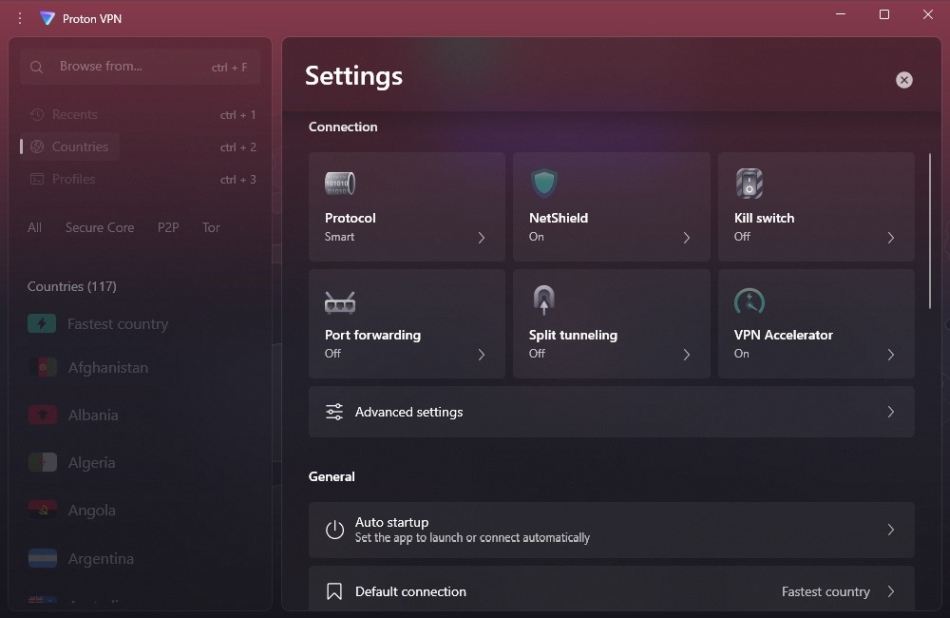
For users dealing with restrictive networks, Proton VPN also offers its proprietary Stealth protocol, designed to bypass deep packet inspection. At the same time, VPN Accelerator helps improve WireGuard performance on slower or unstable connections.
Proton VPN also offers a capable free plan that covers 10 countries, but features such as P2P file sharing, Secure Core, and faster streaming access are reserved for paid plans.
Feature highlights
- Secure Core routing: Routes traffic through secure servers in privacy-friendly countries such as Iceland, Sweden, and Switzerland before reaching the final destination.
- Native port forwarding: Allows incoming connections, making Proton VPN a strong option for P2P users who need better connectivity for seeding.
- Stealth obfuscation protocol: Hides VPN traffic patterns to help bypass VPN blocks and restrictive networks.
- 100% open-source apps: Makes its app source code publicly available, allowing independent security researchers to inspect it.
- VPN Accelerator: Uses custom optimisations to improve WireGuard performance, particularly on slower or unstable connections.
- NetShield ad blocker: A VPN ad blocker that filters ads, trackers, and malicious domains at the DNS level.
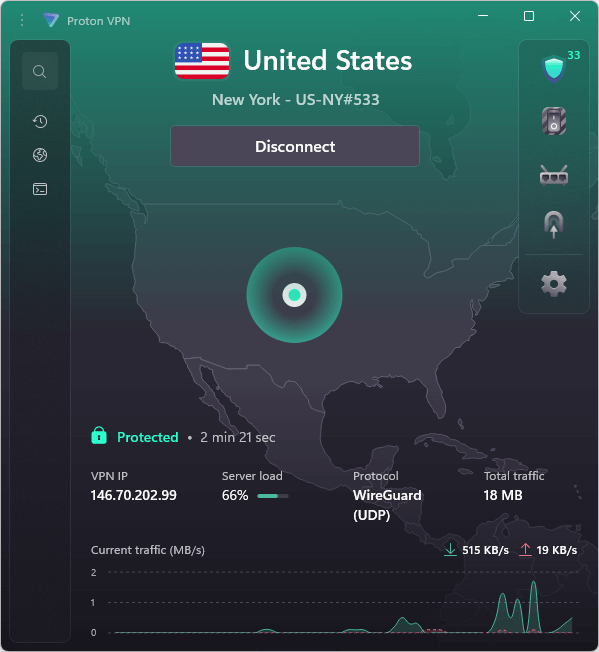
Here you can see some of the privacy features of the Proton VPN Windows VPN app that we tested:
NordVPN VPN features
NordVPN operates 9,500+ servers across 149+ countries, with extensive physical coverage in the US. Its NordLynx protocol, based on WireGuard, is designed to deliver fast connections while keeping dynamic IP addresses separate from user activity.
NordVPN Threat Protection Pro:
- Works system-wide, even when disconnected from the VPN.
- Scans downloaded files for malware.
- Checks for software vulnerabilities.
While Proton VPN’s NetShield focuses on blocking ads, trackers, and malicious domains at the DNS level, NordVPN’s Threat Protection Pro goes further. It can scan downloaded files for malware and check installed software for known vulnerabilities, including when the VPN connection is turned off.
Feature highlights
- Threat Protection Pro: Scans downloaded files for malware and provides system-wide protection, even when the VPN is disconnected.
- Vulnerability detection: Checks installed software for known security vulnerabilities and alerts you when updates are needed.
- Custom NordLynx protocol: Uses WireGuard technology with NordVPN’s double-NAT architecture to deliver fast, private connections.
- 10 gbps server network: Uses high-capacity infrastructure to support faster connections and reduce network congestion.
- Double VPN: Routes your traffic through two VPN servers for an extra layer of encryption and privacy.
- Onion over VPN: Connects your VPN session to the Tor network without requiring a separate Tor connection.
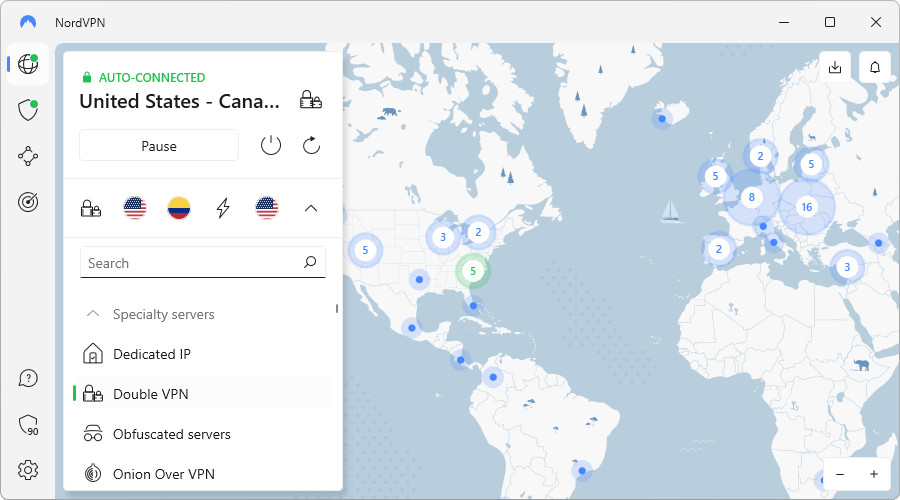
The NordVPN Windows client displays its specialty servers on the left, while the active connection uses Double VPN to route traffic through the United States and Canada.
Streaming and torrenting
Streaming geo-restricted content and handling high-volume P2P traffic are two areas where a VPN’s server network can make a difference. Good routing keeps speeds high and connections stable, while a weaker network can quickly become the bottleneck.
Streaming comparison
VPN streaming sounds simple until Netflix’s geo-blocking gets in the way. Only a handful of VPNs can consistently bypass those location-based restrictions.
| NordVPN | Proton VPN | |
| Supported Netflix Libraries | 15+ | 10 |
| Plans with Streaming Support | All plans | Only paid plans |
NordVPN streaming
NordVPN has one of the fastest networks we’ve tested, with a huge selection of streaming-compatible servers around the world. We currently rank NordVPN as the best VPN for Netflix because it offers fast and consistent access to 15+ Netflix regional libraries. Here we are streaming Netflix with a NordVPN server in the US:
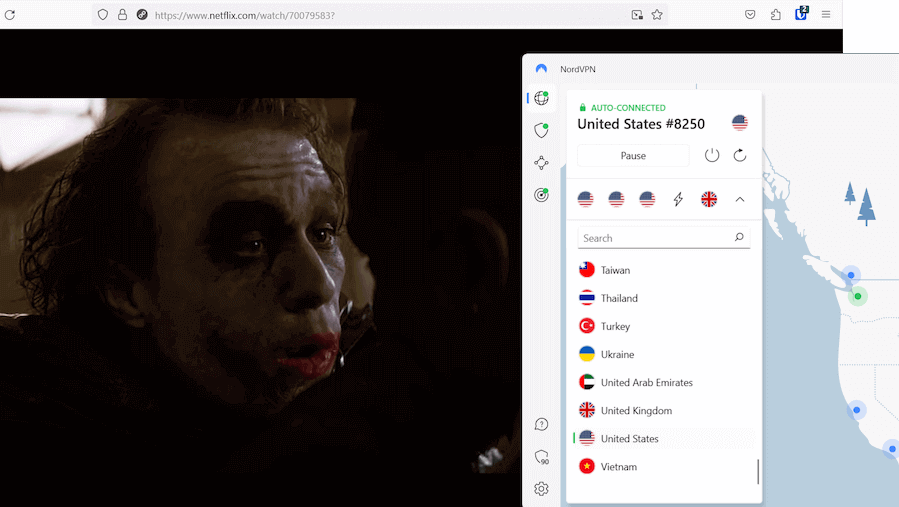
Aside from Netflix, NordVPN is also a great VPN for Disney+, Hulu, BBC iPlayer, and more. They even offer a dedicated Amazon app if you want to use a VPN for Firestick.
Proton VPN streaming
Proton VPN handles the major streaming platforms well, but its coverage falls short of NordVPN’s. Proton VPN Plus unlocked around 10 major Netflix libraries in our testing, along with services such as Amazon Prime Video and Hulu.
The catch is the free plan: Proton VPN Free doesn’t support streaming, so you’ll need a paid subscription to access geo-restricted libraries.
Torrenting comparison
| NordVPN | Proton VPN | |
| P2P network support | All servers | Some servers excluded |
| Dedicated P2P servers | ✅ Natively integrated | ✅ Labeled “P2P” in app |
| Plans with torrenting support | All plans | Paid plans only |
| Download speeds | Very fast (10 Gbps nodes) | Fast (WireGuard optimized) |
NordVPN torrenting
NordVPN is a strong choice for P2P file sharing, combining a verified no-logs policy with speeds that reached 900+ Mbps in our testing. Its 10 Gbps server infrastructure helps maintain fast, stable connections for large downloads without artificial throttling.
Proton VPN torrenting
Proton VPN supports P2P traffic through dedicated servers in 30+ countries. P2P is not available on the Free plan, while paid users are automatically redirected to a P2P-compatible server if they connect to a location that doesn’t support torrenting.
Proton VPN also offers port forwarding on supported desktop apps, giving advanced users more ways to connect with peers. Even so, our speed tests showed NordVPN consistently delivered faster download speeds across global server locations.
Encryption and security
On the security front, both use strong encryption. The bigger differences lie in their server infrastructure and how quickly each network has evolved.
Encryption framework
| NordVPN | Proton VPN | |
| Encryption ciphers | AES-256-GCM / ChaCha20 | AES-256-GCM / ChaCha20 |
| Handshake / authentication | SHA-256 / Poly1305 | SHA-512 / Poly1305 |
| RSA key strength | 4,096-bit | 4,096-bit |
| Infrastructure type | 100% RAM-only (diskless) | 100% RAM-only (diskless) |
| Virtual locations | ❌ 100% physical | ✅ For restrictive zones |
| Post-quantum ready | ✅ Active in live apps | ✅ Gated to infrastructure foundation |
Protocol implementations
Proton VPN and NordVPN have comparable levels of encryption and protocols:
- Proton VPN: Supports OpenVPN, WireGuard, and IKEv2, along with its proprietary Stealth protocol. Stealth is designed to disguise VPN traffic and help bypass VPN blocks and deep packet inspection.
- NordVPN: Supports OpenVPN and its proprietary NordLynx protocol, which is based on WireGuard and uses a double-NAT system to improve privacy while maintaining fast connections.
Server architecture and colocation
Both VPNs use RAM-only servers, meaning data stored in memory is wiped when a server is restarted. The bigger difference is how each provider builds and manages its network:
- NordVPN: Uses physical servers rather than virtual locations and has been expanding its network with high-capacity 10 Gbps servers. Its focus on dedicated infrastructure gives NordVPN greater control over its server hardware and network.
- Proton VPN: Uses a mix of physical and virtual infrastructure, with third-party data centres supporting much of its standard network. Its Secure Core servers are a notable exception, using dedicated physical infrastructure in privacy-focused locations.
Third-party security audits
Both providers have a strong track record of independent security audits. Proton VPN has put its apps through repeated penetration testing by Securitum, with the apps themselves remaining open source. NordVPN has completed six independent no-logs audits, alongside app and infrastructure security testing by firms including VerSprite.
Post-quantum cryptography
Both providers are adding post-quantum cryptography (PQC) to prepare for future threats such as “harvest now, decrypt later” attacks. Proton has introduced post-quantum protection across its ecosystem, while its newer WireGuard implementation provides the foundation for post-quantum VPN connections.
NordVPN has a more mature implementation, with hybrid post-quantum protection built into its NordLynx protocol and active in its VPN apps.
Privacy and logs
| NordVPN | Proton VPN | |
| No-logs policy | ✅ Audited and verified | ✅ Audited and verified |
| Independent audits | ✅ 6 completed | ✅ 4 completed |
| App transparency | Proprietary client | 100% open source |
| Anonymous sign-up | ✅ Email only | ✅ Email only |
| Crypto payments | ✅ Bitcoin, Ethereum, Ripple | ✅ Bitcoin |
| Cash or cash equivalent | ❌ | ✅ Cash via mail and token cards |
Infrastructure transparency and architecture
Proton VPN has a clear advantage in code transparency, with open-source apps that allow researchers to inspect the software for potential vulnerabilities. It also supports privacy-focused payment options, including cash and anonymous payment methods in supported circumstances.
NordVPN takes a different approach, putting more emphasis on independent verification. It has completed six independent no-logs audits by Deloitte, alongside security testing of its apps and infrastructure. Its client software is proprietary, but features such as Threat Protection Pro add another layer of protection by blocking malicious websites, trackers, and other unwanted content.
Speed tests
Given all the work a VPN must do to protect your data, it is only logical that they would slow your VPN connection down somewhat. But how much any particular VPN slows you down can vary enormously.
| NordVPN (NordLynx) | Proton VPN (WireGuard) | Performance gap | |
| Seattle (US) | 903 Mbps | 698 Mbps | NordVPN is 29% faster |
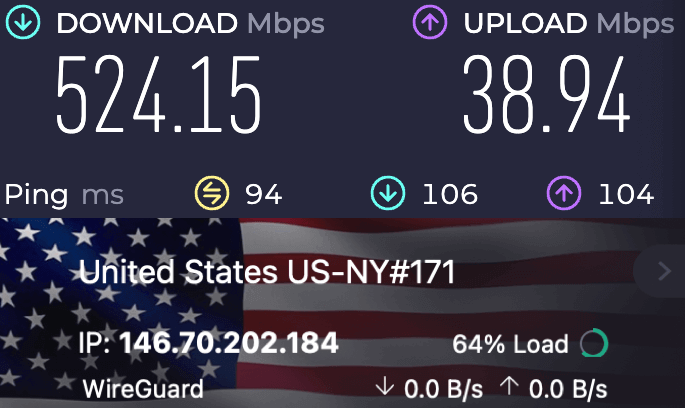
| New York (US) | 825 Mbps | 524 Mbps | NordVPN is 57% faster |
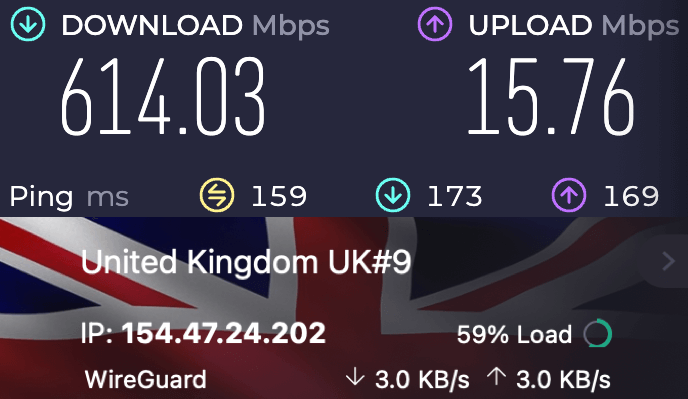
| United Kingdom | 658 Mbps | 614 Mbps | NordVPN is 7% faster |
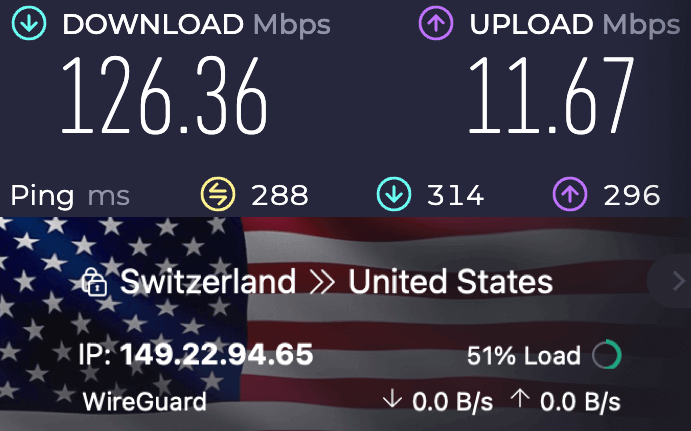
| Multi-Hop / Secure Core | 511 Mbps | 126 Mbps | NordVPN is 4x faster |
Test #1: Seattle, USA
Here is a Proton VPN server in Seattle, which gave me about 698 Mbps. This is really fast and on par with our other top VPNs.
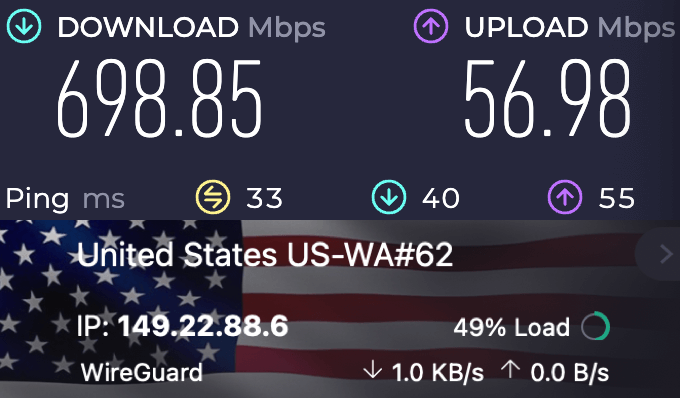
Now let’s see if NordVPN is faster than Proton VPN with this location.
Here was the NordVPN server in Seattle at 903 Mbps.
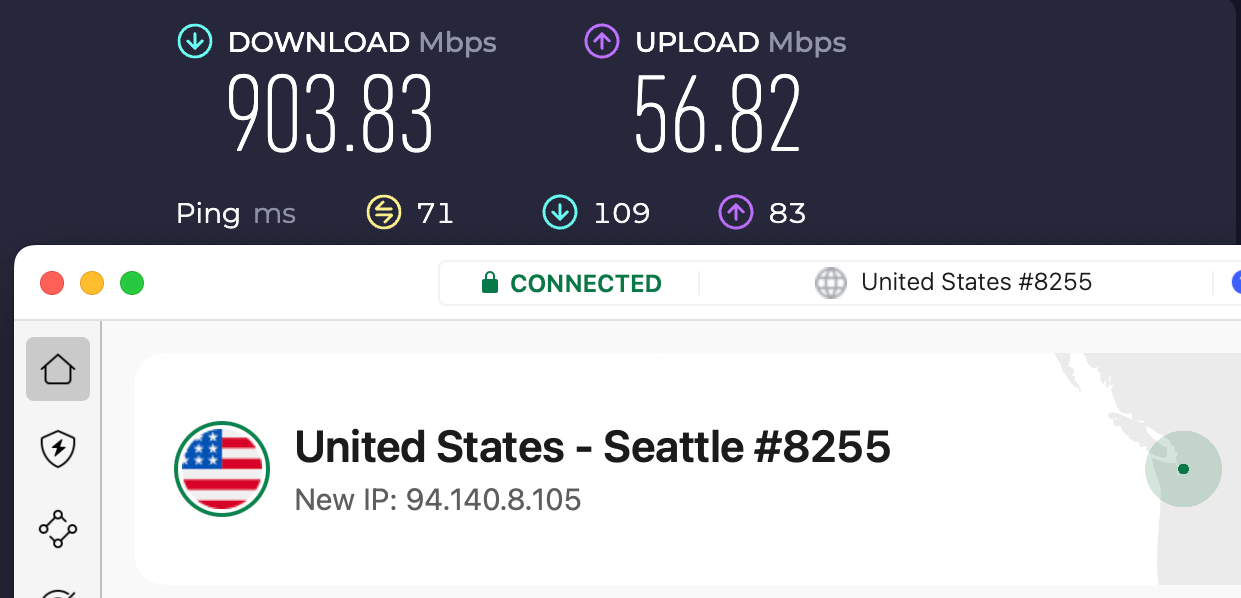
This is the fastest VPN speed test result we’ve gotten here on CyberInsider. For the Seattle server location, NordVPN was more than 200 Mbps faster than Proton VPN.
Test #2: New York, USA
Here was the Proton VPN server in New York at about 524 Mbps.
Here was the NordVPN server in New York, giving us a speed of 825 Mbps.

It’s clear that NordVPN offers faster speeds than Proton VPN with the US servers we tested. Let’s see if overseas servers were any different.
Test #3: United Kingdom
Here was the Proton VPN server in the UK at 614 Mbps.
Here was the NordVPN server in the UK at over 658 Mbps.

For the UK region, NordVPN was again significantly faster than Proton VPN. Still, both scores are really impressive, especially when you consider the high latency and long distance between my location and the VPN server. NordVPN consistently delivers on speeds and is also among the best VPNs for UK server speeds.
Double VPN speed tests
NordVPN and Proton VPN both offer double VPN servers. Because there are two physical servers in a Double VPN connection, they will usually be somewhat slower than a standard connection.
Here we tested a Proton VPN Secure Core server using the Switzerland > United States configuration and got a speed of 126 Mbps.
Here’s a NordVPN double-VPN server with the US > Canada configuration: 511 Mbps.
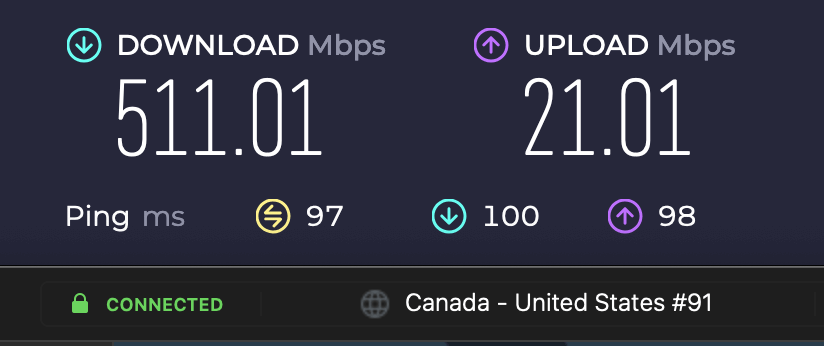
The Double VPN servers from NordVPN are significantly faster than the Secure Core (double VPN) servers from Proton VPN. This is true for other services offering double-VPN servers as well, as seen in our Surfshark vs NordVPN comparison.
Which VPN is faster?
In our latest tests, Proton VPN delivered impressive speeds, but NordVPN was faster across all servers. VPN speed depends on factors such as server hardware, network bandwidth, and distance from the user.
NordVPN consistently outperformed Proton VPN, as we also found in our NordVPN vs CyberGhost comparison, where it led in speed and overall performance.
Prices and refunds
Both VPNs offer a 30-day money-back guarantee, but their pricing and plan structures are quite different.
Proton VPN pricing
| Proton VPN plans | Proton VPN Plus | Proton Unlimited |
|---|---|---|
| 1-month | $9.99/month | $12.99/month |
| 1-year | $3.99/month | $9.99/month |
| 2-year | $2.99/month | $7.99/month |
Deal: Get 70% OFF Proton VPN 2-year plans >
Proton VPN offers a 30-day money-back guarantee, which is pretty standard in the VPN industry.
NordVPN pricing
| NordVPN plans | Basic | Complete | Prime |
|---|---|---|---|
| 1-month | $14.99/month | $19.99/month | $29.99/month |
| 1-year | $5.49/month | $6.49/month | $9.49/month |
| 2-year | $3.49/month | $4.49/month | $7.49/month |
Deal: Get 78% OFF NordVPN + 3 Months Extra >
What you get
Proton VPN has one major advantage: its free plan. It offers unlimited data across 10 countries, although streaming, torrenting, and some other features are limited. The paid VPN Plus plan unlocks the full VPN feature set, while Proton Unlimited bundles VPN access with Proton Mail, Calendar, Drive, and Pass.
NordVPN takes a more traditional tiered approach. The Basic plan gives you the core VPN, while Complete adds encrypted cloud storage, and Prime includes identity theft protection and breach monitoring.
So, Proton VPN is the better choice if price is the priority, especially if you want a free VPN. NordVPN costs more, but its higher tiers add a broader range of security and privacy features.
Value
Value for money looks a little different with these two. Proton VPN keeps things appealing with open-source privacy and a free plan, while NordVPN puts more emphasis on speed, streaming, and built-in security:
- Proton VPN is hard to beat for privacy-focused users who want open-source apps, Secure Core, and a free VPN. The free plan comes with unlimited data, while paid plans unlock streaming, torrenting, and the full server network.
- NordVPN costs more, but you get plenty in return. It delivered 900+ Mbps speeds in our testing, supports 15+ Netflix libraries, and includes security tools such as Threat Protection Pro. That makes it a particularly strong option for users who want more than just a basic VPN connection.
Conclusion
Proton VPN is excellent for open-source privacy, but NordVPN offers the stronger overall mix of speed, streaming, security, and features.
Final category breakdown
| Category | Winner |
| Background and jurisdiction | NordVPN |
| Features | NordVPN |
| Speed tests | NordVPN |
| Streaming | NordVPN |
| Security and encryption | NordVPN |
| Privacy | Tie |
| Torrenting | NordVPN |
| Streaming and torrenting | NordVPN |
| Price and refunds | NordVPN |
| Value | NordVPN |
For most users, NordVPN is the better all-around choice. It combines 900+ Mbps speeds, broad server coverage, strong streaming performance, and built-in security features such as Threat Protection Pro. It costs a little more, but the extra performance and features make it easier to justify.
New subscribers can also try NordVPN with a 30-day money-back guarantee, giving them plenty of time to see how it performs on their own devices.
Thinking about trying NordVPN? Here’s a coupon to get the best deal:
NordVPN’s Black Friday Deal is Live:
Get 78% Off NordVPN with the coupon below + 3 months extra:
(Coupon is applied automatically; 30-day money-back guarantee.)
Alternatively, Proton VPN is an excellent choice for users who put privacy and transparency first. Its open-source apps, Secure Core routing, and P2P port forwarding make it particularly appealing to privacy-focused users and open-source advocates.
Ready to try Proton VPN? Grab the best deal with this coupon:
Proton VPN Black Friday Deal is Live:
Get 75% Off Proton VPN (drops the price to only $2.49/month) with the coupon below:
(Coupon is applied automatically; 30-day money-back guarantee)
NordVPN vs Proton FAQs
Is NordVPN better than Proton VPN?
Yes, NordVPN is the better choice for most users, thanks to faster speeds, broader streaming support, and built-in malware protection. In our testing, NordVPN consistently outpaced Proton VPN, with an even bigger gap on multi-hop connections where it was up to four times faster. NordVPN’s Threat Protection Pro also adds system-wide malware scanning that continues to work even when the VPN is disconnected.
Is Proton VPN safer than NordVPN?
Not necessarily. Both VPNs offer strong security, but they take different approaches to transparency and trust. Proton VPN stands out with open-source apps that can be publicly inspected and independently audited. NordVPN takes a more proprietary approach, backed by six independent no-logs audits that verify its privacy claims.
Why did Proton VPN relocate some of its server infrastructure to Norway?
Proton VPN is moving some of its physical infrastructure to Norway and Germany in response to proposed changes to Swiss surveillance laws. Proton AG remains headquartered in Geneva, Switzerland, but the move gives the company more control over where its physical infrastructure is located as Switzerland’s privacy rules evolve.
Which VPN is better for streaming and unblocking Netflix?
NordVPN is the clear winner for streaming, unlocking more than 15 international Netflix libraries in our testing. It also worked reliably with Disney+, Hulu, Max, and BBC iPlayer. Paid Proton VPN plans unlocked around 10 major Netflix regions, while streaming isn’t available on the free plan.
Does Proton VPN support torrenting and P2P traffic?
Yes, Proton VPN supports torrenting on its paid plans and offers native port forwarding. This can help advanced P2P users connect with more peers and improve seeding performance. However, if download speed is your priority, NordVPN was faster in our testing, making it the better choice for high-speed P2P transfers.
Do NordVPN and Proton VPN offer free plans?
Proton VPN offers a free plan with unlimited data, while NordVPN requires a paid subscription. Proton’s free tier covers 10 countries, but doesn’t support streaming, torrenting, or multiple devices. Both providers offer a 30-day money-back guarantee on their paid plans.

Careful with NordVPN. You may encounter websites that cannot be reached. Just last week they told me “Unfortunately, at the moment, we are not able to help with this particular website.” However, I can reach this particular website in Panama with ProtonVPN. And I got no refund from NordVPN.
I’ve had NordVPN for several years and it’s great. I have it prepaid through September 2027 at $2.89/mo. But I’ve recently subscribed to Proton Unlimited, so for around $4/mo (charged annually) I get secure mail, 500 Gb on drive, password manager, vpn, and other apps I doubt I’ll use. For me, switching to Proton was a no-brainer, even if Proton vpn is a bit slower. I’m now struggling to convert over 200 logins from my gmail address to my new Proton address. I plan to de-Google as much as possible so they can’t sell my info to advertisers or use my emails to train their AI model.
I agree, I just got a new MacBook and iPhone because the Ads and spam have gotten out of control. I also use a windows PC at work and have one at home as well. Using Brave now at home but still on firefox at work. De-googlization will have to help. Still having a problem because everything is cross syncronizing and not sure how to stop them.. However, I want to use a VPN, move my e-mail to a new domain i purchased managed on Apple mail domain manager which is free since I pay for their cloud service. Comcast is my internet provider and my other email provider. I feel Comcast is almost if not worse than Google for tracking, selling and breaching data.
What has your experience been with Proton do you recommend to me that you have used both.
I don’t have a vested interest but I don’t see how you can claim that NordVPN has more countries and servers than ProtonVPN. In the article (and on their websites) they are respectively: 126 vs 127, and 8,000 vs 17,400. “Little” things like that tend to undermine the whole credibility of the comparison.
Hey Mick, thanks for the email. Server numbers are constantly changing, especially with Proton as they scaled up server numbers quite a bit over the past few months. And honestly, the total number is a bit dubious as many of these servers (several thousands) are simply virtual servers anyway, not actual physical servers sitting in a data center.
I find it amazing the extent articles such as this do not address leaks of data via programs and apps calling back to the mothership. It seems hiding your IP address via a VPN does not block hundreds of tracking bots from filling an encyclopedia with data about you. I would like articles about the “best VPN” to address if the software blocks data leaks, and if the VPN package lets you what software on your phone and computer is leaking the data. You could write a rather large article on how (in)effective the common approach of running something like Ublock is in stopping leaks.
current renewal for Nord VPN as it appears when I check it is “The renewal price is $139.08/year”, for Basic Service, while Proton says “renewed at US$83.88 for 12 months”
Yes, I strongly recommend turning off auto-renewal. You will find that for most services, VPNs, email, etc. that the renewal prices are more than the initial deal. So if you simply disable auto-renewal, you can sign up again with the latest deal that is going on after your subscription ends.
I use NordVPN and it has been good in the main, apart from a tendency to fade out on blogs using the Disqus comment system so that I have to keep changing servers. Nord has, however, just made a terrible change to its interface. You can no longer see the useful world server map shown in your picture above, only access different servers from a long list of countries. Also, they have messed up their previous Connect/Disconnect button so that you have to click on Pause and then choose to disconnect, which is annoying if you need to use vPN only on some web sites. I experimented with the free version of Proton, which has quite slow servers but that only applies to the free version. There is no doubt that their interface is much better than Nord’s new one.
Like every other test on the Web everybody interested in speed, speed, speed’ security and usa ability…for streaming these speeds are irrelevant as way exceed what is needed….how about one test, just one, or maybe more as it’s very important…usability and stability
I have Nord vpn subscription have recommended it to many clients and now regret it as it often stops working requires rebooting equipment, rstetting and changing protocols to spark it back into life again…,this is surely a test that should always be done but of course requires more time than a speed test….days, weeks, evens moths
Nordvpn is degrading and becoming more unreliable on every installation I use and oversee
I personally have a cheap and cheerful vpn modem router from Liberty Shield for my home use and just run everything through it on both lan and wifi
Rock solid and fast enough for streaming which is, after all, what most people are looking for…
More thorough testing is required for yours, and everybody’s reviews, not just speed tests and feature lists (most of which people neither understand or really need)….reliability is the key….
I only received a 78% discount after clicking your link to NordVPN. Is the 78% discount only available in specific countries?
Hi Candy, you might want to try using a fresh/cleared browser (clear cookies and cache) and then click the link in the article — or this link for the deal. The 78% discount + Amazon card is available in the US, Canada, UK, and Australia at the moment.
The review (and the NordVPN and Proton VPN websites) leave it sort of vague to me the level of ap tracking blocking you get on an android device or Linux PC.
–NordVPN touts “Threat Protection Pro” but it is only for Win and Mac, and they do not give a good review of the standard “Threat Protection” capabilities.
–Proton VPN lists a pile of great features but does not disclose which features are on which platform.
The leaks of data by aps that are running constantly in the background is the largest threat I see to daily privacy issues.
ProtonMail has optional IP logs originally as optional security measure so the user can check for weird connections to its account, the user can wipe those logs when they want or disable that logging all together, but you decided to paint that in a grim picture, what could understand if in any point of the article you’ve mentioned the NordVPN scandal when they got hacked on 2018-2019 (well, more exactly a server was breached and they didn’t handle it well)
Sorry Dan, but what you are saying is simply wrong.
Regarding Proton, there have been various occasions when Proton has been forced to log IP addresses due to Swiss court orders, which led to the arrest of Proton Mail users. There was absolutely nothing “optional” about these IP logging cases, as they were required by the Swiss court system. You can read news articles (on this site or other sites) covering the events, or just go and read Proton Mail’s transparency report.
Regarding NordVPN, you are also mistaken. Someone posted an expired TLS certificate from NordVPN (as well as certs from TorGuard and VikingVPN) on an 8chan forum back in March 2018. There was literally zero impact to NordVPN users from an expirted TLS cert being posted on a trolling forum, and most people don’t even call this event a “hack”, aside from a few clickbait news articles. We covered the situation in depth here.