
This Incogni review will help you decide whether this popular automated data removal service is worth your time and money.
If you’ve ever Googled yourself only to find your home address, phone number, and relatives’ names staring back at you, you know that exact sinking feeling of digital exposure. In a world where your private data is bought and sold like loose change, a set-and-forget tool sounds almost too good to be true.
To see if it actually works, I spent years testing personal data removal services the unglamorous way: submitting real opt-outs, tracking listings, and verifying whether removed profiles sneakily reappear. We also compared our hands-on data with real user feedback across Reddit and privacy forums to ensure our findings stack up.
| Starting price | $6.79/month (billed annually at $81.50) |
| Broker coverage | 420+ (3,000+ with custom removals) |
| Core advantage | Fully automated, set-and-forget removal system |
| Trust signal | Deloitte audited for privacy and removal accuracy |
| Refund policy | 30-day money-back guarantee |
| Support | 24/7 email and phone support (with premium only) |
| Best deal | 58% Off Coupon > |
Want to give Incogni a try? CyberInsider readers can save 58% with our exclusive deal below:
Exclusive Incogni Deal:
Incogni is giving CyberInsider readers an exclusive 58% off deal with the coupon below:
(Coupon is applied automatically; 30-day money-back guarantee.)
Incogni overview
Incogni is worth considering if you want an easier way to remove your personal information from data brokers without handling every request yourself. It automates the process, tracks removal progress, and regularly follows up to help keep your data off people-search sites.
Here’s what stands out:
- Automated data removal: Incogni handles removal requests across 420+ data brokers, saving you the time and effort of contacting each site yourself.
- Less spam: Removing your phone number and other personal details from broker databases may help reduce unwanted calls, junk mail, and marketing messages.
- Independent verification: Incogni has undergone an independent audit by Deloitte and supports privacy rights under laws such as the GDPR and CCPA.
- Ongoing monitoring: Data removal isn’t always a one-time fix. Incogni regularly revisits brokers to follow up on requests and help prevent your information from reappearing.
The main appeal is convenience. Instead of spending hours tracking down your personal information and submitting opt-out requests, you let Incogni handle much of the work. Whether it’s worth the subscription cost depends on how much you value that time savings and ongoing support.
Incogni pros and cons
+ Pros
- 420+ global data brokers covered automatically
- Over 3,000 data sources via custom requests
- Set-and-forget automation
- Suppression lists block future data resales
- Drastically cuts spam and phone scam risks
- Clean, intuitive Incogni dashboard
- Centralized family plans protect up to 5 members
- Multi-regional support across US, UK, Canada, and EU
- 24/7 live chat assistance on all plans
- Deloitte audited removal request process
– Cons
- No visual proof or screenshots of deleted listings
- Premium paywalls lock custom requests and phone support
- 5-member family cap
Feature summary
Knowing how to not get doxxed starts with limiting how much personal information is available online. Incogni helps with that by automating data removal requests and tracking their progress, so you don’t have to contact every broker yourself. Here’s what its toolkit offers:
- Automated data removal: Incogni identifies data brokers likely to hold your information and sends removal requests across 420+ platforms, saving you the hassle of handling each one manually.
- Recurring scans: Incogni revisits data brokers regularly, reportedly every 60–90 days, to follow up on removal requests and help prevent your personal information from reappearing.
- Unlimited custom removals: The Unlimited plan lets you request removals from additional websites beyond Incogni’s standard coverage. This can be useful for finding your information on smaller, niche data sources.
- Privacy law support: Incogni uses applicable privacy laws, including the GDPR, CCPA, and PIPEDA, to support eligible removal requests.
- Deloitte-audited process: Its dashboard tracks requests as they’re sent, processed, or completed. Incogni’s removal process has also undergone an independent Deloitte audit, although the dashboard doesn’t provide screenshots of individual listings.
- Risk sensitivity scoring: Incogni categorizes data brokers by the types of information they collect, helping you understand where your personal details may be exposed.
- Mobile apps: Incogni’s dedicated iOS and Android apps let you access its service and track removal progress from your phone.
Overall, Incogni takes much of the manual work out of protecting your digital footprint. It can’t guarantee that all your information will disappear from the internet, but recurring removal requests can help reduce your exposure and make it harder for others to piece together your personal details.
How we test
Testing a data removal service takes more than glancing at a dashboard and calling it a day. I spent months testing Incogni’s standard and Unlimited plans to see how well they actually work, tracking removal requests and checking whether personal information disappeared from the sites holding it.
Here’s what went into the testing process:
- Real personal data: Used personal details, including legal names, dates of birth, three email accounts, and multiple home addresses.
- Weekly check-ins: Reviewed the dashboard every Sunday to track requests marked “Sent,” “In Progress,” and “Completed.”
- Manual spot checks: Searched major people-search sites like Spokeo and Whitepages to see whether profiles had actually disappeared.
- Checking for repeat listings: Monitored removed information over several months to see whether it resurfaced and how quickly Incogni followed up.
- A regular customer experience: Signed up as an ordinary user, without corporate perks or special access to the development team.
I scored Incogni across five key areas: Removal speed, data broker coverage, dashboard usability, tracking transparency, and overall value. The goal was simple: look beyond the promises and see how well Incogni holds up in everyday use.
How it works
If the name sounds familiar, there’s a reason. Incogni was launched in 2022 by the privacy veterans at Surfshark (the same crew behind one of the world’s best VPNs). By now, it evolved from a niche add-on into a powerhouse standalone service, often bundled into the Surfshark One+ and NordVPN ecosystems.
But what is it actually doing behind the scenes?
Simply put, Incogni identifies, tracks, and legally compels data brokers, those shadow companies that package your home address, phone number, and relatives’ names into tidy profiles for sale, to hit the delete button.
| Incogni plans | Standard | Unlimited | Family | Family Unlimited |
| Data broker coverage | 420+ top-tier brokers | 2,400+ (standard and custom) | 420+ top-tier brokers | 2,400+ (standard and custom) |
| Custom requests | ❌ | ✅ 3,000+ extra sites | ❌ | ✅ 3,000+ extra sites |
| Best for | Casual users and spam reduction | High-profile individuals | Households (up to 5 users) | Privacy-conscious families and niche site removals |
The Deloitte audit
In an industry that usually asks you to “just trust us,” Incogni did something radical. They opened their doors to Deloitte for an independent third-party audit. This verified that Incogni actually does what it says: It securely handles your data and relentlessly pursues brokers until they comply. In 2026, this remains one of the strongest reasons to choose them over “fly-by-night” competitors.
The three types of data sources Incogni targets:
- Public people-search sites: Directories where people can find details like your phone number, address, and relatives’ names.
- Private data brokers: Companies that collect and trade personal information for marketing, profiling, and risk assessment.
- Niche data sources: Additional websites and registries that may be available through custom removal requests on eligible plans.
How privacy laws help
Incogni uses privacy laws such as the GDPR in Europe, the CCPA in California, and PIPEDA in Canada to support removal requests on users’ behalf. Depending on the law and circumstances, these regulations can give people the right to request that their personal information be deleted.
The rules vary, and not every request guarantees removal. Still, having Incogni submit requests and follow up can save you the hassle of managing the process yourself.
Dashboard tour
If reclaiming your privacy sounds like a part-time job, take a breath. I timed the onboarding process, and it took me exactly 8 minutes and 42 seconds to go from the homepage to sending my first batch of removal requests.
Incogni is built for the set-it-and-forget-it crowd, but a few details in the sign-up process are worth knowing before you get started.
The onboarding
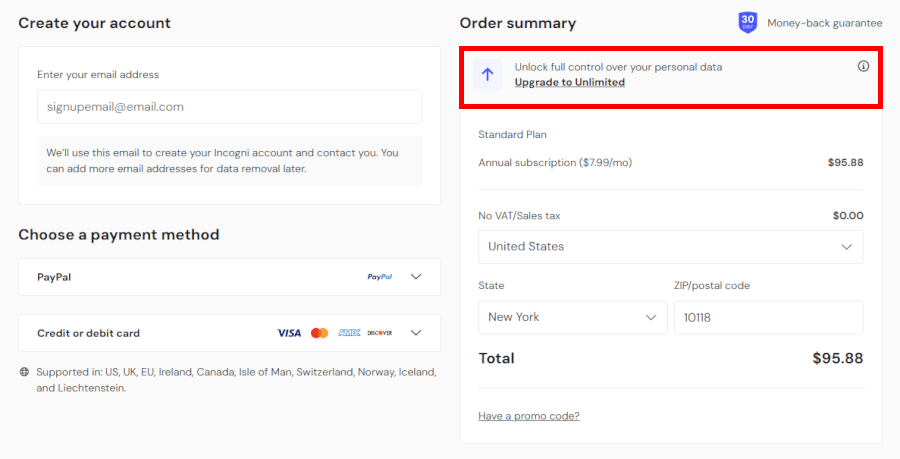
Getting started is straightforward: Choose your plan, verify your email, and sign the authorization form.
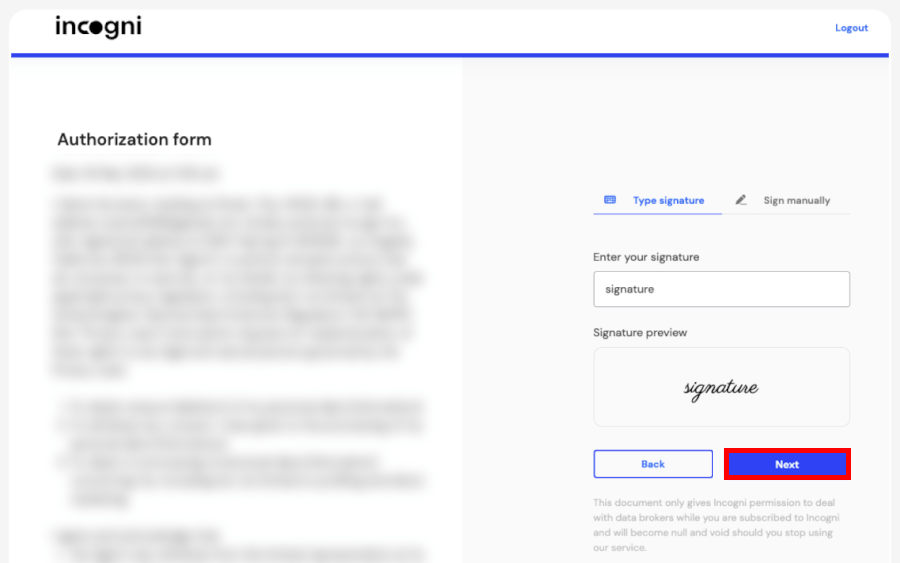
Think of the form as permission for Incogni to act on your behalf. Without your signed consent, it can’t submit requests for you. Once that’s sorted, you’ll provide the personal details Incogni needs to find your records.
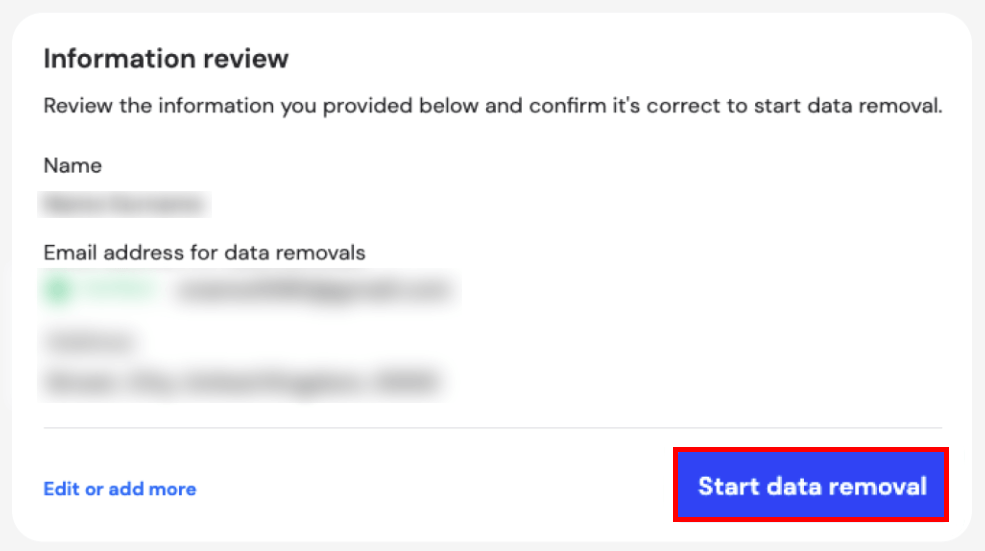
I entered my full legal name, date of birth, and primary phone number. You can also add up to three email addresses and three physical addresses. It’s worth including any relevant details you have, since data brokers may hold outdated contact information or list you under different details.
The dashboard
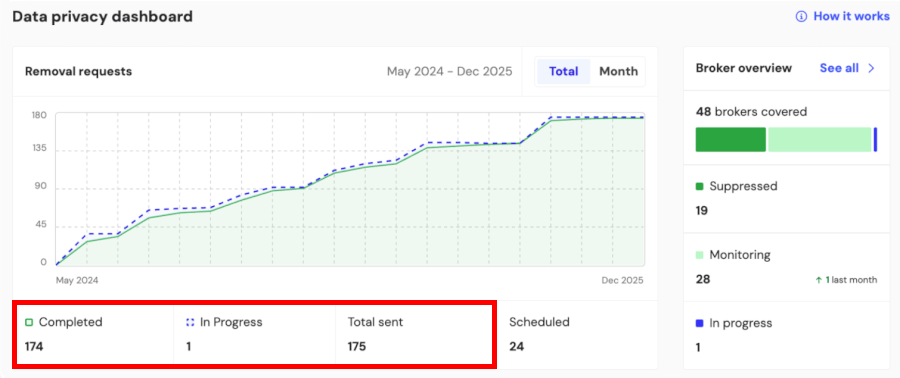
Once the initial scan is complete, you land on a dashboard that’s refreshingly easy to navigate. There’s no wall of technical jargon to decode – only a clear overview of what’s happening behind the scenes:
- Request status: Counters show how many requests have been sent, are in progress, or have been completed.
- Removal progress: You can keep tabs on the cleanup instead of wondering whether anything is actually happening.
- Hours saved: Incogni estimates how much manual work its automation saves you. During my testing, the dashboard estimated over 100 hours saved.
- Less inbox clutter: Incogni’s process can reduce the need to deal with individual broker follow-ups, so you spend less time managing opt-out requests.
Incogni custom removals
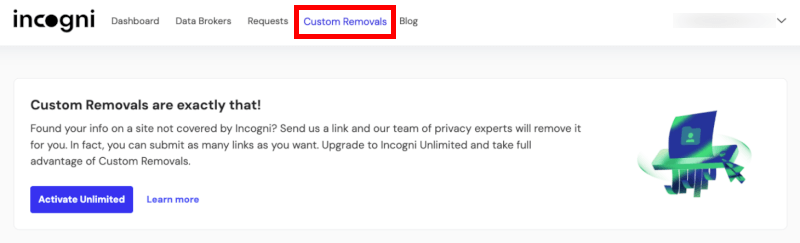
You can also check individual brokers, such as Whitepages or Acxiom, to see the status of specific requests. That added visibility makes it easier to follow the process without having to chase every site yourself.
Deletion timeline
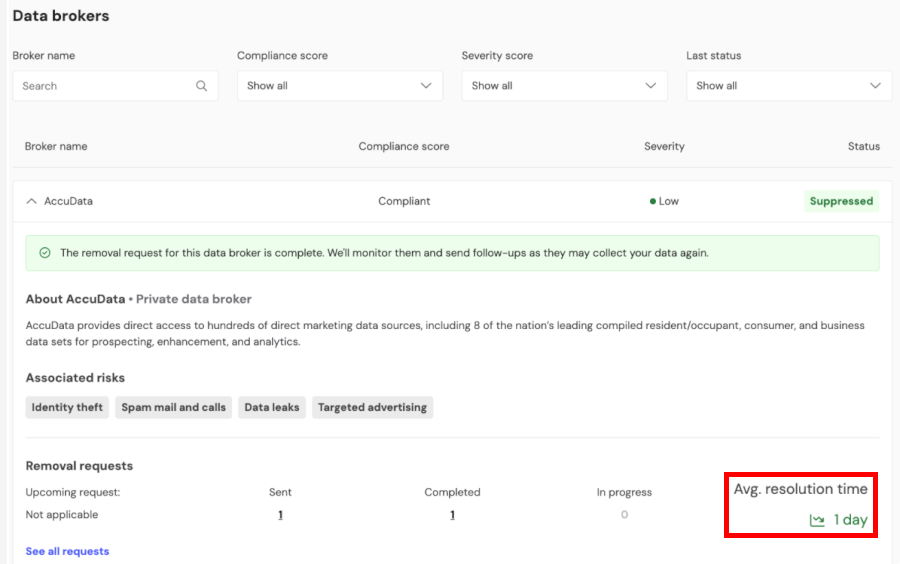
Incogni starts sending removal requests right away, but getting your personal data off the internet takes time. Some data brokers respond quickly, while others take weeks to process requests.
Here’s what the first month can look like based on hands-on testing:
Week 1: The initial wave
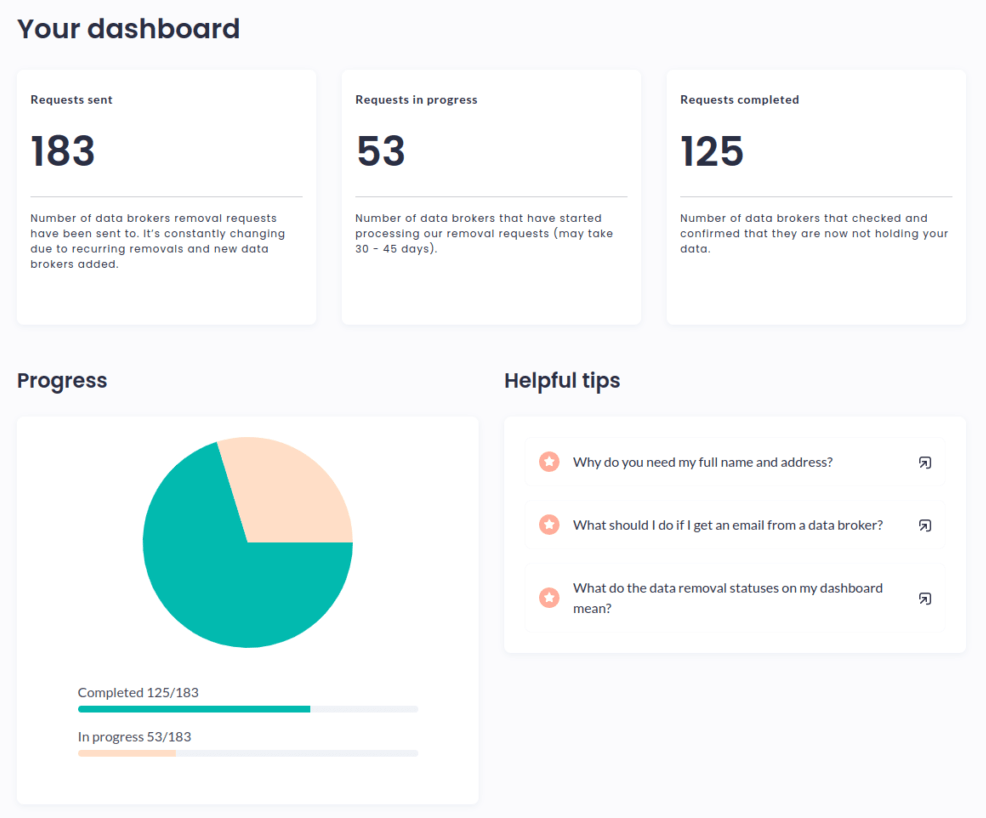
Incogni sends out removal requests, with some resolved within the first seven days. You may start seeing personal details disappear from major people-search sites.
Week 2: The slow burn
Requests to slower data brokers continue working their way through the system. More removals are completed as companies process requests and suppress your information.
Weeks 3–4: The waiting game
The remaining niche marketing registries and background check databases are processed as they hit their strict 30-to-45-day CCPA and GDPR statutory response limits.
Day 30 and beyond: Continuing protection
The system shifts from an aggressive cleanup into a permanent security guard, automatically running fresh rescan loops every 60 to 90 days to stop “zombie data” from resurfacing.
Ongoing maintenance
Once the initial cleanup wraps up, Incogni shifts from a “search and destroy” approach to ongoing data removal and monitoring. Its automated system continues following up on requests and checking for new listings to help prevent your personal information from resurfacing.
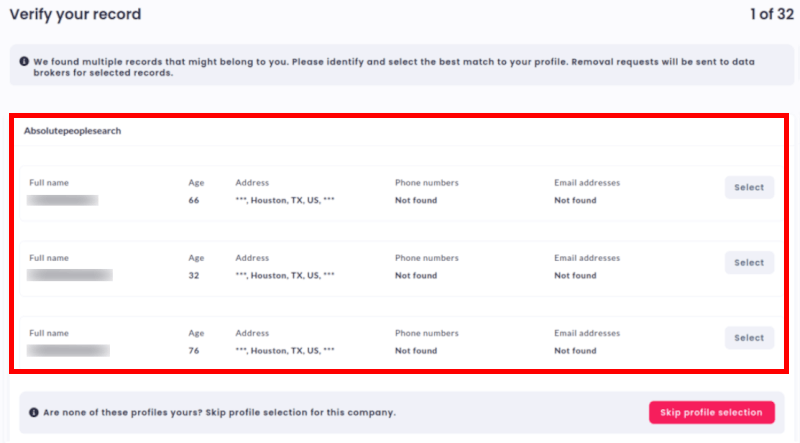
Here’s what ongoing maintenance looks like at a glance:
| Feature | Frequency | What it does |
| ✅ Automated rescans | Every 60–90 days | Checks directories for personal data that has reappeared |
| ✅ Progress reports | Monthly via email | Summarizes removal progress and estimated hours saved |
| ✅ Broker suppression | Ongoing | Follows up with data brokers to help keep your information off their databases |
| ✅ Inbox shielding | Real-time | Intercepts broker validation emails to help keep your primary inbox clean |
Privacy monitoring on autopilot
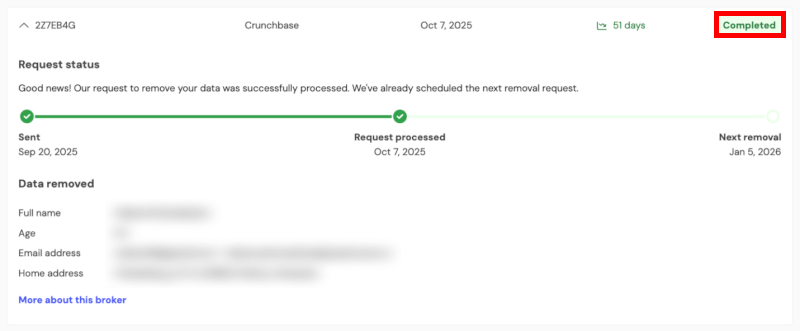
The interface relies on ultra-clear, color-coded indicators (Green = Done, Yellow = In Progress) that let you audit your security footprint in under 30 seconds.
You’ll get a monthly “privacy digest” email that breaks down:
- The total kill count: How many requests are now fully resolved.
- The “hours saved” perk: A reminder of how much manual labor you avoided.
- New broker additions: If Incogni adds a new broker to their database, they’ll automatically send them a removal request without you lifting a finger.
The “zombie data” paradox
Data handlers constantly scrape fresh third-party marketing profiles, leading to resurrected listings. Incogni neutralizes this threat by running permanent, recurring sweeping cycles every 60 days for public people-finders and every 90 days for private background engines.
Manual progress verification
- Public directories: You can easily verify removal success by running personal Google sweeps to check Spokeo or Whitepages profiles.
- Ad-tech registries: Deep corporate marketing databases lack public interfaces, meaning tracking relies directly on Deloitte-audited dashboard indicators.
Registry coverage
| Broker category | Real-world examples | Why it matters | Status |
| People-search sites | Whitepages, Spokeo, MyLife | Stops nosy neighbors or stalkers from finding your home layout | ✅ Targeted |
| Ad-tech aggregators | Marketing profile databases | Shuts off the data flow to advertisers to stop telemarketing spam | ✅ Targeted |
| Background checkers | Tenant and employment screens | Clears out outdated or incorrect files before you apply for a job or lease | ✅ Targeted |
| Location and property | Real estate deed records | Scrubs aggregators that specialize in tracking your exact asset values | ✅ Targeted |
| Risk and Profiling | Insurance scoring agencies | Protects you from shadow agencies that influence loan calculations | ✅ Targeted |
| Public court records | Legal judgments, marriage licenses | These are government-owned public files that no private tool can legally erase | ❌ Unsupported |
| Personal accounts | Social media profiles, news articles | Media posts and accounts you control must be deleted manually by you | ❌ Unsupported |
What kind of data does Incogni remove, and which sites does it target? The service focuses on removing personally identifiable information (PII) held by data brokers. Rather than erasing your information from the entire internet, it targets broker profiles containing details such as your legal name, aliases, phone numbers, past addresses, email addresses, and other personal data used for profiling and advertising.
The covered databases generally fall into five main categories:
- People-search sites: Open public directories like Whitepages, Spokeo, and MyLife utilized by nosy individuals.
- Ad-tech aggregators: Massive profile databases that bundle consumer habits to sell to advertisers, fueling telemarketing spam.
- Risk and profiling: Private financial and hazard evaluation agencies that influence auto insurance or loan calculations.
- Background checkers: Tenant screening and employment verification registries crucial to clear before renting or applying for jobs.
- Location and property: Public deed and real estate aggregators that specialize in tracking home values and asset ownership records.
What Incogni can’t do
It’s important to understand what Incogni can’t remove. The service can’t simply erase personal social media posts, news articles, court documents, official marriage records, or information from accounts you control yourself.
The Standard subscription automatically targets 420+ data brokers, while the Unlimited plan expands coverage to 3,000+ additional niche sites and allows custom removal requests. This broader reach can help you tackle listings beyond the standard coverage, although removal depends on each site’s policies and the applicable privacy laws.
Tracking transparency
As we explain in our operational overview, Incogni’s removal process has undergone an independent Deloitte audit. This adds a layer of third-party oversight to how removal requests are handled, though it doesn’t guarantee every listing will be removed. You can track your requests through the dashboard without having to rely on guesswork.
Is the reporting enough?
Incogni’s dashboard focuses on clear, high-level metrics rather than overwhelming you with technical details. The status indicators make it easy to see which requests have been sent, are in progress, or are marked as completed. However, users who want downloadable copies of individual legal notices or detailed correspondence logs may find the reporting limited.
Ultimately, you’re still relying on the dashboard to track much of the process. The independent Deloitte audit adds reassurance, but it doesn’t guarantee that every listing will be removed or that your personal information won’t reappear.
Plans and pricing
Incogni offers several plans to suit different budgets and privacy needs. Annual subscriptions are cheaper than paying month to month, and the right tier depends on whether you’re protecting just yourself or your whole family, and whether you need custom removal requests beyond the standard coverage.
Here’s the pricing breakdown using the INSIDER promotional discount of 58%:
| Incogni plan | First-year promo rate | Standard renewal rate | Unique perks |
| Standard | $6.79/month | $7.99/month | Core 420+ automated broker removals |
| Unlimited | $12.74/month | $14.99/month | 3,000+ custom sources & live phone lines |
| Family | $13.59/month | $15.99/month | Multi-user central account dashboard |
| Family Unlimited | $19.54/month | $22.99/month | Full house coverage with custom requests |
The Standard annual plan is a good fit for individuals who want Incogni to handle routine removal requests from major data brokers like Whitepages and Spokeo automatically. If you’re looking to protect several people under one subscription, the Family plan covers up to five members and can lower the cost per person.
For broader coverage, the Unlimited plans add access to extra data sources and unlimited custom removal requests, making them worth considering if your information appears on less common sites. Incogni also offers a 30-day money-back guarantee on eligible subscriptions, so check the current terms before signing up.
Data privacy
How does Incogni handle your data? It might seem a little ironic to share your personal information with a company when your goal is to get it off the internet. But Incogni needs those details to find your records and request their removal from data brokers.
The platform relies on a strict data defense framework to ensure this process remains secure:
- Minimal data rule: Only requests core identification fields (Name, DOB, Address, Email) strictly required to generate legally binding opt-out orders under CCPA and GDPR.
- Bank-grade security: Scrambles all stored and in-transit data fields using military-grade AES-256-GCM encryption protocols.
- Twelve-month clean slate: Purges your entire physical database footprint within 12 months of a cancellation, alongside supporting immediate manual data-wipe requests.
- Account-level two-factor authentication: Supports rapid 2FA configuration directly within your security dashboard to guarantee your privacy metrics remain locked.
Customer support
Even with automated data removal running in the background, you might occasionally need a human in your corner. For this Incogni review, I tested the Incogni customer support channels to see how they treat everyday users:
| Feature | Standard plan | Unlimited and Family plans |
| ✅ 24/7 live chat | Included (under 5 minute response) | Included (priority routing) |
| ✅ Email ticketing | Standard response | VIP priority response |
| ✅ Knowledge base | Full access | Full access |
| ✅ Phone support | ❌ Not available | ✅ Live support included |
| ✅ Custom removal help | ❌ Not available | ✅ Human-assisted service |
My experience with Incogni’s 24/7 live web chat was a major highlight during my testing. Support agents consistently joined the chat window in under three minutes. They answered my privacy questions directly instead of using robotic, canned scripts. If you prefer a DIY route, their self-help article database is deep and easy to parse.
Incogni protects users globally across the US, UK, Canada, and the EU. However, specific premium security additions like identity theft insurance are currently restricted to US residents.
Account cancellation
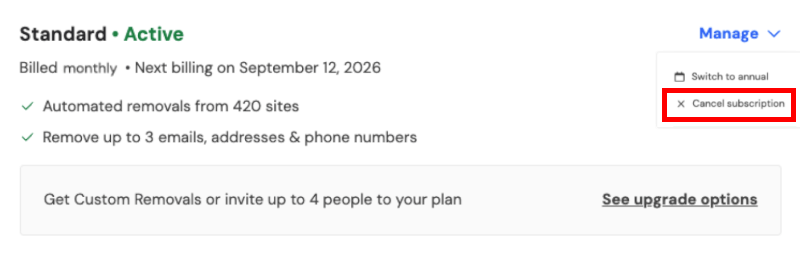
Incogni does not force you to argue with a pushy retention specialist to close your account. They keep the cancellation process transparent and stress-free:
- One-click control: Cancel your subscription directly from your main user dashboard.
- No awkward phone calls: Skip annoying sales pitches or retention traps entirely.
- Continuous data protection: Keep active broker tracking running until your billing cycle ends.
- Guaranteed refund window: Test the service risk-free with a 30-day money-back guarantee.
Competition
With thousands of data broker companies operating in the shadows, choosing between competing data removal services is the difference between a clean slate and a wasted subscription.
| Feature | Incogni | DeleteMe | Optery |
| Data broker coverage | 420+ (3,000+ on Unlimited) | 100 automated (800+ via custom; 969 total) | 370+ |
| First-week speed | Fastest | Moderate | Slower |
| Deloitte audited? | ✅ Yes | ❌ No | ❌ No |
| Free scan? | ✅ Yes | ❌ No | ✅ Yes |
Incogni vs DeleteMe
DeleteMe is a long-standing option in this space, but Incogni usually wins on raw speed. In my testing, Incogni hit nearly three times the number of first-week removals. While DeleteMe gives you highly detailed, human-vetted reports, Incogni’s relentless automation makes it the superior set-and-forget choice if you want to skip reading massive monthly progress files.
Incogni vs Optery
Optery stands out for its deep free scan that shows you exactly which brokers hold your data using visual screenshots. It is a fantastic reality check tool. However, when it comes to actually running cleanups, Incogni’s removal engine is significantly more aggressive. Incogni’s automated opt-out process cleared nearly 100 profiles in the same timeframe that competitors were still processing their first dozen entries.
The bottom line
After a year of testing Incogni, I found that it helps reduce spam calls and remove personal information from public directories. It won’t erase news stories or every trace of your online life, but it can make it harder for data brokers to build a profile on you. I’d recommend it to professionals in sensitive fields, anyone dealing with online harassment, or people who’d rather not spend hours chasing removal requests themselves.
An Incogni annual plan offers lower monthly rates, and I saw removal activity within the first month. Just keep in mind that results vary by broker, and some requests take longer to complete.
For me, the biggest plus is not having to handle all that tedious work myself. If you want to try it, check out our exclusive 58% off Incogni discount for CyberInsider readers below to get more for your money.
Exclusive Incogni Deal:
Incogni is giving CyberInsider readers an exclusive 58% off deal with the coupon below:
(Coupon is applied automatically; 30-day money-back guarantee.)
Incogni FAQs
Does Incogni remove info from Google?
Not directly, but it fixes the root problem. Incogni cannot force Google to alter its search results. Instead, it targets the data brokers feeding those search results. Once Incogni removes your personal profile from a broker database, the corresponding Google links lead to dead pages and quickly drop off search indexes entirely.
How fast does Incogni work?
You will see quick dashboard updates within 48 hours. However, full data removal across the web takes time. Legally, many data brokers have 30 to 45 days to comply with automated data removal orders under frameworks like the CCPA and GDPR. For a comprehensive digital cleanup, expect a four-to-six-week window.
Is Incogni safe to use?
Yes, it is one of the safest choices available. Giving your personal data to a company to delete your data feels counterintuitive, but Incogni operates with high transparency. They use bank-grade AES-256 encryption, maintain a strict “no data resale” policy, and back up their claims with an independent, third-party Deloitte audit.
What happens if I cancel?
Your removed data will eventually creep back online. Data broker companies are aggressive re-scrapers that constantly pull fresh information from public records. If you stop using Incogni’s recurring 60-to-90-day sweep cycles, your personal profiles will likely reappear on search sites within a few months.
Is Incogni or DeleteMe better?
Incogni is the superior set-and-forget value choice. While DeleteMe provides slightly more detailed manual reports, Incogni wins easily on automated speed-per-dollar. It covers 420+ brokers right out of the gate without hidden tier paywalls, making it the easier choice if you want hands-off protection.

Will this product cover landline phone numbers (non-SMS Text) for spam/scams?
Hi Richard, yes it will.
Most of my spam are political texts. I receive 20-30 per day. Will Incogni block these even though I have occasionally contributed to some campaigns?
Informative review but one mistake I saw Incogni does have a mobile app
My son is married and lives in another sate, can I include them in my Family Plan?
Hi Dale, I believe so, but that would be a good question for Incogni.
Now that Ingocni (and Surfshark) are part of Nord Security, you’d think the pricing pages would be the same across all three sites. It ain’t so. I just dropped my Surfshark account for technical reasons and went with NordVPN (I already has NordPass).
On the Nord site, there isn’t a Family Plan or Unlimited options. Only the very basic, one user plan matches pricing/plans on the Incogni site. I didn’t bother Looking at Surfshark since it was mentioned ‘bundling’ in the article.
Can multiple email addresses be provided? Nowadays, people use multiple email addresses precisely to protect their privacy. Without providing several email addresses, I assume it will be difficult to find all of a person’s entries.
Hey,
Yes, both multiple e-mail addresses and physical addresses are supported with all plans.
Can you compare deleteme with Incogni?
Yep, we have a comparison guide here:
https://cyberinsider.com/data-removal/incogni-vs-deleteme/