
Finding the best data removal services takes more than a quick Google search as not all of them are worth your hard-earned time or money. While a few standout options will quietly work in the background to scrub your digital footprint clean, others barely make a dent in getting your records off the web.
I’ve spent weeks deep in the trenches testing the leading privacy tools to find out which ones actually deliver on their promises. This guide breaks down the absolute top options on the market, openly compares what they do well (and where they fall short), and helps you choose the perfect fit for your specific needs and budget.
Privacy services compared
Here’s a snapshot of how the top data removal services stack up on coverage, cost, and what they do best:
| Best for | Broker coverage | Starting price (billed annually) | |
| Incogni | Set-and-forget automation | 420+ automated brokers (plus 2,000+ custom sites on higher tiers) | $6.79/month |
| DeleteMe | Expert human-led takedowns | 100+ standard brokers (up to 750+ on premium plans) | $8.60/month |
| Aura | All-in-one digital security bundle | 425+ highest-impact people-search registries | $9.99/month |
| Optery | Visual proof and transparent reporting | 130 to 640+ automated brokers (scans 1,000+ total sources) | $3.25/month |
| Privacy Bee | Proactive, 24/7 active surveillance | 400 to 1,000+ targeted data sites | $8.00/month |
The numbers tell part of the story. Let’s look at the legal rules and automated tools these services use to tackle data brokers.
How it works
Data brokers don’t just collect your information once and call it a day. They keep updating your profile with new public records, voter rolls, and details gathered online. That means one cleanup may not be enough; regular checks help catch your information when it pops up again.
The privacy loop
Data brokers are persistent. They don’t just collect your data once; they “re-populate” their lists using new public records, social media pings, and app data. This is why a one-time scrub is useless. You need a service that plays a continuous game of “whack-a-mole” to keep your name off their lists.
A reliable privacy platform runs a continuous background cycle:
- Deep-web scanning: Searching hundreds of registries for your names, old addresses, and phone numbers.
- Legal enforcement: Submitting deletion requests using legal muscle like the CCPA, GDPR, or the 2026 California Delete Act.
- Active rescanning: Double-checking databases every month to catch records that reappear.
- Verification reporting: Updating your personal dashboard so you can track verified deletions.
Removal limits
It’s important to manage expectations. These services are powerful, but they aren’t magic wands:
- They aren’t “invisibility cloaks”: They won’t stop every spam call or replace your VPN and antivirus.
- They aren’t “erasers”: They cannot remove official court records, news articles, or government filings.
How we test
We rank the best data removal services based on hands-on testing, security checks, and real-world performance. Our goal is to help you delete your digital footprint more effectively, so, we rate each service across seven core criteria:
- Broker coverage: We focus on services that reach the major data brokers showing up in search results, rather than those that simply boast about high removal counts.
- Automation speed: We look at how quickly services send opt-out requests, including whether they use API integrations to speed up the process when your data appears in a broker’s database.
- Transparency: We give higher marks to services that clearly show removal progress, provide timelines, or offer before-and-after screenshots to show what’s changed.
- Security: We check each provider’s security measures, including multi-factor authentication, policies on selling user data, and independent security audits.
- Pricing and value: We compare subscription costs, renewal rates, multi-device access, and family plans to see which services offer the best value over time.
- Identity protection: We give extra credit for useful add-ons such as dark web alerts, email masking, and identity theft insurance.
- Customer support: We check how quickly support teams respond and whether they can step in to handle stubborn data brokers when automated removal requests don’t work.
Top choices for 2026
We tested the leading data broker removal tools to find the best options this year. These five providers stand out for their opt-out processes, ongoing monitoring, and overall performance.
Incogni – Best data removal tool

| Pricing range | $6.79 – $19.54/month (with 1-year plans) |
| Broker coverage | 420+ (Standard) up to 2,000+ (Unlimited) |
| The X-factor | Independent audits. Unlike competitors who say “trust us,” they let firms like Deloitte verify their work |
| Best deal | 55% off coupon > |
I’ve found that most people quit using personal data removal services because they’re just too fussy. Too many dashboards, too many manual forms, and way too many follow-ups. Incogni fixes that. It’s like hiring a relentless digital lawyer who works 24/7 filing opt-out requests on your behalf, except you don’t have to chase anyone down or argue with customer support reps.
The basic plan already targets 420+ data brokers, which covers all the usual suspects. But in 2026, their Unlimited tier is where things get interesting. It gives you the power of unlimited custom removals, letting you submit requests for those obscure, bottom-feeder sites that most automated tools completely ignore.
To help you decide which level of protection you need, here is how the 2026 plans break down by cost and coverage:
| Incogni plan | Price (annual) | Broker coverage | Core benefit |
| Standard | $6.79/month | 420+ automated brokers | Fully automated hands-off removals |
| Unlimited | $12.74/month | 420+ (plus 3,000+ custom sites) | Custom removal requests for stubborn sites |
| Family | $13.59/month | 420+ automated brokers | Protects up to 5 family members at once |
| Family Unlimited | $19.54/month | 420+ (plus 3,000+ custom sites) | Custom removals for the whole household |
| Protect | $17.63/month | 420+ (plus 3,000+ custom sites) | Adds up to $1M identity theft insurance |
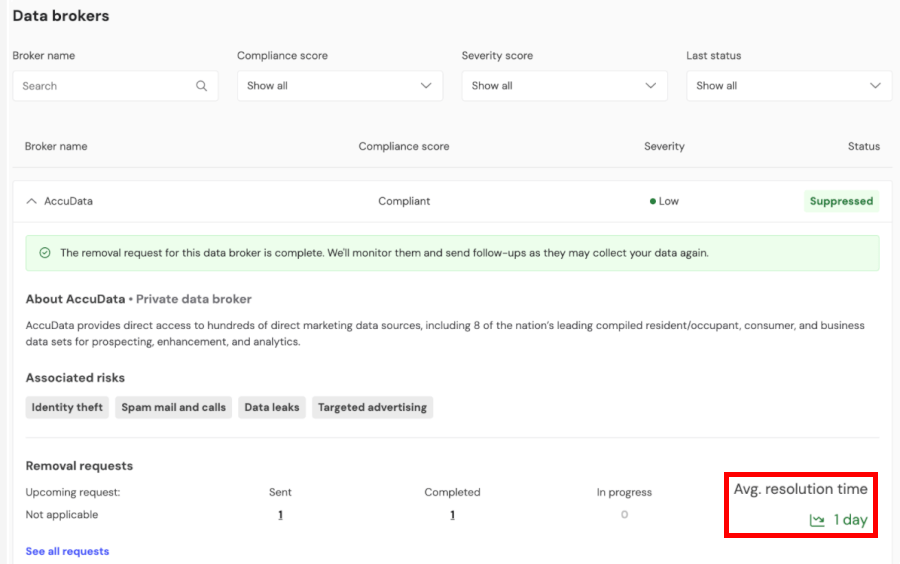
Incogni doesn’t just send a removal request and call it a day. They continuously monitor and re-contact brokers every few months to make sure your profile hasn’t re-spawned from a fresh data leak. Most users start seeing their Google results clean up within 24 to 90 days, but the real value is that it keeps working quietly in the background.
What makes the “relentless lawyer” analogy real is the limited Power of Attorney you grant them during signup. That’s what gives their legal team the authority to act on your behalf. When a broker tries to stall with “please verify your identity” hoops, Incogni can push past the nonsense and formally demand deletion under privacy law. You don’t print forms. You don’t argue. You don’t upload ID scans to 50 random sites. They handle the bureaucracy while you sleep.
In a world where everyone claims to be “the best,” I value transparency. Incogni is one of the few services that undergoes independent audits, including a recent one by Deloitte. They provide a searchable list of targeted brokers and ongoing status updates, so you can see exactly who’s been contacted and what’s happening. No vague promises. No mystery process.
It’s not a magic wand. Incogni is a removal specialist, but not a full security suite. It won’t manage your social media privacy, it doesn’t include a VPN, and it won’t mask your email address. If you want a full digital fortress, you’ll need to pair it with other tools (such as Aura).
Incogni pros and cons
+ Pros
- Pure, hands-off automation
- Crushes brokers in the US, the UK, and the EU
- Backed by helpful 24/7 live chat
- Clean, simple UI
- Proactive status updates
- One of the cheapest annual plans available
- Stops spam cold
- Re-checks brokers every few months
- Targets 3,000+ obscure sources via custom requests
- Built by Surfshark, world-class cybersecurity experts
- Independently verified by Deloitte
– Cons
- No proof photos
- No extra tools like VPN or antivirus
Exclusive Incogni Deal:
Incogni is giving CyberInsider readers an exclusive 58% off deal with the coupon below:
(Coupon is applied automatically; 30-day money-back guarantee.)
DeleteMe – Expert-led data removal
| Pricing range | $129 – $329 / year (annually; no monthly plans) |
| Broker coverage | 100+ standard (up to 969+ via custom requests) |
| The X-factor | Human privacy experts who manually contest and bypass anti-bot defenses |
| Best deal | 20% off DeleteMe here > |
If Incogni operates like a relentless background script, DeleteMe functions like a hands-on digital protection detail. Operating since 2011, they bypass automated restrictions by deploying real human privacy experts to manually scrub data fields that automated bots simply cannot access.
DeleteMe relies on consistent, expert-backed manual interventions to outmaneuver frustrating broker identity-verification traps. To help you evaluate household coverage options, here is how the core annual plans break down:
| DeleteMe plan | Price (annual) | Broker coverage and core benefit |
| 1 Person | $129/year | Covers 1 adult; expert analysts handle stubborn “un-bottable” registries |
| 2 People | $229/year | Shared dashboard protecting two adults with manual expert review |
| Family | $329/year | Full household shielding covering up to 4 family members |
Their standard plans target the biggest people-search networks, while premium tiers expand total tracking to 969+ data brokers. If you locate your personal records on an obscure regional directory, you can submit the specific URL directly to your assigned analyst for manual removal.
The service also packages advanced privacy tools like masked email addresses and phone numbers to neutralize tracking vulnerabilities before they spawn new listings.
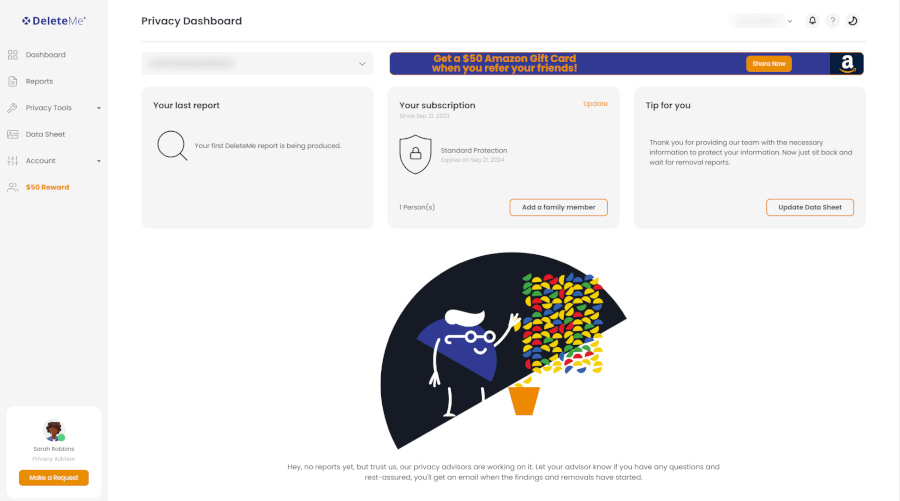
Instead of a real-time tracking panel, the platform issues comprehensive, deep-dive privacy reports every seven days initially, followed by regular quarterly updates outlining absolute exposure milestones. While the reporting cadence means you won’t see instant daily updates, the manual tracking depth offers a highly robust defense against persistent data leaks.
DeleteMe pros and cons
+ Pros
- Human-led handling
- Custom removals
- Built-in email and phone masking
- Phone support
- Free DIY opt-out guides
- Clean, easy-to-use dashboard
- 15+ years in the industry
- Strong follow-up on major brokers
– Cons
- No 24/7 support
- No free trial
- Higher upfront cost
- Quarterly updates
Exclusive DeleteMe Coupon:
DeleteMe is now offering CyberInsider readers 20% off ANY plan with the exclusive link below:
(Coupon is applied automatically)
Aura – All-in-one bundle

| Pricing range | $9.99 – $24.99 / month (annually; 60-day refund) |
| Broker coverage | 425+ automated data broker networks |
| The X-factor | Full cybersecurity suite adding three-bureau credit locks and up to $5M in identity insurance |
| Best deal | 68% Off Coupon > |
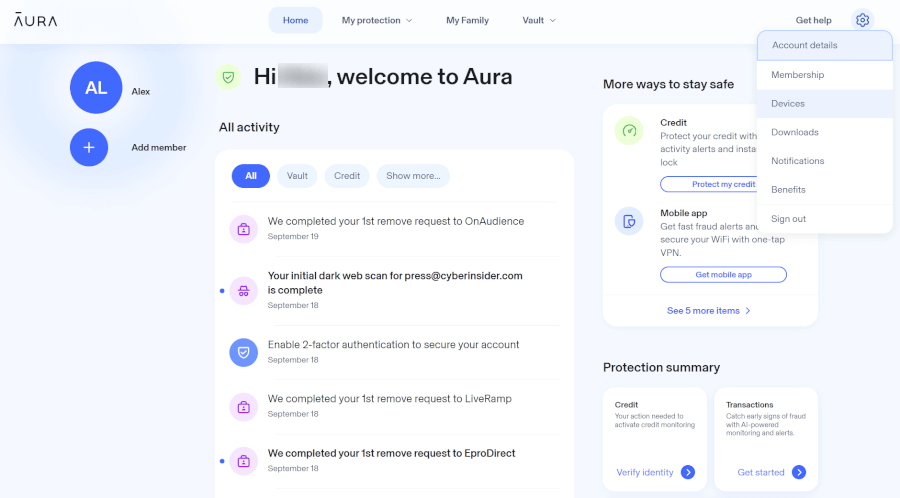
If Incogni files the legal requests and DeleteMe handles the toughest manual cleanups, Aura watches your back as a 24/7 digital security detail. It eliminates app clutter by consolidating data removal, identity theft alerts, and device security into one unified dashboard.
Depending on whether you are protecting just yourself or your entire household, here is how Aura’s core annual plans stack up:
| Aura plan | Price (annual) | Broker coverage | The X-factor |
| Premium | $9.99/month | 425+ registries | Covers 1 adult with a $1M fraud insurance policy |
| Ultimate | $17.99/month | 425+ registries | Covers 2 adults with separate dashboards and $2M total insurance |
| Ultimate Plus | $24.99/month | 425+ registries | Covers 5 adults, unlimited kids, parental controls, unlimited devices, and $5M total insurance |
Aura’s automated scrubbing engine targets 425+ of the highest-impact people-search sites, running continuous daily removal cycles to ensure deleted data doesn’t reappear.
However, the primary reason to choose Aura is the comprehensive safety net it places around your personal data:
- Identity monitoring: Issues real-time alerts if threat actors attempt to open unauthorized financial accounts in your name.
- Dark web surveillance: Instantly flags exposed Social Security Numbers, leaked passwords, or compromised credentials.
- Integrated safety suite: Protects up to 10 active devices with a high-speed VPN, antivirus software, and a native password manager.
If a dark web alert surfaces an active compromise, you can freeze your credit files directly within the application with a single tap. Should full identity theft occur, Aura assigns you a dedicated, US-based fraud resolution specialist to handle recovery logistics manually, backed by up to $1 million in dedicated insurance coverage per adult.
The trade-off is less depth in data removal. Aura may fall short if you need to scrub thousands of niche international directories. Unlike Incogni’s Unlimited tier, it lacks manual URL submissions, and it doesn’t offer Optery’s visual proof logs. You’re trading deeper data scrubbing for broader domestic security.
Aura pros and cons
+ Pros
- All-in-one digital identity fortress
- Massive identity insurance
- AI scam screening
- Simple-to-use dashboard
- Round-the-clock support
- Real-time three-bureau credit monitoring
- Secures up to 10 active devices
- Superb value for families with children
- Instant breach warnings
- Rapid turnaround speed
- Human recovery assistance.
– Cons
- US-only restriction
- No before-and-after removal screenshots
Exclusive Aura Data Removal Coupon:
Get 68% Off Aura 1-year subscription plans with the coupon below:
(Coupon is applied automatically; 60-day money-back guarantee.)
Optery – Perfect for transparency

| Pricing range | $3.25 – $20.70 / month (annually; free basic scan available) |
| Broker coverage | 130 to 640+ automated data brokers (1,000+ total registries) |
| The X-factor | Before-and-after screenshots proving your data was deleted |
| Best deal | Save 17% off with 1-year plans > |
If you are the type of person who needs to see the receipts to believe the job is done, Optery is your brand. Instead of just telling you a removal was processed, Optery actually shows you before-and-after screenshots of your listings being scrubbed.
The visual exposure report maps out exactly where your home address, phone number, or private email was found, followed by visual confirmation once it’s deleted.
Optery scans a massive network of 1,000+ data brokers and people-search registries—one of the largest footprints on the market. Depending on your budget, they automate removals for anywhere from 130 to 640+ sites, with higher tiers allowing unlimited custom removal requests for obscure, niche directories.
Their free basic scan doesn’t delete listings for you, but it acts as a high-intensity diagnostic tool that sends a detailed report with direct DIY opt-out instructions.
To help you decide which layer of visual tracking you need, here is how Optery’s annual plans break down:
| Optery plan | Price (billed annually) | Broker coverage | The X-factor |
| Core | $3.99/month | 130 – 365+ | Essential automated removals covering top high-impact brokers |
| Extended | $14.99/month | 305 – 545+ | Adds human privacy agent elements and deep before-and-after screenshots |
| Ultimate | $24.99/month | 385 – 640+ | Maximum database coverage, cache clearing, and unlimited custom requests |
Optery includes an opt-in map blurring tool for Extended and Ultimate subscribers, allowing you to easily submit property obscuring requests to Google Maps and Apple Maps right from your dashboard.
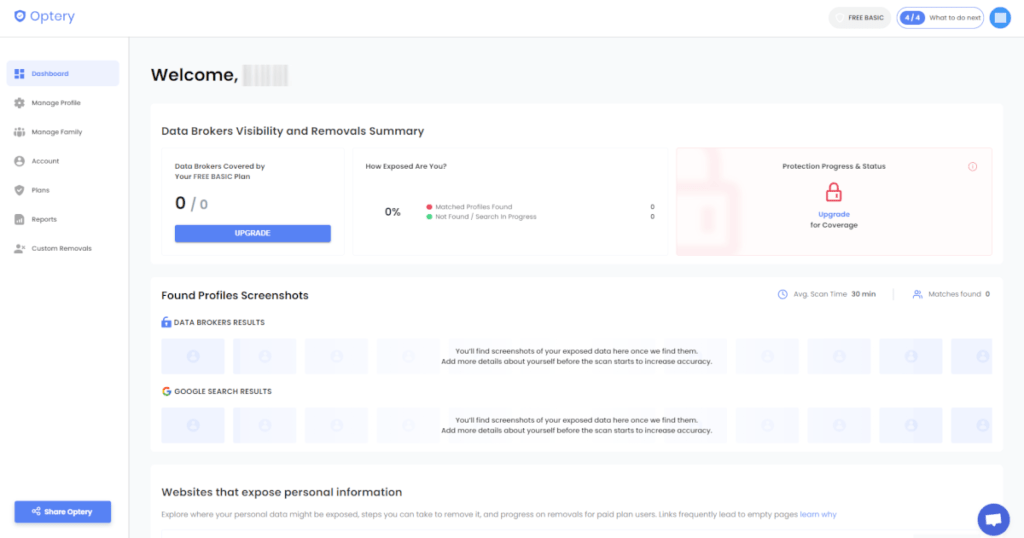
Paid subscriptions also activate an AI-driven exposure risk score to prioritize threats and an expanded reach engine that targets “shadow brokers”, the hidden backend data aggregators fueling the web.
They also dig deeper than the sites you see on page one of Google. Paid plans include “expanded reach”, which sends opt-out requests to shadow brokers, the hidden aggregators that feed the search sites. It’s a quieter but essential layer of protection that cuts the data flow off at the source.
While California’s free state-run DROP system is an incredible local initiative, it only requires brokers to run deletion loops every 30 to 45 days. Optery fills that massive gap by providing continuous active surveillance and national coverage far outside California’s jurisdiction.
The interface can feel slightly data-heavy for absolute beginners, and the Ultimate tier requires a larger upfront investment. However, if you demand concrete, visual proof that your data has actually been erased, Optery has no equal.
Optery pros and cons
+ Pros
- Before-and-after removal screenshots
- Deepest free scan covering 1,000+ sites
- Blurs your house on Google Maps
- Automates removals for 640+ data brokers
- Unlimited custom removals
- Free DIY guides for every detected profile
- Monthly billing available
- Includes “TrueScan” to find sneaky aliases
- AI ranks your most dangerous exposure risks
– Cons
- No screenshots on the basic Core plan
- Complex interface
- Premium pricing
Privacy Bee – Robust data removal

| Pricing range | $197 – $797+ / year (annually; no monthly payment options) |
| Broker coverage | 400 to 1,000+ targeted data sites |
| The X-factor | A real-time tracking dashboard that treats your personal privacy like a credit score |
| Best deal | N/A |
If you want a service that treats your privacy like a high-stakes security operation, Privacy Bee is the play. They have carved out a specific niche as an “always-on” continuous monitor, specializing in deep-tissue footprint cleanup and constant surveillance of your digital trail.
Their standout feature is the weekly privacy audit. Unlike competitors that only check in monthly, Privacy Bee updates your exposure dashboard every single week, ranking discovered data leaks by risk level so you know exactly which listings are the most dangerous. As your data gets systematically removed, your security score improves.
To help you evaluate their specialized surveillance tiers, here is how the core annual plans break down:
| Privacy Bee plan | Price (annual) | Broker coverage | The X-factor |
| Essentials | $197/year | 450+ data sources | Provides deep weekly risk audits and continuous removal rescans |
| Pro | $397/year | 1,000+ data sites | Broadens surveillance to target 180k+ niche corporate registries |
| Signature | $797/year | 1,000+ data sites | White-glove concierge account handling with a dedicated privacy officer |
Privacy Bee also works proactively to stop new leaks before they happen. Their native browser extension blocks tracking scripts in real time and handles complex marketing opt-outs while you surf the web. They actively track down alternate versions of your digital identity, such as old addresses, typos, aliases, or maiden names, to prevent brokers from quietly re-listing you under a “new” profile.
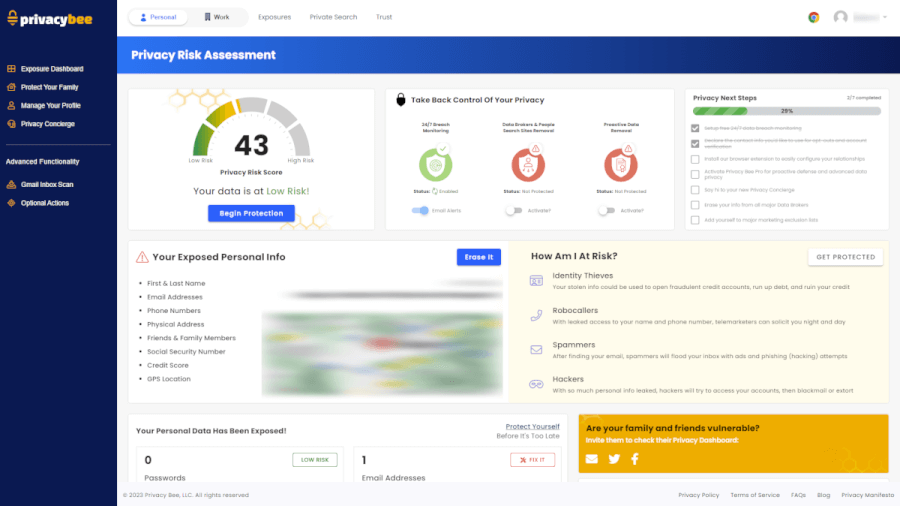
The dashboard also lets you whitelist specific corporate brands you trust. This ensures your favorite retail loyalty programs or accounts are not accidentally disrupted while the rest of your public footprint is scrubbed.
The primary trade-off is the premium price point. Privacy Bee does not feature month-to-month billing structures, nor does it include visual before-and-after screenshots like Optery or device protection tools like Aura. It is a premium, focused service built for people who want highly aggressive tracking surveillance without lifting a finger.
Privacy Bee pros and cons
+ Pros
- Aggressive, round-the-clock monitoring
- High-frequency updates
- Advanced AI-driven risk scoring
- Targets over one thousand data sites
- Harassment shielding
- Proactive blocking
- Huge family plans
- User-friendly dashboard
– Cons
- Higher annual cost than most competitors
- Billing restrictions
- Lacks actual before-and-after screenshots
The California Delete Act
If you live in the Golden State, 2026 just became the year you officially took the steering wheel back. The California Delete Act (SB 362) is now in full swing, and it gives your online privacy a solid boost.
Core consumer rights include:
- The master switch: Residents can submit one single request through privacy.ca.gov/DROP that forces over 600 registered data brokers to delete their personal info simultaneously.
- The processing clock: While the law launched requiring brokers to run deletion loops every 45 days, California’s newly signed AB 883 amendment shortens this processing window down to a mandatory 30-day cycle.
- Strict state enforcement: Registered data brokers must process these state-verified requests or face administrative fines of $200 per day for non-compliance.
Do you still need a paid service?
Yes. While the state’s tool is a massive win, data removal services like Incogni or DeleteMe are still highly recommended for continuous, automated, and national coverage. Paid privacy tools use these state laws as legal weight to demand deep removals while proactively capturing hidden “shadow brokers” operating completely outside California’s jurisdiction.
Can you remove data for free?
You can opt out of data brokers for free, but handling all those requests yourself takes time and regular follow-ups. Here’s how doing it yourself compares with letting an automated service take care of it:
| Manual DIY cleanups | Paid removal services | |
| Upfront cost | 🟢 Completely free | 🟡 Around $3.25 to $10.75 per month |
| Initial time required | 🔴 10–15 hours of manual forms | 🟢 Under 5 minutes for setup |
| Front-page brokers | 🟡 Limited to major sites you find | 🟢 Full automated API coverage |
| “Shadow” aggregators | 🔴 No coverage (nearly impossible to find) | 🟢 Deep-web background sweeps |
| Custom URL requests | 🔴 Requires manual browser digging | 🟢 Unlimited custom site submissions |
| Profile “re-spawning” | 🔴 No protection (listings return) | 🟢 Continuous, monthly rescan loops |
Overall, most people opt for premium services, as others have pointed out in Incogni reviews on Reddit.
Why go pro?
Data removal services like Incogni or Optery don’t just “click buttons” for you; they provide the legal muscle and persistence that individuals lack. They use frameworks like the California Delete Act to force compliance and run automated “rescan” loops so you never have to think about it again.
Recommended hybrid approach
If you are on the fence about paying for a subscription, use this practical middle-ground strategy to evaluate your data exposure:
- Run a free scan: Use the Optery free scan to see exactly where you are listed. It’s a massive wake-up call.
- Manual blitz: Pick the top five people search sites (the ones on page one of Google) and remove them yourself.
- Evaluate your time: If, after those five sites, you feel like pulling your hair out, it’s time to let the bots (or DeleteMe’s human experts) take over.
If you value your personal time at more than $5 an hour, outsourcing the continuous monitoring loop to a professional service is almost always the more economical choice.
Prevent future leaks
A data removal service can help clean up your existing digital footprint, but a few simple habits can help keep new information from spreading to data brokers.
Simple ways to protect your privacy:
- Use email aliases: Try masked email addresses for shopping accounts and newsletters instead of sharing your main inbox.
- Share less: Leave optional fields blank when filling out online forms.
- Protect your phone number: Use a secondary number, such as Google Voice where available, when you don’t want to share your personal one.
- Check checkout boxes: Look for preselected options that allow retailers to share your information.
- Secure your accounts: Use a password manager and enable multi-factor authentication.
- Keep your home address private: Consider a PO box for situations where you don’t need to provide your residential address.
- Review app permissions: Check which apps can access your personal information and revoke permissions they no longer need.
Make privacy checks a habit:
- Every week: Watch for unexpected password-reset emails or suspicious account activity.
- Every month: Search your name online for new listings and remove apps you no longer use.
- Every three months: Review credit alerts and check whether your personal details have reappeared on data broker sites.
- Once a year: Review family privacy settings and check whether your subscriptions still meet your needs.
Data removal FAQs
Yes, for most people, the massive amount of personal time saved makes them an absolute bargain. Manually hunting down and opting out of hundreds of individual data brokers can easily eat up over 40 hours of tedious work. A professional service automates that entire headache for a few dollars a month, running continuous background sweeps to ensure those deleted profiles don’t simply reappear a few weeks later.
You will usually see the first major wave of broker removals within 7 to 14 days. While prominent people-search sites move relatively quickly, achieving a thorough deep clean across the entire global data broker ecosystem typically takes anywhere from 60 to 90 days. Most platforms provide an active dashboard timeline so you can visually watch your overall exposure risk drop as deletions are officially confirmed.
It significantly slashes daily spam, though it isn’t a complete digital mute button. You can expect a major drop in robocalls by cutting off brokers who sell phone numbers, but separate corporate data breaches require individual attention.
Yes, because data brokers persistently re-list information. As databases refresh with new public records and registries, canceling a subscription allows automated scrapers to recreate profiles within months.
No, they are effective privacy tools rather than absolute erasers. While they remove data from search sites and marketing databases, they cannot alter official government filings, property deeds, or public court and news records.
Yes, when using audited, subscription-backed services. Reputable platforms rely on membership fees rather than data exploitation, securing onboarding details with strong encryption and strict no-sale policies.

I’m not entirely sure what the “forensic” activity entails, but if these services simply handle the process on your behalf, I don’t see an issue with that. However, based on my experience, opting out of a service to “erase my digital footprint” can come at a cost: losing access to that service altogether.
Here’s what I mean. Suppose Company A has an app or website that I want to use, or have used in the past, and I want all the personal data they’ve ever collected about me erased. While they may comply with that request, I may no longer be able to access or use their service unless I agree to let them collect and harvest my personal information all over again.
In other words, I can erase my data, but doing so may mean giving up access to the very services I want to use—or agreeing to have my data collected again just to regain access.
I am commenting to advise of a flaw with Incogni’s service. I have used Incogni for about 3 years. They do do a good job of removing data. However, if you have been the victim of any kind of data breach or hack and need to change the email address you used at sign-up – they DO NOT allow this. You must delete/close your account subscription and open a new one. This results in losing all your data and and prior removals – that is start from scratch.
Realize this also will impact anyone who has their email through the Internet Service Provider or through a third party service. If you want to change ISPs, move or if the third party ceases to operate, you CAN NOT change your email address with Incogni.
To me this seems ridiculous, especially in today’s data security environment.
I am intrigued with Incogni and would like to add another service that might be useful: EastOptOuts. It is an inexpensive annual service that scans multiple data broker websites and automatically sends opt-out requests on your behalf. It also conducts an initial search and removal right away, then repeats the process every four months to ensure your data is removed from any new sites that may list it over time.
https://easyoptouts.com
If you’d rather not spend money and are willing to take the time to do it on your own, I have found this to be a very good data broker list to use in order to sent opt-out requests:
https://github.com/yaelwrites/Big-Ass-Data-Broker-Opt-Out-List