

Coldcard maker Coinkite has disclosed a security flaw affecting multiple generations of its Bitcoin hardware wallets that reduced the randomness used when generating wallet recovery seeds, potentially placing funds at risk.
The company has released patched firmware for all affected devices and is urging users to stop creating new wallets until they update and migrate to a newly generated seed.
The advisory states that the issue affects Coldcard Mk2, Mk3, Mk4, Mk5, and Q devices running vulnerable firmware versions. According to Coinkite, the bug weakened the entropy used during seed generation, meaning some wallets were created with significantly less randomness than intended. While users should have received 128 bits of entropy, seeds generated on Mk4, Mk5, and Q devices before the fixed releases contained roughly 72 bits. Mk2 and Mk3 devices running firmware versions 4.0.1 through 4.1.9 are considered the most severely affected.
Coinkite develops Coldcard, a line of Bitcoin-only hardware wallets widely used by security-conscious investors for their support of fully offline transaction signing and advanced backup options.
The vulnerability affects only seeds generated on the impacted firmware versions. Installing the latest firmware fixes future seed generation, but does not repair wallets that were already created. As a result, users who generated a wallet before installing the patched firmware are advised to migrate their funds to a newly generated seed.
An exception exists for users who added sufficient independent dice entropy during wallet creation. According to Coinkite, entering at least 50 private, random dice rolls provided enough additional entropy to protect the resulting seed from this specific flaw. Users who entered fewer than 50 rolls, who cannot remember how many they used, or who relied solely on the device’s random number generator should assume their seed is affected.
Users who secured their wallet with a strong, unique BIP-39 passphrase have an additional layer of protection because an attacker would need both the weakened seed and the passphrase to access funds. However, Coinkite stresses that a passphrase does not fix the underlying problem, and affected users should still migrate to a new wallet as soon as practical.
The disclosure follows reports of ongoing thefts linked to vulnerable Coldcard-generated wallets. Galaxy Research said it has identified a third wave of suspected attacks that drained an additional 207.7294 BTC. The firm estimates the total observed losses have reached approximately 1,367 BTC, worth around $88.6 million at current prices, across 4,585 compromised addresses. Neither Coinkite nor Galaxy Research has confirmed that every theft stems from this vulnerability, but the timing has raised concerns within the Bitcoin community.
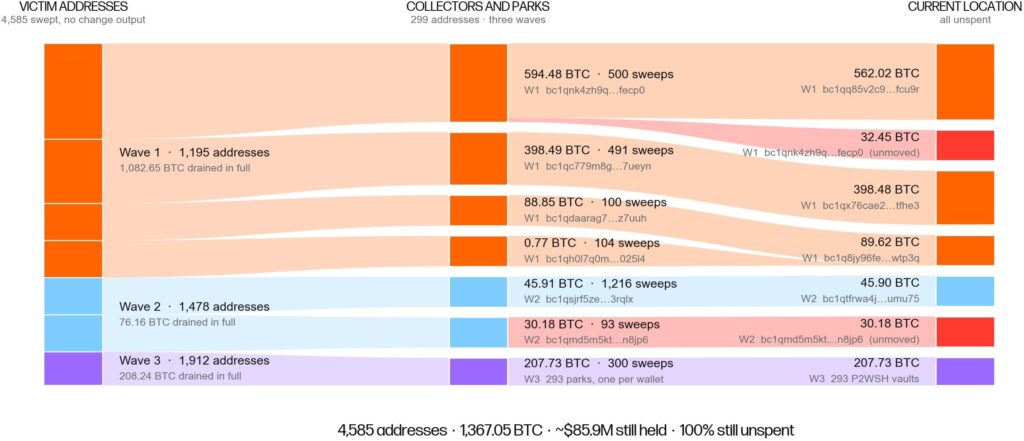
Coinkite says TAPSIGNER, SATSCARD, and OPENDIME products are not affected because they use different codebases. The company is continuing its investigation and plans to publish a detailed technical review.
What affected users should do now
Users who own a Coldcard should first verify whether their device is running the fixed firmware for its model.
Anyone who generated a seed on an affected firmware version should generate a new wallet only after updating, verify the new backup and receiving address, send a small test transaction, and then move the remaining funds. Users should keep the old backup until the migration is fully confirmed.
Those using a BIP-39 passphrase should continue to protect it and migrate to a new seed, while users who added at least 50 private dice rolls during seed generation are generally not considered at risk from this flaw.



Leave a Reply