

A study by Proton found tracker code associated with companies in China and Russia in many of the most downloaded free Android games in the US and Europe.
The findings raise questions about how much information games may collect, although the analysis does not establish what data the apps actually transmitted.
Proton examined the 100 most downloaded free mobile games on Google Play in each of the US, the UK, Germany, and France. It used AppTweak estimates for May 2026 downloads and Exodus Privacy reports to identify tracker signatures in the Android apps.
In the US, games containing trackers associated with Chinese entities accounted for 81% of the downloads Proton examined. Games with trackers linked to Russian entities accounted for 71%, while those with trackers linked to Israeli entities and companies in Five Eyes countries accounted for 95% and 98%, respectively. The figures reflect shares of estimated downloads, rather than shares of distinct games or users.
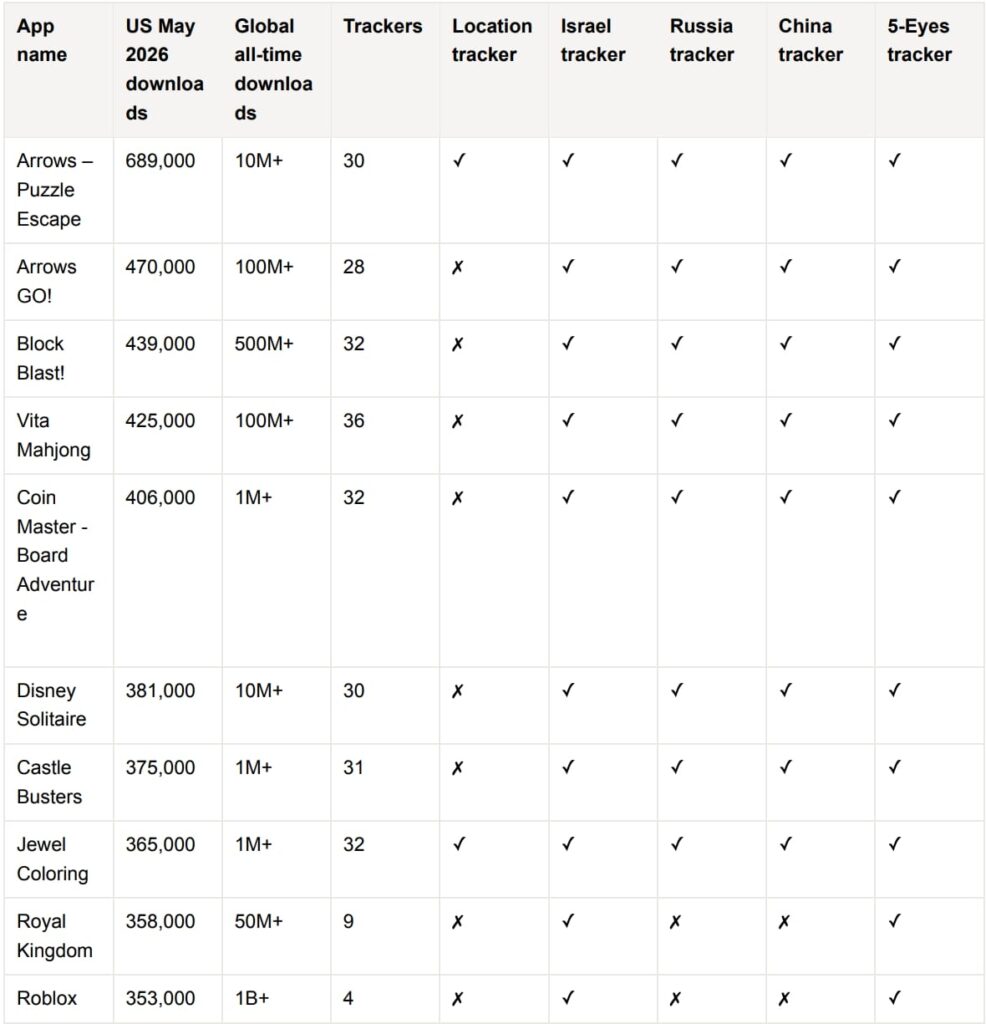
Proton
Trackers associated with Chinese entities appeared in games representing 84% of the examined downloads in the UK, 82% in Germany, and 78% in France. The corresponding figures for Russian entities were 74%, 69%, and 70%.
Dozens of tracker signatures in Android games
Among the titles listed in Proton’s findings are Block Blast!, Disney Solitaire, Subway Surfers, and Vita Mahjong. The report identifies 32 tracker signatures in Block Blast! and 36 in Vita Mahjong. It also flags location-related tracker code in games including Arrows – Puzzle Escape and Jewel Coloring.
These counts need careful interpretation. Exodus Privacy identifies known tracker code through static analysis of an app. A signature does not prove the tracker ran, accessed a particular category of personal data, or sent information to a company abroad. Proton’s report does not present network traffic captures showing the data transmitted by the games it examined.
This distinction matters especially for location. Proton lists seven games among its global top 100 with location-related tracking capabilities, including Pokémon GO, which uses location as part of its gameplay.
Even with that limitation, the study illustrates how many third-party components can be included in widely downloaded games. Advertising and analytics software can give developers ways to measure use and earn revenue, while making it harder for players to understand which companies may receive information generated as they play.
Players concerned about tracking can review a game’s permissions and privacy disclosures, deny location access when it is unnecessary, and remove games they no longer play. Tracker-blocking tools may also limit connections to known tracking domains, though they may not apply to every data-flow channel on Android.



Leave a Reply