

Mozilla is launching a new AI controls panel in Firefox 148, set to roll out on February 24, allowing users to fully block or selectively manage AI-powered features within the browser.
This move builds on Mozilla’s pledge to make artificial intelligence optional and transparent, reaffirming its position as a privacy-first player in an increasingly AI-saturated tech landscape.
The new feature introduces a dedicated “AI controls” section in Firefox’s desktop settings. From this panel, users can toggle a global switch labeled Block AI enhancements, which disables all current and future generative AI functions. Alternatively, individual features can be enabled or disabled based on preference. Preferences persist across browser updates and can be modified at any time.
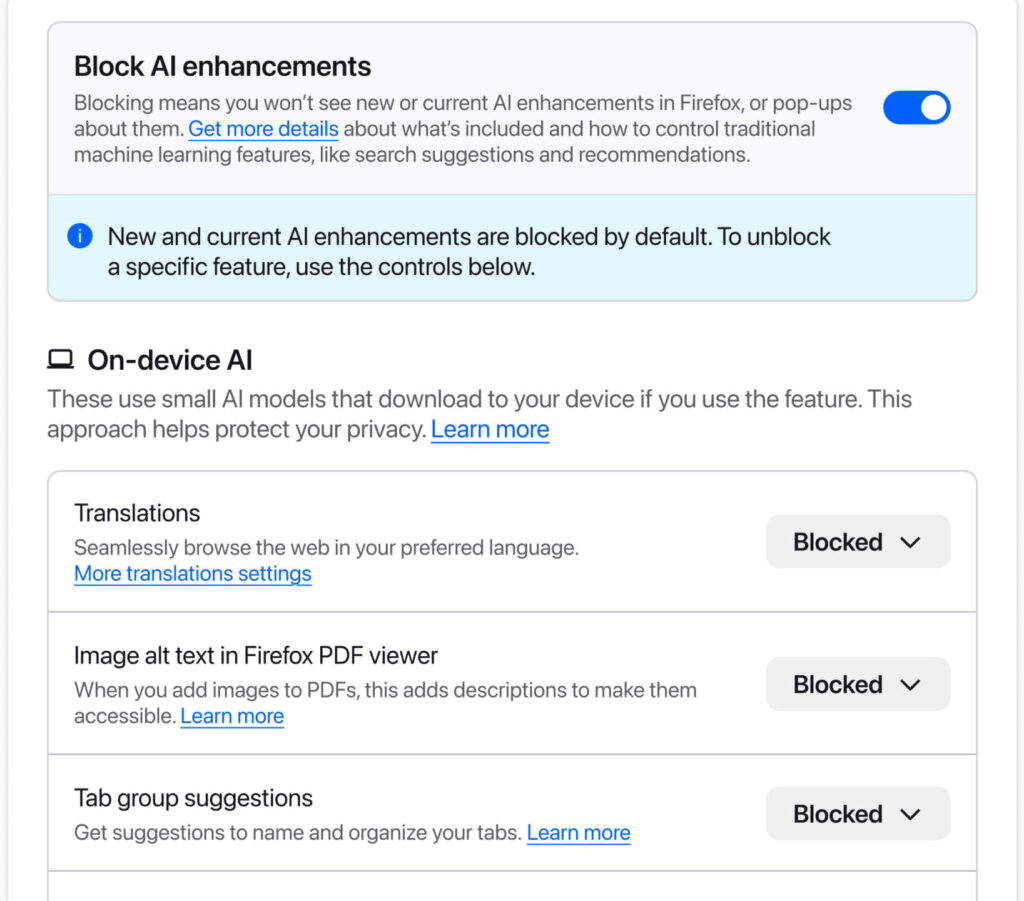
At launch, Firefox users will be able to manage the following AI features individually:
- Translations, for language conversion while browsing.
- Alt text generation in PDFs, adding image descriptions for accessibility.
- AI tab grouping, suggesting related tab clusters and group names.
- Link previews summarizing content before opening a page.
- Sidebar chatbot integrations, offering access to services like ChatGPT, Claude, Microsoft Copilot, Google Gemini, and Mistral’s Le Chat.
This update follows Mozilla’s December 2025 announcement, in which newly appointed CEO Anthony Enzor-DeMeo laid out the company’s AI roadmap. Enzor-DeMeo made it clear that Firefox would evolve into a next-generation browser enriched with AI tools, but only under conditions of full user control and transparency. At the time, he emphasized that Mozilla’s future AI features would ship with a clear “kill switch,” a promise now materializing in Firefox 148.
Mozilla’s approach is a direct response to growing concerns around AI privacy, user consent, and the increasing opacity of AI-enabled software. While many competing browsers have begun integrating generative AI features, often without granular opt-outs, Mozilla is attempting to carve out a distinct position by building AI “with consent baked in,” offering users fine-tuned control over each function.
With Firefox 148, Mozilla is betting that granular control will help it strike the right balance. By enabling users to opt in or out of AI on their own terms, the company positions itself as a browser developer that respects autonomy while still embracing innovation.
If you’re looking for completely AI-less browsers, potential options include the Firefox-based Tor browser or the power-user-focused Vivaldi, both of which have rejected AI.



Leave a Reply