

Researchers at the Swedish Defense Research Agency (FOI) have developed an AI system that uses Wi-Fi signals to identify people carrying concealed handguns.
The system, called WiFireNet, could eventually complement surveillance cameras and metal detectors, although the findings establish feasibility under controlled conditions rather than readiness for public security deployments.
The researchers also introduce WiFire, a dataset that pairs wireless measurements with camera footage to train and evaluate concealed weapon detection models.
The team frames Wi-Fi sensing as a way to address gaps in conventional screening. Cameras cannot directly see weapons hidden under clothing, while metal detectors typically require people to pass through narrow checkpoints and cannot distinguish different kinds of metallic objects.
Detecting weapons through wireless measurements
WiFireNet analyzes channel state information (CSI), measurements describing how a wireless signal travels between transmitters and receivers. Its neural network processes signal amplitude and phase, translates those measurements into an image-shaped representation, and predicts people’s locations and object classes in the scene.
Camera footage supplies training labels and helps teach the wireless model, but only Wi-Fi measurements are needed when the trained system makes predictions.
The experiments used a modified IEEE 802.11a implementation running through GNU Radio at 5.68 GHz with 20 MHz bandwidth. The setup therefore does not establish that an unmodified household router can perform the same task.
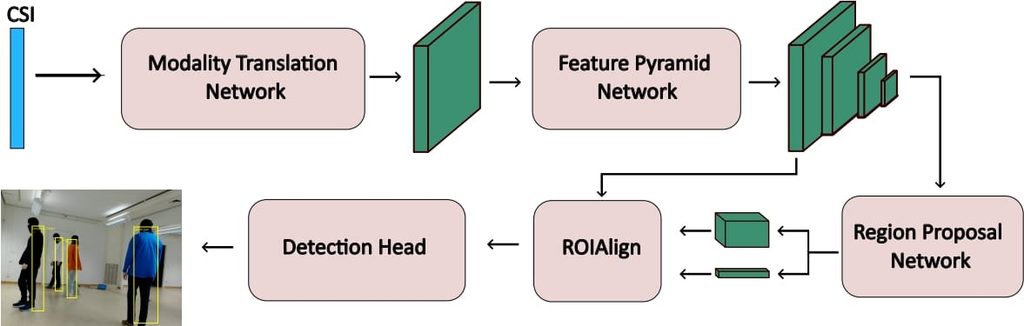
Arxiv.org
Participants moved within an eight-square-meter area with up to two people or a 12-square-meter area with up to four. At most one person carried a concealed, deactivated metal handgun. Other test objects included a plastic handgun, a metal water bottle, and a mobile phone, challenging the model to distinguish the weapon from items sharing its shape or material properties.
Promising results, with substantial limitations
The standard Wi-Fi configuration achieved an average precision of 72.5% for handguns at a lenient localization threshold, falling to 53.8% when predicted locations had to overlap more closely with the annotated locations.
Across the evaluated classes, mean average precision was 50.3% and 47.1% at those respective thresholds. These are detection benchmark scores, rather than a simple percentage of people correctly screened.
An experimental configuration using more pilot subcarriers to measure the wireless channel performed worse overall. The authors suggest that the relatively uncluttered environment and differences between recordings could explain the unexpected result, leaving that question for further research.
The evaluation also divided individual signal samples between training and testing. Consequently, it does not establish performance in entirely unfamiliar rooms or in separately recorded sessions, an important limitation for assessing deployment potential.
The ability to infer concealed objects without camera input also raises privacy questions around discreet screening.
The authors say they are releasing the dataset, model, and code to support further research.



Leave a Reply