

An Android app with camera permission can recover parts of speech played through a phone’s built-in speaker without microphone access.
On phones equipped with Android’s system-wide privacy toggles, the motion data behind the leak may keep flowing even when the camera or microphone access is disabled.
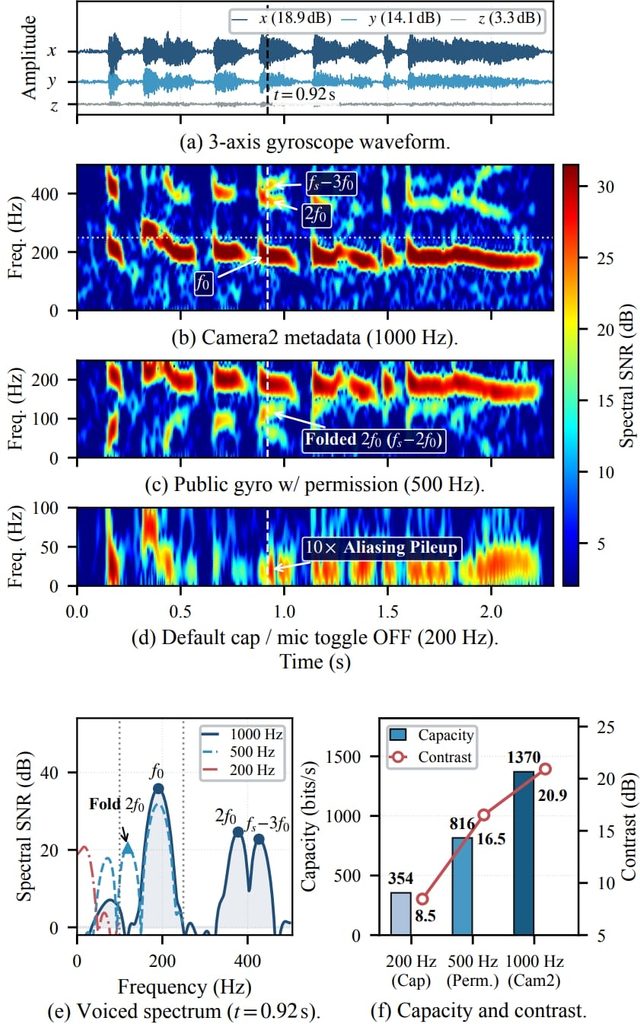
Zhejiang University and Wenjing Wang of the Electric Power Research Institute of Guangdong Power Grid described the findings in a preprint posted November 20, 2026. They examined 50 Android smartphones from 10 vendors, released between 2020 and 2026, and found that 37 exposed gyroscope data through Android’s Camera2 interface. On 26 phones, the data came through faster than the 200 samples per second normally allowed by Android’s motion-sensor interface.
arxiv.org
How camera stabilization leaks speech
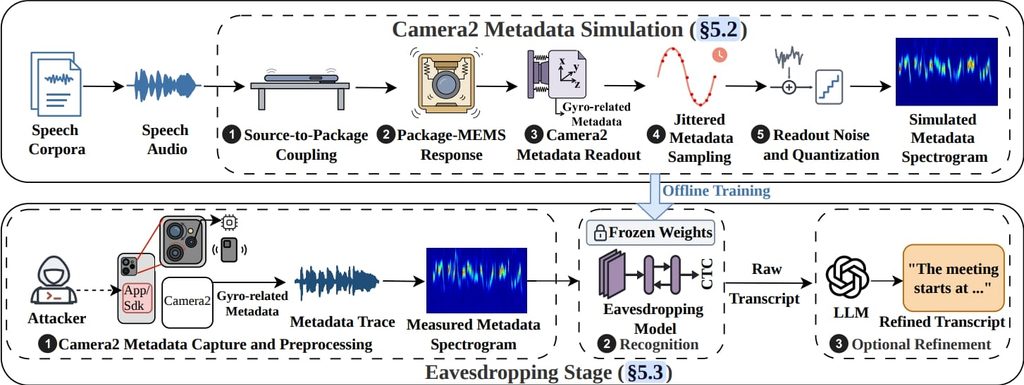
Phones use gyroscopes to measure motion and compensate for camera shake. When the built-in speaker plays speech, tiny vibrations travel through the phone’s chassis and show up in those same readings. During an active camera session, some manufacturers include high-frequency gyroscope readings in the metadata sent to apps alongside camera frames.
Android normally limits how quickly apps can read the gyroscope through its standard sensor interface and enforces that limit when microphone access is switched off. The camera metadata was available without the special permission for high-rate motion sensors. Turning off camera access produced blank frames, but apps that still held camera permission continued receiving the motion data.
arxiv.org
The six phones with the fastest readings, at roughly 800 to 1,000 samples per second, were the vivo X300s, X300 Pro and X200 Ultra, Xiaomi 17T Pro, Redmi K90 Max, and Honor Magic8 Pro Air. All six ran Android 16 during the speech recognition tests.
What the researchers could recover
The team trained a speech recognizer called CamEar on simulated vibrations and tested it on real readings from the six phones. With each phone resting on a table and playing English speech at full media volume, CamEar averaged 52.1% word accuracy and reached 61.8% on the best-performing device. Average accuracy fell to 34.7% at 80% volume and 19.2% at 60%.
The demonstration focused on sound coming from the phone itself, such as the remote side of a speakerphone call or a voice message. The researchers say earphone playback and ordinary room speech transfer little vibration to the handset. A malicious app or an embedded software component could potentially collect the readings during an active camera session.
The authors say they disclosed the issue to affected vendors and recommend keeping high-rate stabilization data away from third-party apps. In a follow-up test, reducing the data to Android’s usual sensor limit brought average word accuracy down to 2.3%. Users concerned about sensitive calls can use headphones and revoke camera permission for apps that do not need it.



Leave a Reply