
Proton has launched a free tool that shows users how much personal information ChatGPT and Claude may reveal through their conversation histories, highlighting the privacy risks of repeatedly sharing sensitive information with AI chatbots.
Called AI Paper Trail, the tool analyzes exported conversation data from OpenAI’s ChatGPT or Anthropic’s Claude and generates a personalized report detailing what can be inferred from a user’s chats. Proton said even seemingly harmless conversations can accumulate into a detailed profile covering a person’s work, relationships, identity, habits, and personal interests.
Users first need to export their conversation history from ChatGPT or Claude and upload the resulting file to AI Paper Trail. The tool then produces several assessments, including a “Privacy Type” based on the user’s approach to privacy and an “AI Exposure Score” calculated from the number of personal data points identified and how revealing they are.
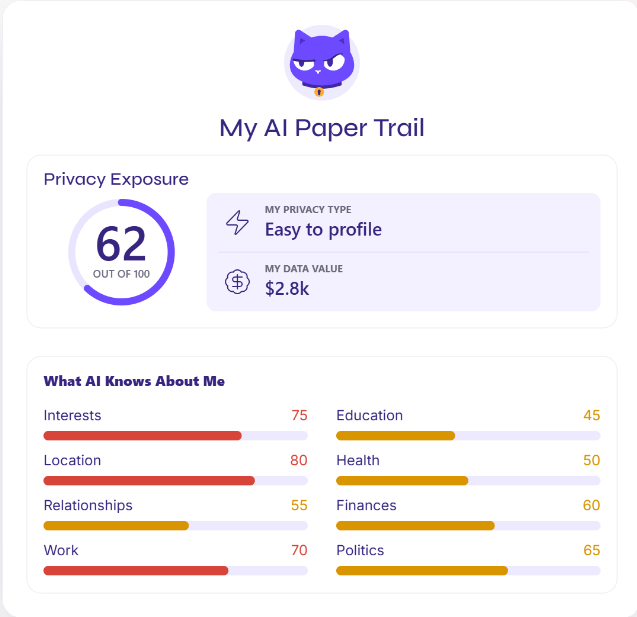
The report also includes a section showing what the AI may know about the user, such as information about their identity, relationships, habits, and other aspects of their personal life. Another feature estimates the monetary value of the user’s personal data to an AI provider, although Proton does not explain in detail how that figure is calculated.
The tool is intended to illustrate how information disclosed across months or years of conversations can become significantly more revealing than any individual prompt. Proton points to examples such as work-related requests, personal advice, travel plans, finances, health concerns, relationships, and other sensitive subjects that can collectively provide a detailed picture of an individual.
AI platforms can also collect information beyond the contents of conversations, including uploaded files, usage patterns, account information, and device and network data. Proton says some platforms may retain such information for extended periods, use it for model training, or share it with third parties depending on their policies and settings.
Proton said privacy was a key consideration in the design of AI Paper Trail. Uploaded conversation data is deleted after analysis and is not stored on Lumo’s servers, while the resulting report is visible only to the user. The tool can also generate a shareable version of the report that is designed to demonstrate AI privacy exposure without revealing the underlying personal information.
AI Paper Trail is part of Lumo, Proton’s privacy-focused AI assistant. Proton says Lumo does not retain conversation logs, uses zero-access encryption to protect chats, and does not use user conversations to train its AI models or sell the data. The tool currently supports exports from ChatGPT and Claude, with Proton saying support for additional AI platforms is planned.



Hi Alex,
I just used Brave A.I. to make recommendations and plan my transition from one banking company to another.
While I did not provide any person specific personal information or upload any of my docs, I do wonder if the information via general nature queries is potentially collated, stored or used. Brave seems to say at the high level that they do not do those things.
I have very good ad blocking which means to my my mind, that it is very difficult to serve me an ad but this does not mitigate the collection and use or my data.
What would be the advise?
Hi BoBeX, sounds like you are taking great precautions. Another private AI tool you could consider using is Lumo by the folks at Proton.
https://cyberinsider.com/proton-launches-lumo-2-0-with-advanced-reasoning-and-image-generation/