
An OpenAI engineer has been arrested and charged with allegedly planting a concealed audio recording device in an executive conference room at the company’s San Francisco offices.
OpenAI says it used its own AI models to investigate the device and identify the employee, who has since been fired.
The US Department of Justice identified the suspect as Abdulrahman Alfozan, a 35-year-old Saudi national who joined OpenAI as an engineer in July 2025. He was arrested on October 9 and made his initial appearance in federal court on October 13, charged with using or attempting to use a device to intercept oral communications.
According to the criminal complaint, OpenAI personnel discovered the recorder around September 30, plugged into a USB port behind a television. The device was concealed in toilet paper, contained encrypted contents, and prosecutors say it was installed around September 28.
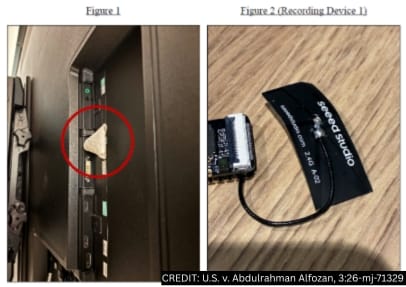
US DoJ
OpenAI, the artificial intelligence company behind ChatGPT, keeps its research and commercial plans closely guarded. Prosecutors say the targeted room regularly hosted discussions involving proprietary research, product plans, government engagements, commercial relationships, and other confidential technical and strategic information.
Surveillance footage and chatbot activity
Investigators cited CCTV footage showing Alfozan near the conference room on multiple occasions before the recorder’s discovery, despite lacking authorization to access the room or participate in its meetings.
The complaint also alleges that he used a productivity tool to research office addresses, meeting-room capacities and calendars, executive locations, and external partner meetings.
Separately, a chatbot account associated with Alfozan’s spouse allegedly submitted prompts between September 24 and September 30 concerning continuous audio recording, Wi-Fi connectivity, live listening, concealment, remote access, and SD-card encryption. Prosecutors say that the account shared several identifiers and attributes with Alfozan’s own account.
Some prompts allegedly referenced the discovered recorder’s custom header and unique MAC address, a hardware identifier used in network communications.
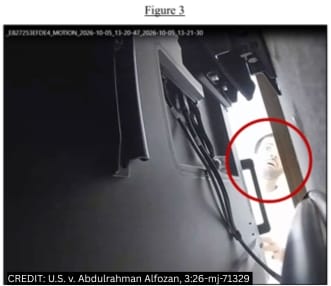
On October 5, CCTV footage allegedly captured Alfozan entering the conference room and looking behind the television. That same day, OpenAI security personnel found a second, similar recording device inside a bag he had left unattended elsewhere in an OpenAI building. The bag also contained his wallet and identification.
OpenAI says no indication of customer data theft
In its October 13 statement, OpenAI said its models helped it understand the device and trace its origins, leading the company to identify an employee and refer the matter to the FBI. It did not explain which models or investigative techniques it used.
The company said it currently has no indication that the individual improperly accessed or exfiltrated model weights, source code, or customer data. Neither supplied announcement establishes what conversations, if any, were captured or whether recordings reached another party.
Federal officials framed the case as a national security matter involving protection of American AI technology. However, the DOJ announcement does not identify a foreign sponsor or allege that Alfozan acted on behalf of the Saudi government.
The FBI investigation remains ongoing. If convicted, Alfozan faces up to five years in prison, a $250,000 fine, and three years of supervised release. The allegations have not been proven in court.



Leave a Reply