
Meta is expanding its Private Processing infrastructure to AI glasses, allowing cloud-based AI to analyze personal context while preventing Meta itself from accessing the underlying data.
The system combines confidential computing, hardware-backed isolation, anonymous routing, remote attestation, and encrypted storage to protect information during processing.
Meta engineers Pritam Shah and Oskar Linde said increasingly capable AI glasses cannot rely entirely on local processing. Features such as streaming transcription, contextual search, long-term recall, and proactive assistance require larger AI models and persistent state that exceed the compute and storage available on wearable devices.
Meta, which operates Facebook, Instagram, WhatsApp, and its Meta AI services, has been investing heavily in AI-powered wearables, including its smart glasses products. The privacy challenge is significant because glasses can continuously encounter highly sensitive information about a user’s surroundings, conversations, routines, and relationships.
Private Processing, also used on WhatsApp, extends the trusted boundary from the glasses into Meta’s data centers. AI workloads execute inside confidential virtual machines (CVMs) running within Trusted Execution Environments, or TEEs, supported by compatible CPUs and GPUs.
Unlike conventional cloud systems, where encrypted information must normally be decrypted in host memory for processing, TEE hardware encrypts CVM memory using keys unavailable to the host operating system, hypervisor, infrastructure administrators, or Meta.
Before glasses send private context to the cloud, the system also attempts to separate requests from user identities. Devices obtain blind-signed anonymous credentials on randomized schedules and route connections through third-party Oblivious HTTP relays operated by Fastly or Cloudflare. A processing node is then selected without relying on user-identifying information.
The glasses verify that node using remote attestation over RA-TLS. The TEE provides hardware-signed measurements of the software it is running, which the client compares against vendor certificates and hashes recorded in an append-only, independently witnessed transparency ledger. If the verification fails, the device refuses to send data.
Persistent information receives additional protections. When AI features need to remember data between sessions, the system encrypts information using user-provided keys before it leaves the TEE. Meta stores only ciphertext, while decryption and searches occur inside the protected environment.
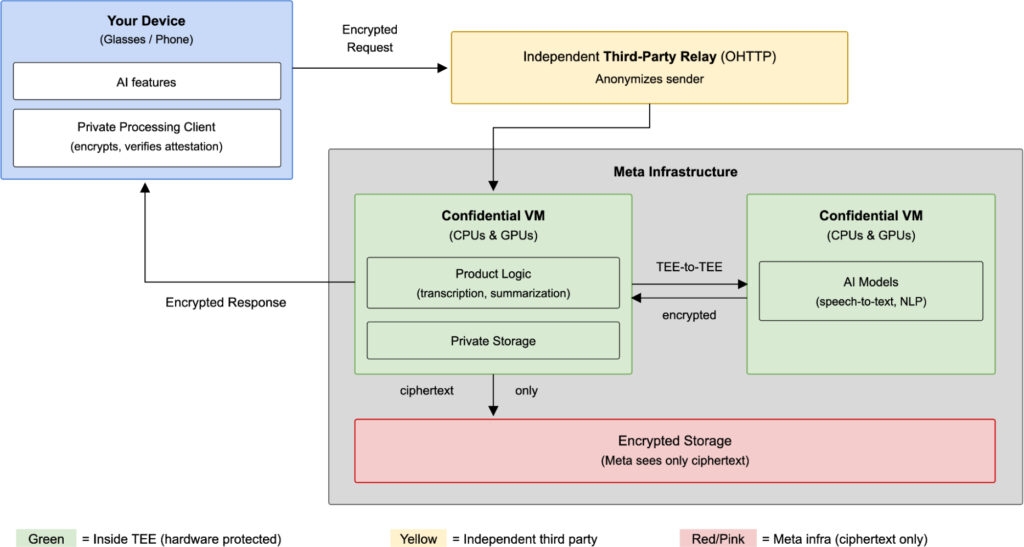
Meta says it also placed the storage engine inside the TEE to reduce privacy leakage from database access patterns. An external encrypted database could still reveal when records are accessed, how frequently requests occur, and which records are queried together, potentially exposing behavioral patterns even without revealing their contents.
Stronger isolation, however, comes with certain operational limitations. Meta engineers cannot attach debuggers to running TEEs, inspect memory dumps, or examine AI prompts and responses following failures. Instead, the company says it monitors aggregate metrics such as CPU usage, memory allocation, latency, and hardware failure rates.
Meta is expanding its bug bounty program to include Private Processing for AI glasses and plans to provide researchers with CVM binaries and documentation. It also says independent security firms, including NCC Group, are involved in reviewing the architecture.



Leave a Reply