If you’re looking for a Mullvad dedicated IP, the short answer is still a firm “no.”
Their reasoning is simple: A dedicated IP is a permanent digital breadcrumb that links your online activity to a single identity. To preserve your anonymity, Mullvad exclusively uses shared, rotating IPs that mix your traffic with thousands of other users.
While this strength-in-numbers approach is perfect for privacy, it creates massive friction for my daily workflow. Without a dedicated IP, I’m constantly hit with “prove you’re a human” CAPTCHAs, and my banking apps often flag my rotating location as suspicious.
In short, if you need a consistent online identity for remote work or secure servers, Mullvad’s current setup likely isn’t for you. Fortunately, four expert-tested alternatives bridge the gap perfectly.
Top 4 alternatives for a dedicated IP with Mullvad
Since Mullvad isn’t an option for static IPs, I’ve vetted the best providers that offer dedicated addresses without compromising your security. Here is how they stack up this year:
- NordVPN – The best overall. With dedicated IPs in 28 countries and new post-quantum encryption, it’s the most feature-rich alternative (with a 75% off coupon here).
- Surfshark – The best value. It offers unlimited simultaneous connections and a budget-friendly dedicated IP add-on in over 15 locations.
- ExpressVPN – The privacy pro. Their unique blinded-token system ensures they can’t trace your dedicated IP back to you — a feature even Mullvad would respect.
- Proton VPN – The Swiss powerhouse. Based in a privacy haven, Proton offers dedicated VPN servers for business users who need a hardened, static gateway.
Why Mullvad refuses dedicated IPs
Over years of evaluating privacy tools, I’ve consistently seen Mullvad stand out as one of the few providers that strongly stick to its anonymity-first philosophy. To them, a dedicated IP is a permanent digital fingerprint. Even if a third party doesn’t know your name, they can still track your specific online patterns, habits, and recurring logins because your IP never changes.
Mullvad has taken the road less traveled; it simply does not provide dedicated IP addresses. It’s official FAQ confirms that they only offer shared IP addresses because they believe your traffic should always “blend in” with everyone else’s to maintain high-level anonymity.
Why I find their shared IP strategy effective:
- The masquerade effect: Mullvad uses shared IP addresses to mix your traffic with thousands of other users simultaneously. It’s like a digital masquerade ball where everyone wears the same mask, making it nearly impossible for trackers to identify a single participant.
- No personal data required: I love that Mullvad diverges from traditional services that require emails or passwords. Instead, they assign a random 16-digit account number. This means I didn’t have to share any personal info just to sign up.
- Strict no-logs policy: They do not retain any user activity logs, ensuring your behavior remains truly private. This is a key differentiator I noted in my Mullvad vs NordVPN comparison.
While this strength-in-numbers approach is elite for privacy, I’ve noticed it can be a double-edged sword. Because you’re sharing an IP, you’re more likely to run into blocked websites or endless CAPTCHAs. If you need a consistent identity for banking or work, this is where alternatives like NordVPN or ExpressVPN become essential.
Dedicated IPs vs anonymity
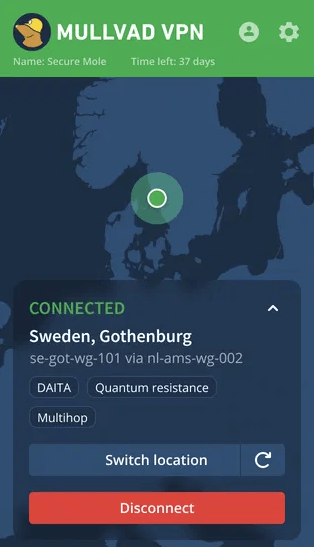
In my experience, choosing a dedicated IP is the ultimate balancing act. On one hand, you get a consistent online identity that stops those soul-crushing CAPTCHAs and lets you log into your bank without a security heart attack. On the other hand, a static IP is a permanent digital fingerprint. Even if a website doesn’t know your name, it can profile you simply because your IP never changes.
Mullvad remains the most vocal critic of this trade-off. They argue that as soon as you’re the only person using an IP, you lose the crowd protection that makes a VPN effective. By refusing to offer dedicated IPs, Mullvad ensures your traffic is always buried among thousands of others, making it nearly impossible for advertisers or trackers to build a reliable profile of your habits.
Mullvad VPN’s account system
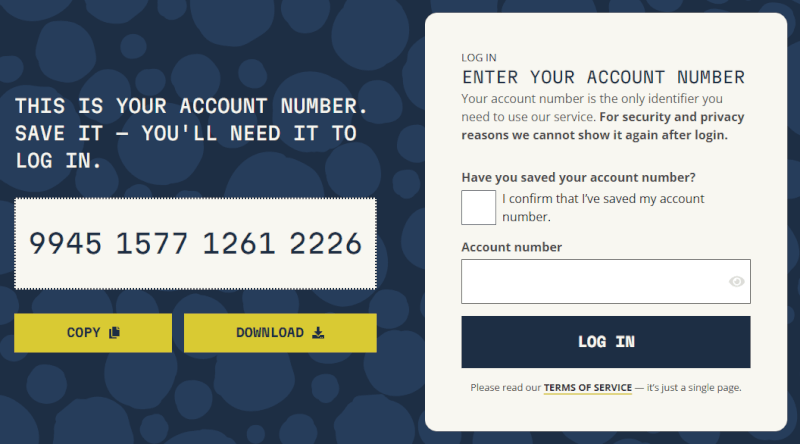
Mullvad’s signup process is the most anonymous I’ve ever tested. Unlike NordVPN or ExpressVPN, which require an email address to manage your subscription, Mullvad doesn’t want to know who you are. You simply click “Generate Account” on their site, and they hand you a random 16-digit number. That’s it, no name, no phone number, and zero personal data linked to your identity.
The good and the risk:
- Perfect privacy: Since there’s no email on file, there’s nothing for a hacker (or a government) to subpoena. You are truly just a number in their system.
- The “lost key” risk: The biggest downside I’ve found is that if you lose that 16-digit code, your account is gone forever. There is no “forgot password” link because there’s no email to send it to.
- Payment stealth: To stay totally off the grid, I recommend using their cash-by-mail option or Monero. Even if you use a credit card, Mullvad’s system is designed to purge payment links as quickly as possible.
While this system is a dream for privacy purists, it’s a hurdle if you’re used to the convenience of modern account recovery.
Why some users need a dedicated IP
Even though I admire Mullvad’s hardline privacy stance, the reality of the internet makes shared IPs a struggle for some. If you’ve ever been locked out of your bank or forced to solve ten CAPTCHA in a row, you’ve felt the bad neighbor effect of a shared IP.
In my testing, these are the primary reasons I see users switching from Mullvad to a dedicated provider:
- Total server control: For power users, a dedicated IP allows for easier port forwarding and hosting personal home labs.
- Seamless remote work: Many corporate databases and secure servers require an IP whitelist. Without a static address, you’ll be blocked every time your VPN rotates your IP.
- Smooth online banking: Financial apps hate hopping locations. A dedicated IP keeps your connection looking consistent, preventing those annoying account freezes.
- Bypassing stealth blocks: Streaming services and gaming platforms are getting better at flagging shared VPN ranges. An exclusive IP is far less likely to be blacklisted.
It’s important to address the privacy paradox Mullvad warns about. When you use a dedicated IP, you lose the safety in numbers of a crowd. However, top-tier providers like NordVPN and Proton VPN have mitigated this by using audited, zero-knowledge hardware. They ensure that while your IP is static for your use, they still don’t keep logs that could link that IP to your physical identity.
The role of dedicated IPs in bypassing CAPTCHAs
One of the biggest wins for a dedicated IP is ending the CAPTCHA gauntlet. These scripts are designed to spot automated bot traffic, and when thousands of people share a single VPN IP, websites start to see that address as a red flag. This leads to those endless puzzles where you’re picking out fire hydrants to do a simple Google search.
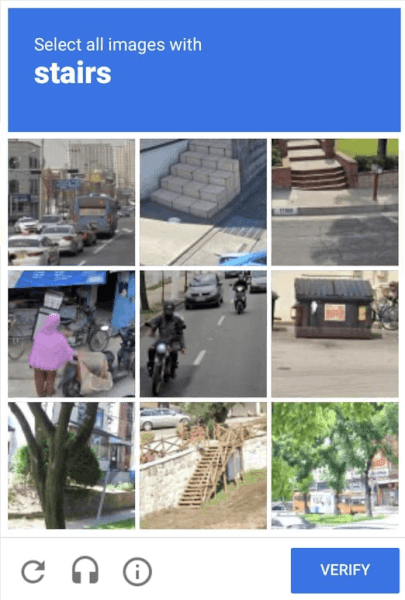
A dedicated IP provides a unique, consistent identity that only you use. Because there isn’t a crowd of bad neighbors triggering security alerts, search engines and banking sites are far less likely to flag your connection as suspicious. It’s a massive quality-of-life upgrade if you’re tired of being treated like a bot every time you log in.
How this impacts your browsing:
- You’ll see significantly fewer “prove you’re human” prompts on sites like Google, AWS, and GitHub.
- By being the sole user, you build a clean slate reputation for your IP, preventing false alarms from fraud engines.
- You bypass the “unusual traffic” warnings that often block shared VPN users from accessing sensitive financial tools.
Accessing restricted networks and services
Another major benefit of dedicated IPs is their ability to access restricted networks and services that a shared VPN simply can’t reach. In my experience, dedicated IP addresses are now essential for establishing secure connections to specific resources that require a whitelisted identity. They facilitate seamless access to private networks, making them a must-have feature for anyone managing a remote team or a home server.
Services and networks that enforce strict access controls (or even simple geo-restrictions) rely on your IP address to verify who you are. By using a dedicated IP, you can effectively bypass these limitations, providing dependable access to sensitive company data or regional content that might otherwise be blocked by the rotating nature of a standard VPN like Mullvad.
Alternatives to dedicated IPs with Mullvad VPN
While Mullvad refuses to offer dedicated IPs, they do provide a static-like alternative for users who need a bit more consistency than a standard rotating VPN.
Mullvad’s static IP-like service
Even though Mullvad doesn’t provide traditional static IPs, they assign a public IP address that is stored in memory solely for the duration of your connection. In my testing, I’ve found that this address is promptly deleted the moment you disconnect, in line with their strict RAM-only server policy. It’s a great middle ground if you just need a stable connection for a few hours, but it won’t help with long-term whitelisting for work or banking.
The death of port forwarding
It’s important to note that port forwarding (a feature many used as a workaround for dedicated IPs) is no longer available on Mullvad. This was once a go-to for hosting websites or managing game servers, as it allowed you to direct incoming traffic through a specific port on your VPN server.
Unfortunately, as I’ve followed in recent years, some users have abused this feature to host malicious services from Mullvad’s infrastructure. This led to a wave of law enforcement inquiries, blacklisted IPs, and hosting providers dropping Mullvad’s accounts entirely. As a result, Mullvad made the tough call to remove all forwarded ports and ban the creation of new ones.
Mullvad’s strengths and weaknesses
| VPN | Mullvad |
| Based in | Sweden |
| Logs | No logs |
| Price | $5.86/mo. |
| Support | |
| Refund | 30 days |
| Website | Mullvad.net |
Mullvad remains the purist’s choice for anonymity, but that hardline stance comes with real-world trade-offs. Here is my breakdown of where this VPN shines and where it hits a wall.
Why privacy pros like Mullvad:
- Strong encryption standards: Mullvad doesn’t cut corners. They use AES-256 for OpenVPN and ChaCha20 for WireGuard. As of today, they’ve also fully integrated post-quantum encryption, protecting your data against future decryption threats.
- Audited no-logs policy: Their claims aren’t just marketing. Mullvad’s infrastructure is regularly audited by third parties like Assured AB, proving they truly do not store your IP, browsing history, or connection logs.
- The “ghost” account system: I love that I don’t need an email or password to sign up. The 16-digit random ID system is the most anonymous setup in the industry.
- Advanced security features: You get a rock-solid kill switch, multi-hop (double VPN) for extra layers of encryption, and DNS filtering to block ads and trackers at the source.
- Transparent pricing: While others use introductory rates that spike after a year, Mullvad has kept a flat €5/month price since 2009.
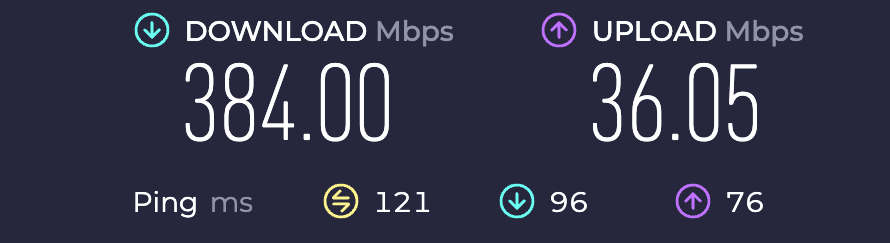
In recent speed benchmarks, Mullvad delivered underwhelming performance, recording a top speed of only 384 Mbps on a 1,000 Mbps lab connection via the Seattle route. This result falls significantly short of competitors Surfshark and NordVPN, which achieved over 750 Mbps and 900+ Mbps on the same route, respectively.
Other areas where Mullvad falls short:
- Streaming struggles: If you want a VPN for Netflix, BBC iPlayer, or Disney+, look elsewhere. As we found in our Mullvad review, Mullvad often fails to unblock these services because its smaller server network is more easily identified and blocked.
- Speed and stability issues: In my latest benchmarks, Mullvad’s performance was middle-of-the-pack. While I hit 384 Mbps on a Seattle route, it felt sluggish compared to Surfshark (750+ Mbps) or NordVPN (900+ Mbps). The speeds can be highly variable depending on the time of day.
- The CAPTCHA nightmare: Because Mullvad refuses to offer dedicated IPs, you are constantly sharing addresses with hundreds of other users. This leads to frequent and annoying “prove you’re human” prompts on Google and other secure sites.
- Small server footprint: With under 600 servers, Mullvad is tiny compared to NordVPN’s 9,300+ or Proton VPN’s 20,000+. This smaller pool leads to faster congestion and more frequent IP blocking by third-party services.
- No port forwarding: This was once a core feature, but Mullvad removed it permanently due to abuse. For power users needing to host servers or game with an open NAT, this is a major deal breaker.
Mullvad pros and cons
+ Pros
- Strong privacy and security features
- Dedicated apps for Windows, macOS, Linux, Android, and iOS
- No IP address or DNS leaks detected
- Audited
- Accepts private payments
– Cons
- Smaller server network
- Above average prices
- Captcha issues affect usability
- Does not work well for streaming
Mullvad’s plans and pricing
| Mullvad plan | Price (monthly) | Total cost |
| 1 month | €5 | €5 |
| 1 year | €5 | €60 |
| 1 decade | €5 | €600 |
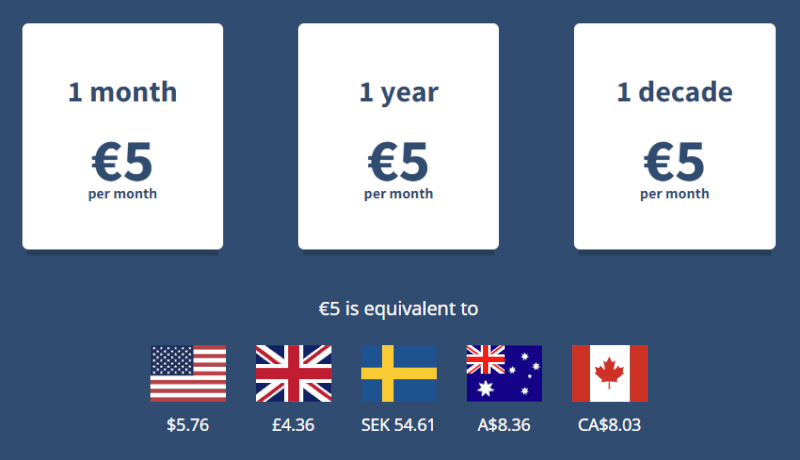
In an industry full of “80% off” sales and hidden renewal hikes, Mullvad is a breath of fresh air. Since 2009, they’ve maintained a flat subscription price of €5 (roughly $5.86) per month. Whether you sign up for 30 days or three years, the price never changes. While this doesn’t land them in the low-cost category (where brands like Surfshark offer plans under $3.00) you’re paying for the peace of mind that your rate will never suddenly double.
Each account still supports five simultaneous connections, which is standard, though a bit low compared to the 10+ devices we now see from NordVPN or ExpressVPN. However, where Mullvad really wins is in payment anonymity. They don’t just “accept” private payments; they encourage them.
Available payment methods:
- Physical cash: I can literally mail an envelope of cash to their headquarters in Sweden with my 16-digit account number. No paper trail, no digital footprint.
- Cryptocurrency: Full support for Bitcoin, Bitcoin Cash, and Monero (XMR), which is the gold standard for untraceable transactions.
- Standard options: They still accept bank wires and credit cards for those who prioritize convenience over total stealth.
The best part? Because Mullvad doesn’t use an email-based account system, they don’t need any personal info during the checkout process. Whether I’m paying with Bitcoin or a bank wire, my identity remains decoupled from my VPN usage. It’s a level of financial privacy that most other providers simply can’t match.
Mullvad VPN vs the top dedicated IP providers
| Mullvad | NordVPN | Surfshark | |
| Dedicated IP | ❌ | ✅ 28 countries | ✅ 15+ countries |
| Peak speed | 384 Mbps | 900+ Mbps | 750 Mbps |
| Device limit | 5 | 10 | Unlimited |
| Signup info | Random ID only | Email required | Email required |
| Best for | Stealth purists | Power users and streaming | Families and budget |
While I admire Mullvad’s stance on anonymity, it’s a completely different beast compared to the industry titans. If you’re torn between pure stealth and daily usability, here is how the current landscape looks.
Mullvad VPN vs NordVPN
In my testing, NordVPN consistently wins on raw power. It delivers significantly faster speeds (900+ Mbps vs. Mullvad’s 384 Mbps), a massive network of 9,300+ servers, and a dedicated IP system available in 28 countries. If you need a VPN for Netflix, secure banking, or whitelisting a remote work IP, NordVPN is the superior tool.
However, Mullvad’s commitment to “ghost” accounts remains unrivaled. While NordVPN requires an email and has a more traditional corporate structure, Mullvad lets me sign up with a random number and pay in cash.
Mullvad VPN vs Surfshark
When stacked against Surfshark, Mullvad struggles to hold its own on value. Surfshark is one of the best cheap dedicated IP VPNs I’ve benchmarked, offering a static IP add-on for just a few dollars. Plus, Surfshark’s support for unlimited simultaneous connections makes it a better fit for a household full of devices.
In my speed tests, Surfshark nearly doubled Mullvad’s performance, hitting over 750 Mbps. While Mullvad offers better financial privacy (like Monero support), Surfshark provides a much smoother experience for streaming and daily browsing without the constant “Shared IP” blocks.
Mullvad VPN vs ExpressVPN
When I stack Mullvad against ExpressVPN, the conversation shifts to high-end privacy tech. ExpressVPN’s standout is its blinded-token dedicated IP system, which mirrors Mullvad’s zero-knowledge philosophy better than anyone else. While Mullvad refuses to offer dedicated IPs to avoid any trace, ExpressVPN uses advanced encryption to ensure they can’t link your static IP back to your account.
In my lab tests, ExpressVPN delivered peak speeds on par with the industry leaders (718 Mbps), and its app remains the most user-friendly on the market. If you want a dedicated IP that feels as private as a Mullvad shared connection, ExpressVPN is the winner. If you want a flat €5 price and the ability to pay with physical cash, stick with Mullvad.
If you want to see how Mullvad and ExpressVPN compare, check out our Mullvad vs ExpressVPN comparison guide.
Mullvad VPN vs Proton VPN
Comparing Mullvad to Proton VPN is a battle between two of the most respected names in the industry. Based in Switzerland, Proton VPN offers a middle ground: It has the open-source transparency of Mullvad but adds the high-end features Mullvad lacks, like dedicated servers for business and power users. Proton’s Secure Core feature is particularly impressive, routing your traffic through hardened Swiss servers before hitting your exit point.
Mullvad is still the better pick for one-off anonymity because of its random 16-digit account IDs. However, for now, Proton VPN offers a much more robust ecosystem, including encrypted email and cloud storage. If you need a dedicated IP backed by Swiss privacy laws and a faster, more global network, Proton is the way to go.
To see how Proton VPN and Mullvad match up, check out our Proton VPN vs Mullvad comparison for the latest information.
Navigating the Mullvad app
Getting started with Mullvad is a different experience from that of mainstream VPNs. There are no passwords to remember, no email verification loops, and no marketing pop-ups. It’s a utility-first interface that I find surprisingly refreshing.
My 3-step setup:
- Generate your identity: Head to the Mullvad website and click “Generate Account.” You’ll instantly get a unique 16-digit number. Write this down immediately — it is your only way to log in.
- Add your credit: Top up your account using anything from Monero (XMR) to physical cash in an envelope.
- Launch the app: Download the client for your device (Windows, macOS, Linux, iOS, or Android). Just enter your 16-digit code, and you’re connected.
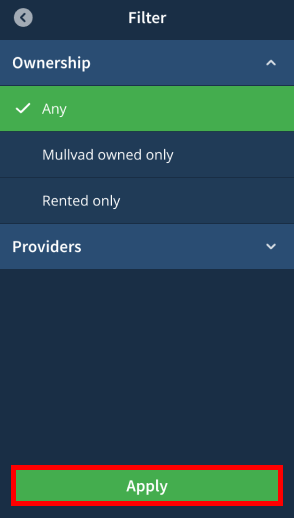
The interface is incredibly clean, featuring an interactive map for quick city and server selection. But under the hood, I’ve found some powerful customization options that make it a top choice for ease of use:
- One-click connectivity: The “Secure My Connection” button is front and center. I love the Auto-Connect feature, which ensures my traffic is encrypted the moment my device wakes up.
- Protocol selection: You can easily toggle between WireGuard (which I recommend for breakneck speed) and OpenVPN for older network compatibility.
- Local network sharing: I find this essential when I need to access my wireless printer or a local NAS while keeping my web traffic hidden.
- Advanced content blocking: Much like Surfshark’s CleanWeb, Mullvad now offers DNS-level toggles to strip out ads, trackers, and malware before they ever hit your browser.
The leak-proof kill switch
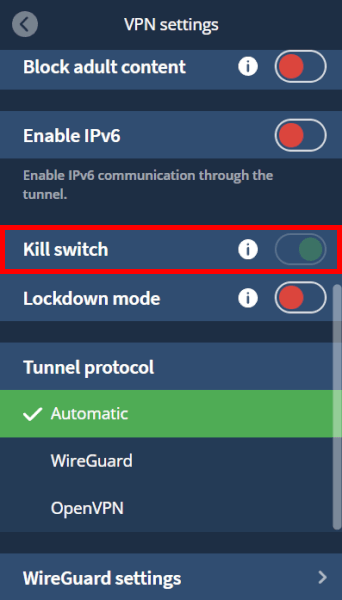
In my testing, Mullvad’s kill switch is one of the most reliable in the industry. It’s built-in and always on, meaning if your VPN connection drops for even a second, your internet cuts out instantly. While this can be a bit jarring if you aren’t expecting it, it’s the only way to ensure your real IP address is never accidentally exposed to the sites you’re visiting.
Mullvad’s customer support
In an era where every major VPN offers a 24/7 live chat bubble, Mullvad sticks to its no-data roots. You won’t find a chatbot or a live support agent waiting to ping you on their website. Instead, Mullvad relies on a traditional email-based system via support@mullvad.net.
In my experience, this is a bit of a double-edged sword. While their responses are incredibly technical and helpful (usually coming from someone who actually understands the WireGuard protocol) the lack of an instant response can be frustrating. If you’re in the middle of a time-critical task and your connection drops, waiting a few hours for an email reply feels like an eternity.
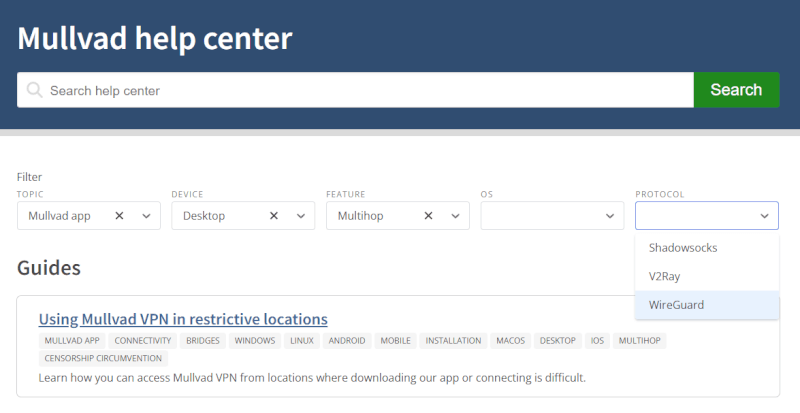
On the bright side, their self-help library is one of the best I’ve used. Whether you’re setting up a split-tunneling config or trying to get the app running on a niche Linux distro, their step-by-step guides are clear and fluff-free.
Before you hit “send” on that email, I highly recommend checking their system status page. Because Mullvad has a smaller server network (under 600 servers), localized outages happen. Checking the status first has saved me from sending a support ticket more than once!
Verdict: Is Mullvad right for you?
Mullvad VPN remains the industry’s anonymity purist, but its refusal to offer a Mullvad dedicated IP makes it a specialized tool rather than a general-purpose one. By prioritizing shared, rotating IPs and post-quantum encryption, Mullvad helps you stay off the radar online. However, as I’ve found in my latest tests, this stealth-first approach comes with the high cost of constant CAPTCHA challenges, slower speeds, and being blocked by essential banking or work networks.
If you don’t mind the friction of a shared IP for the sake of peak privacy, Mullvad’s unique no-email account system and flat €5 pricing are unbeatable. But if you actually need to use the modern web without a security heart attack every time you log in, you need a provider that bridges the gap between stability and security.
The best Mullvad alternatives for a dedicated IP
If you’ve realized that a static identity is non-negotiable for your workflow, I recommend these two powerhouses:
- NordVPN: This is my top pick for a dedicated IP. It offers the best balance of speed (900+ Mbps) and a massive network across 28 countries. It effectively solves the CAPTCHA problem while maintaining high-end security.
- Surfshark: If you’re on a budget but need a dedicated IP on unlimited devices, Surfshark is the best value choice right now. It’s significantly faster than Mullvad and much better for streaming Netflix or Disney+.
Mullvad dedicated IP not available FAQs
No, Mullvad VPN does not offer dedicated IP addresses and has no plans to add them. I’ve found that they remain one of the few hardline privacy providers that exclusively use shared, dynamic IPs to ensure your traffic is always hidden in a crowd. While this makes it impossible for them to link a specific IP to your 16-digit account number, it does mean you’ll have to deal with more CAPTCHAs and potential blocks from banking sites that prefer a static identity.
Mullvad refuses to offer dedicated IPs because they view a static address as a digital fingerprint that compromises your anonymity. In my experience, their philosophy is built on the idea that if you are the only person using an IP, it becomes much easier for third parties to track your online patterns over time. By forcing everyone onto shared IPs, Mullvad ensures that your browsing habits are mixed with those of thousands of other users, making it nearly impossible to pin any single action on you.
The best all-around alternative to Mullvad is NordVPN, which offers dedicated IPs in 28 countries. If you love Mullvad’s privacy but need a static address, NordVPN is my top pick because it combines high speeds (900+ Mbps) with audited security. For those on a budget, Surfshark is another excellent choice, offering dedicated IPs and unlimited device connections for a significantly lower monthly price.
No, you can no longer use port forwarding as a workaround because Mullvad permanently removed the feature in 2023. While many power users previously used porting for “static-like” functions, Mullvad cancelled the service due to systemic abuse by malicious actors. If you require port forwarding alongside a dedicated IP, I recommend looking at Proton VPN instead.
Yes, using Mullvad often results in a higher frequency of CAPTCHA because many users are crowded onto the same IP address. When a website sees massive traffic coming from a single IP, its security filters often flag it as a bot. This is the main “usability tax” you pay for Mullvad’s high privacy; if you’re tired of picking out traffic lights and storefronts, switching to a dedicated IP from ExpressVPN is the only real fix.

Leave a Reply