

An unpatched vulnerability in HP ThinPro 8 and 9 allows attackers with physical access to bypass the operating system’s TPM-backed full-disk encryption protections and recover the key securing the device’s root partition.
The zero-day remained without a publicly available fix when researcher Darren McDonald disclosed it on August 8, nearly six months after first reporting the issue to HP.
Security researcher Darren McDonald discovered the weakness while examining thin-client disk encryption implementations in early 2026. Testing on second-hand HP t530 and t540 systems showed that ThinPro’s Trusted Platform Module (TPM) verifies only part of the boot chain before releasing the LUKS encryption key.
ThinPro stores its operating system on a LUKS2-encrypted Btrfs partition and seals the encryption key inside the TPM. HP ThinPro is a Linux-based operating system designed primarily for HP thin clients used in enterprise environments such as virtual desktop deployments, call centers, healthcare facilities, kiosks, and other centrally managed workplaces.
The problem lies in what the TPM checks before unsealing the key. McDonald found that HP’s policy uses TPM Platform Configuration Registers (PCRs) 0, 2, and 4, covering the BIOS firmware, option ROMs or UEFI drivers, and the GRUB bootloader.
However, the policy does not include measurements covering the files subsequently loaded by GRUB, including the Linux kernel and initramfs.
That gap allows someone with access to the device’s storage to modify the initramfs without changing the PCR values required by the TPM.
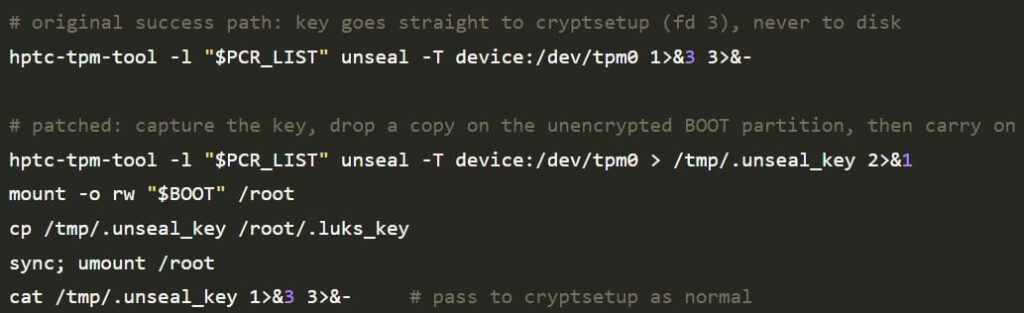
McDonald demonstrated the attack by removing the M.2 SATA drive, modifying the unseal_key shell script stored inside the initramfs on the unencrypted boot partition, and reinstalling the drive.
During the next startup, the measured components remained unchanged, so the TPM released the legitimate disk-encryption key. The modified script then copied that key onto the unencrypted boot partition while still passing it to cryptsetup, allowing the machine to boot normally without obvious signs that anything had changed.
After removing the drive again, an attacker could retrieve the raw 32-byte LUKS key and decrypt the protected partition offline.
AmberWolf
McDonald confirmed the process on an HP t530 running ThinPro 8.1.0 build 22 and an HP t540 running ThinPro 9.0.0 build 15. The decrypted data included device configuration, certificate and credential stores, and /etc/shadow password hashes for root and user accounts.
The flaw received a CVSS 3.1 score of 6.1 because exploitation requires physical access. It does not break LUKS encryption itself; instead, it undermines the mechanism deciding whether the TPM should release the encryption key.
McDonald reported the issue to HP PSIRT on February 22, 2026. HP later confirmed that a fix was being developed, but remediation was delayed. As of the August 8 disclosure, there was no released patch, HP security bulletin, or CVE for the issue.
Organizations using ThinPro should therefore not assume full-disk encryption will protect data after a device is stolen, returned, or otherwise leaves their control. McDonald recommends enabling Secure Boot and configuring a BIOS password to make physical tampering harder, though neither addresses the missing TPM measurements. For systems being retired, organizations should securely destroy or erase the M.2 storage rather than relying solely on ThinPro’s disk encryption.



Leave a Reply