
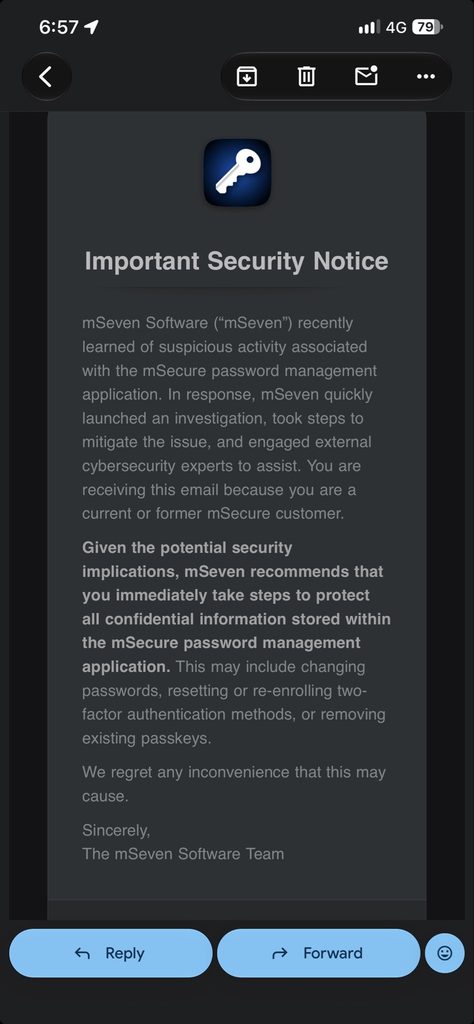
mSecure developer mSeven Software has alerted current and former customers to a security incident, urging them to change passwords as soon as possible.
The warning, received by users on November 3, 2026, offers little detail about what happened, leaving customers questioning whether their vault contents are at risk.
In the notification shared on social media, mSeven says it recently discovered suspicious activity associated with the mSecure application. The company says it launched an investigation, took steps to mitigate the issue, and brought in external cybersecurity experts. It does not identify the affected systems, the incident’s timeframe, or the number of customers potentially impacted.
mSecure is a password manager and secure data vault available for Windows, macOS, Android, and iOS. Beyond passwords, it supports storing sensitive records, documents, passkeys, and built-in one-time authentication codes.
The company’s notice recommends immediate action to protect all confidential information stored in the application. Depending on the information involved, this could mean changing passwords, resetting or re-enrolling two-factor authentication methods, and removing existing passkeys.
However, the notification does not confirm whether attackers accessed or stole encrypted vaults, obtained encryption keys, or viewed any information in readable form. It also does not explain whether the recommendations are precautionary or based on evidence of credential exposure.
Users left to uncertainty
Those omissions have fueled concern among recipients discussing the notification on Reddit. Several described the prospect of changing hundreds of credentials as a major undertaking, while others said they had begun securing important accounts, contacted support for clarification, or planned to move to another password manager. Some even questioned the email’s authenticity because they could not find a corresponding public announcement.
A recurring question was how the warning fits with mSecure’s published zero-knowledge security model. The company says vault data is encrypted locally using AES-256 before leaving a device, and that it cannot access customers’ decrypted information. Its documentation describes a locally generated Account Key protected by the user’s account password.
Access to encrypted data would not, by itself, establish that its contents had been decrypted. The notice provides insufficient technical information to determine whether those protections were affected.
Recipients also asked whether local-only vaults or data synchronized through third-party services face the same risk as mSecure Cloud accounts. The notification does not distinguish between these configurations, so their relative exposure remains unclear.
Users following the warning can prioritize primary email, financial, and other sensitive accounts and make changes directly through each service’s official app or website.



Leave a Reply