

Mozilla has unveiled a new proposal called PACT (Private Access Control Tokens), a framework designed to help websites distinguish legitimate users from abusive bots without relying on invasive tracking, hardware attestation, or repeated CAPTCHA challenges.
According to Mozilla, websites increasingly struggle to differentiate between malicious bots and privacy-conscious users. Traditional anti-abuse systems have historically relied on browser fingerprints, IP addresses, and other passive signals to identify visitors. However, modern privacy protections, VPN usage, and anti-tracking features have reduced the effectiveness of those methods. At the same time, advances in generative AI have made CAPTCHA far less reliable, with automated systems often solving challenges faster and more accurately than humans.
Mozilla warns that the current trajectory risks creating a web where users must disclose personal information or use approved hardware and software simply to access content and services.
Opposition to device attestation
A significant portion of Mozilla's proposal critiques recent industry approaches based on device attestation. The company specifically references Google's abandoned Web Environment Integrity (WEI) proposal and Apple's Private Access Tokens (PATs).
Mozilla argues that such systems ultimately concentrate power in the hands of operating system and hardware vendors by allowing websites to verify that visitors are using approved devices and software. While Apple’s Private Access Tokens are built on the privacy-focused Privacy Pass protocol and provide stronger privacy protections than WEI, Mozilla contends that PATs still depend on hardware-level trust controlled by device manufacturers.
According to the company, tying web access to approved hardware could limit user choice and make it more difficult for alternative browsers, operating systems, and emerging AI agents to operate freely on the web.
How PACT works
Instead of proving that a user is running approved software, PACT focuses on proving access to a scarce resource that attackers find difficult to replicate at scale.
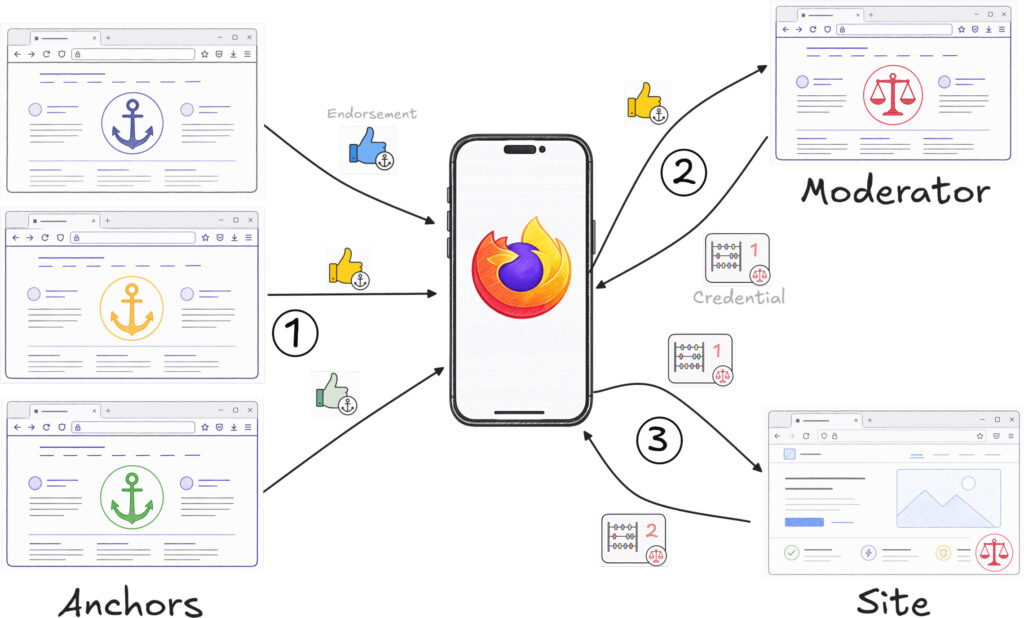
Mozilla proposes that trusted entities called Anchors issue cryptographic Endorsements to users who possess some form of scarcity, such as:
- Paid subscriptions
- Verified accounts
- Phone numbers
- Email addresses
- VPN subscriptions
For example, a VPN provider could act as an Anchor by vouching for legitimate subscribers. This could potentially allow websites to treat VPN users as individual visitors rather than blocking entire VPN IP ranges.
When a user visits a participating website, those Endorsements can be exchanged for a privacy-preserving credential managed by a Moderator. In many cases, the Moderator would simply be the website itself, though third-party anti-abuse providers could also serve in that role.
The system combines several privacy-focused cryptographic technologies, including:
- Privacy Pass, which provides unlinkable authentication tokens.
- Issuer blinding, which prevents websites from determining which specific Anchor vouched for a user.
- Anonymous Credit Tokens (ACTs), stateful credentials that allow websites to adjust trust levels and rate limits over time without tracking individual users.
- Prio, Mozilla's privacy-preserving aggregation technology based on multiparty computation.
Mozilla says the design ensures websites receive only the information necessary to determine whether a visitor falls within acceptable rate limits, rather than learning their identity or browsing history.
Benefits for AI agents
Under PACT, AI agents operating on behalf of users could carry the same credentials as their owners, thereby making users accountable for their agents' behavior while enabling legitimate automation. Alternatively, AI service providers could function as Anchors and vouch for their own agents, leaving websites free to decide whether to trust those endorsements.
Mozilla argues that this approach could allow websites to distinguish between legitimate user-controlled agents and large-scale abusive automation without resorting to blanket blocks.
PACT remains a conceptual framework rather than a finalized standard. Mozilla acknowledges that significant work remains before deployment, including security reviews, privacy analysis, and protocol standardization.
The company plans to bring draft specifications to both the Internet Engineering Task Force (IETF), which would oversee the underlying cryptographic protocols, and the World Wide Web Consortium (W3C), which would handle browser-facing APIs.



Leave a Reply