The best identity theft protection services monitor your information across all three credit bureaus, scan the dark web for leaks, and provide up to $5 million in insurance plus expert recovery help. You face identity theft risks every time you shop online, apply for credit, or share personal details.
LifeLock built its reputation over decades, yet newer competitors have arrived, bundling VPNs, antivirus, and faster alerts at lower prices. After hands-on testing of monitoring depth, response times, and overall value, one provider delivered the most complete package for 2026, and it outperformed expectations.
In this guide, we’re breaking down the top identity theft protection (ITP) services available today, what they offer, how much they cost, and how they perform when things go wrong.
Our top picks
After thorough research and rigorous testing, here is how our top six identity theft protection services for 2026 stack up:
| Starting price | Max insurance | Best for | |
| Aura | $9.00/month | Up to $5M (family) | Best all-around value with quick threat alerts |
| Coveron | $4.74/month | Up to $2M | Cyber extortion coverage and NordVPN integration |
| Identity Guard | $7.50/month | Up to $1M | AI-powered alerts and unlimited kids on family plans |
| LifeLock | $10.42/month | Up to $3M | Bundling with Norton 360 antivirus & VPN |
| IdentityIQ | $8.49/month | Up to $1M | Scalable tiers with Bitdefender security extras |
| IDShield | $14.95/month | Up to $3M | Large households and licensed private investigators |
How we test
Not all identity theft protection services offer the same level of security, and a higher price doesn’t always mean better protection. We looked beyond marketing promises to compare what each provider actually brings to the table. Our rankings focus on six key areas:
- Cost and value: We compared subscription prices against the features included in each plan. The goal? Find identity theft protection services that offer meaningful coverage and useful tools without charging more than necessary.
- Discounts and guarantees: We checked annual pricing, introductory discounts, special offers, and money-back guarantees. A good deal matters, but so does knowing you can get your money back if a service doesn’t meet expectations.
- Comprehensive protection: Identity theft protection is only part of the picture. We examined whether providers offer extra security features, including antivirus software, VPNs, password managers, and parental controls, to help protect users across their devices and online accounts.
- Credit monitoring: We assessed how closely each service monitors credit activity and whether it covers all three major credit bureaus: Experian, Equifax, and TransUnion. Broader monitoring can help users spot suspicious changes sooner.
- Dark web monitoring: We looked at how providers track exposed personal information across the dark web and whether they send timely alerts when sensitive data, such as email addresses or other personal details, is found.
- Identity theft insurance: Since recovering from identity theft can be costly, we compared insurance coverage limits and the financial protection each provider offers. We also considered how much support users can expect when dealing with the consequences of identity theft.
1. Aura — Best all-around

| Starting price | $12/month ($9 with coupon) |
| Supported platforms | Windows, macOS, Android, and iOS |
| Three-bureau credit monitoring | Yes (Experian, TransUnion, and Equifax) |
| Identity theft insurance | $1M – $5M ($1M per adult) |
| Best deal | 68% off coupon > |
Aura provides exceptional all-round protection with its comprehensive identity monitoring toolkit. We’ve found that Aura goes beyond just monitoring credit files from the major bureaus — it actively detects potential threats and alerts you promptly. What’s really impressive is its spam call protection, ensuring a secure user experience. Aura also offers up to $1M in identity theft insurance per member (up to $5M with family-focused packages) and round-the-clock customer support, which has been helpful in urgent situations.
The built-in VPN service ensures anonymity across multiple devices, while the password manager keeps accounts secure by flagging compromised or weak passwords. We’ve found the antivirus software effective against malware and other cyber threats, providing peace of mind.
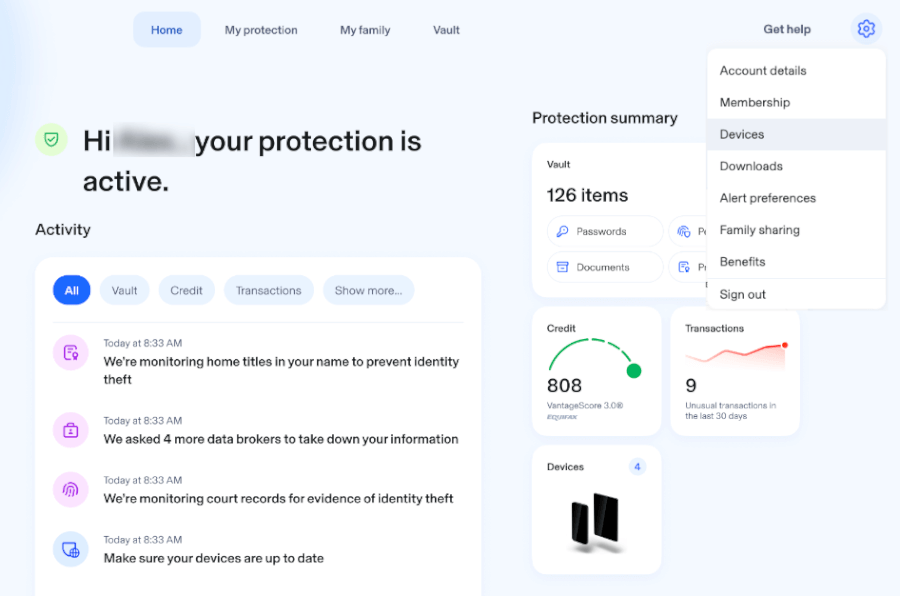
Aura’s dashboard is intuitive and user-friendly, allowing easy access to features like credit monitoring, dark web scans, and real-time alerts. Check the screenshot below for an example of its streamlined design:
Aura’s dark web monitoring is thorough, constantly scanning for leaks of personal information and notifying users of any breaches. Additionally, its financial transaction monitoring keeps a watchful eye on credit, banking, and investment accounts for any signs of fraudulent activity.
One unique feature, CreditLock, allows users to lock their Experian credit report to prevent unauthorized access, a handy tool for added security. In case of a lost wallet, Aura assists promptly with card cancellation and develops a recovery plan to safeguard your identity. Plus, their 60-day money-back guarantee on annual subscriptions adds confidence to your investment.
Aura pros and cons
+ Pros
- Antivirus software across all plans
- Dark web monitoring and automated data broker removal
- Fraud call protection
- Up to $1 million in insurance coverage per adult ($5M family)
- Plans for individuals, couples, and families
- Useful parental control app
- Password manager and VPN included
- 24/7 customer support and fraud resolution
- Transparent pricing
- 3-bureau credit monitoring included in all plans
– Cons
More expensive than some competitors
Exclusive Aura Coupon:
Get 68% Off Aura subscription plans with the coupon below:
(Coupon is applied automatically; 60-day money-back guarantee.)
2. Coveron — Best for cyber extortion
| Starting price | $4.74/month |
| Supported platforms | Windows, macOS, Android, and iOS |
| Three-bureau credit monitoring | Yes (Experian, TransUnion, and Equifax) |
| Identity theft insurance | $2M |
| Best deal | 66% Off Coupon > |
If you’ve ever tried NordVPN, you already know Nord Security takes online safety seriously. Now, with Coveron (formerly NordProtect), they’re bringing that same level of dedication to identity protection — and then some. It’s a full-on security suite that blends identity monitoring, credit alerts, and powerful cybersecurity tools into one slick, easy-to-use package. Think of it as your personal bouncer in the wild world of the internet.
One of Coveron’s standout features is its identity theft insurance, which covers up to $2 million per adult for stolen funds, legal fees, lost wages, and even mental health support. They’ve even thrown in cyber extortion protection, which means if someone tries to hold your data for ransom, Coveron has your back.
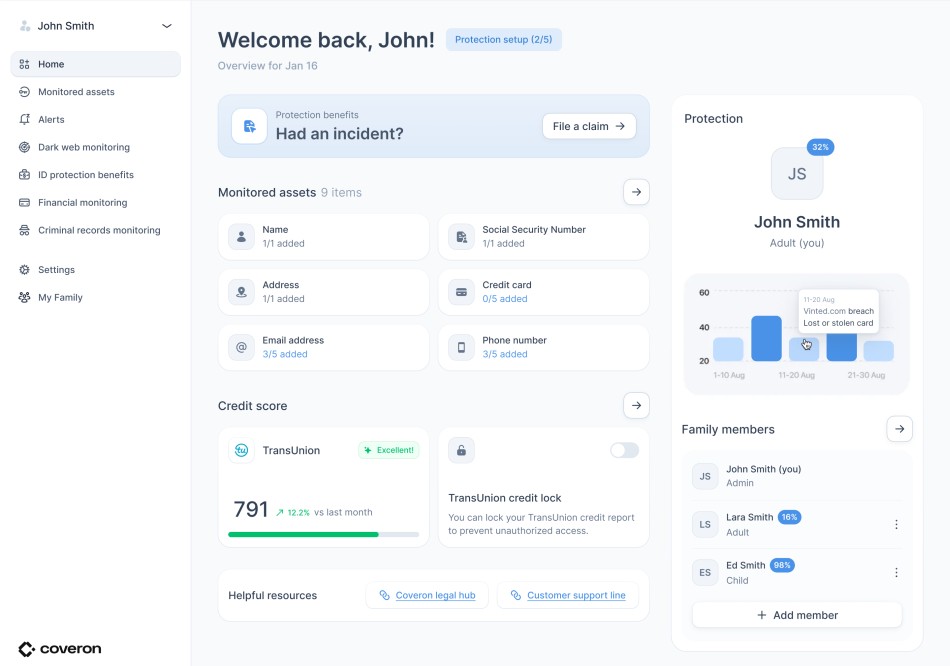
Setup is smooth sailing, just what we’ve come to expect from Nord. It’s quick, painless, and the dashboard is a breeze to use. Don’t just take our word for it — check out the clean layout below:
No need to bundle up — Coveron stands on its own. Check out the table below to see how much it’ll run you:
Either way, you’re getting solid identity protection, and if you go for the full package, you’ll also be securing your browsing and password management in one tidy deal.
Coveron stays on high alert, scanning the dark web 24/7 to catch any signs of your info being leaked. If something sketchy turns up, you’ll be the first to know. The credit monitoring is solid, too, with 3-credit monitoring available on the Full Protection plan. Those real-time alerts help you catch fraud early, and if you need to freeze your credit, Coveron walks you through it step by step.
One of the serious standouts? Cyber extortion coverage. If a shady hacker tries to hold your data for ransom, Coveron jumps in with expert support. It even helps cover the costs — a rare safety net most identity protection services skip entirely. And if identity theft strikes, the dedicated recovery specialists will walk you through every step.
So, is Coveron worth it? If you’re after rock-solid identity protection with a dash of cybersecurity muscle, it’s a fantastic pick — especially if you’re already rolling with NordVPN. You can bundle it or go solo, depending on what fits your needs (and budget) best.
Coveron pros and cons
+ Pros
$2M identity theft recovery
Cyber extortion coverage
24/7 dark web monitoring
Effortless to set up and use
Criminal record and malware breach alerts
3-bureau credit monitoring on Full Protection
Highest tier includes NordVPN, next-gen antivirus, and Incogni data removal
Accepts a range of payment methods
- Frequent deep discounts on long-term plans
30-day money-back guarantee
– Cons
Pricey premium plans
SSN required for credit monitoring (but that’s typical)
3. Identity Guard — AI identity alerts

| Starting price | $7.50/month |
| Supported platforms | Windows, macOS, iOS, and Android |
| Three-bureau credit monitoring | Yes (Experian, TransUnion, and Equifax) |
| Identity theft insurance | $1M |
| Best deal | 63% Off Coupon > |
Identity Guard taps into the brainpower of IBM Watson AI to deliver smart, lightning-fast identity theft protection. Thanks to this AI-driven setup, you’ll get alerts about data breaches, shady transactions, and dark web sightings faster and more accurately than with many other services. It’s like having a supercomputer on your side, scanning the digital world 24/7 to catch threats before they spiral out of control.
You’ve got options when it comes to plans. The “Ultra” plan is loaded with three-bureau credit monitoring (Experian, Equifax, and TransUnion), monthly credit score updates, an Experian credit lock, and yearly full credit reports. It also keeps you in the loop via email, text, or phone alerts — so you’re never caught off guard.
The “Total” and “Value” plans scale things down. The “Value” plan skips credit monitoring entirely, which feels like a letdown compared to what you get even in some entry-level LifeLock plans. The “Total” plan gives you daily credit score updates but no full credit reports. Still, all plans come with up to $1 million in identity theft insurance, which ups the peace-of-mind factor.
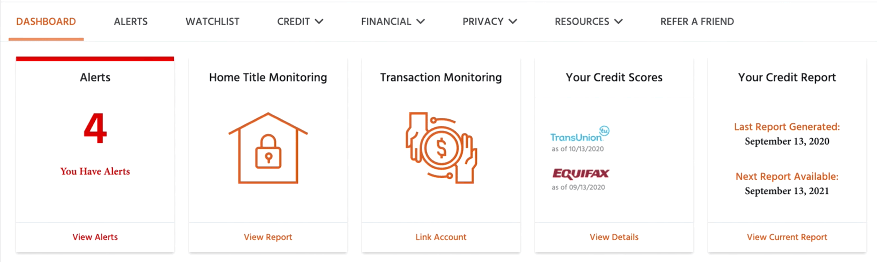
Identity Guard’s dashboard is smooth and easy to navigate, whether you’re on desktop or the mobile app. We found the desktop version especially handy for getting the big picture at a glance — take a peek at the screenshot below to see it in action.
Now, it’s not perfect. Identity Guard doesn’t include a VPN or antivirus software, and the premium plans aren’t exactly cheap. But thanks to its powerful AI engine, robust monitoring, and clear pricing, it’s still one of the top picks for serious identity protection.
Identity Guard pros and cons
+ Pros
$1 million in identity theft insurance on all plans
AI-powered identity monitoring
Simple-to-understand, upfront pricing
US-based customer support
Comprehensive individual or family coverage
Password managers included in all plans
Family plan protects an unlimited number of children
Predictive risk management score
– Cons
Monthly credit score or credit card monitoring requires a more expensive plan
Limited cybersecurity tools
4. LifeLock — Strong Norton security bundle
| Starting price | $10.42/month |
| Supported platforms | Windows, macOS, iOS, and Android |
| Three-bureau credit monitoring | Yes (Experian, TransUnion, and Equifax) |
| Identity theft insurance | $1M – $3M |
| Best deal | 37% off coupon > |
LifeLock teams up with Norton 360 to bring you a one-two punch of identity theft protection and cybersecurity. It keeps tabs on your credit, scans the dark web for your personal info, and alerts you the moment something shady pops up. While no service can catch everything, LifeLock offers solid peace of mind — and a recovery crew ready to help if things go south.
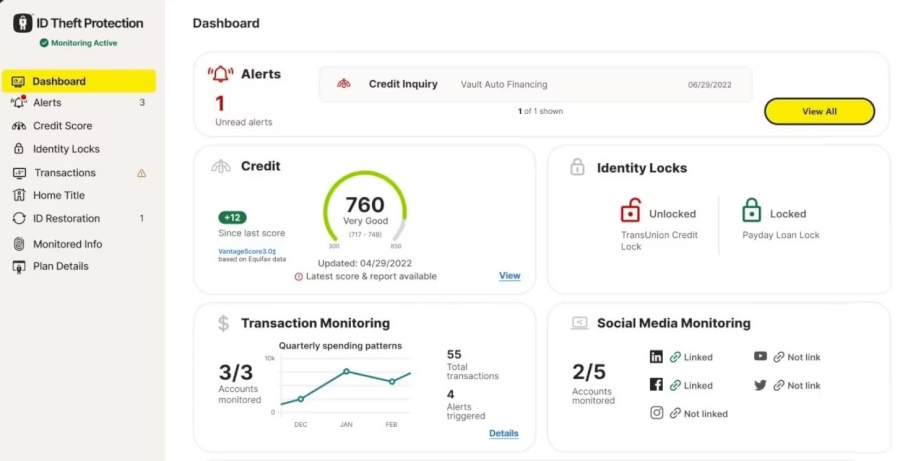
Navigating LifeLock is a breeze. The dashboard is clean and simple, making it easy to find what you need — whether checking alerts, reviewing credit activity, or scanning for dark web breaches.
And here’s where the combo with Norton shines: family-focused and higher-tier LifeLock plans come bundled with Norton Secure VPN and antivirus tools. It’s a major security upgrade — though heads up, entry-level plans don’t include those extras by default (you’ll have to pay extra to bundle them with Norton 360), and the basic tier sticks to single-bureau credit monitoring without free credit reports.
For complete credit protection, note that you must manually freeze or lock your files with Experian and Equifax, as LifeLock only automates this for TransUnion. However, it effectively manages your TransUnion file while monitoring vital information like your Social Security number, credit cards, and bank activity for dark web leaks and suspicious transactions.
It monitors key info like your Social Security number, credit card details, and bank activity. If your data leaks onto the dark web or a sketchy transaction pops up, LifeLock fires off an alert so you can jump on it fast. It also keeps an eye on your financial accounts to catch potential fraud early.
Lose your wallet? LifeLock’s got your back with fast support to cancel and replace your cards and IDs. You also get up to $1 million in insurance for identity theft losses on every plan — and if you’re on the top-tier option, you get the same coverage for stolen funds too.
Need help? LifeLock offers 24/7 customer support, and there’s a 30-day free trial so you can take it for a spin before making a commitment.
LifeLock pros and cons
+ Pros
30-day free trial period (recently added)
A VPN with family plans
Comprehensive identity theft protection service
Can be combined with Norton 360 antivirus software
Up to $3 million insurance for certain costs incurred from identity theft
User-friendly interface and easy setup
Stolen wallet protection
Simple-to-use mobile apps
– Cons
Confusing paid plan structure
Higher cost compared to some competitors
5. IdentityIQ — Scalable ITP plans
| Starting price | $8.49/month |
| Supported platforms | Windows, macOS, iOS, and Android |
| Three-bureau credit monitoring | Yes (Experian, TransUnion, and Equifax) |
| Identity theft insurance | $1M |
| Best deal | 15% off coupon > |
IdentityIQ offers different levels of protection, so you can choose the plan that fits your needs best. If you want the most coverage, the “Secure Max” plan has it all — $1 million in identity theft insurance, monitoring for child identity theft, alerts for new applications in your name, and even credit-building tools like utility payment reporting. You’ll also get monthly credit reports and strong support if fraud happens.
What sets IdentityIQ apart? Its partnership with Bitdefender. That means you get antivirus and VPN protection baked into your plan — a sweet bonus if you want an all-in-one security setup. That said, heads up: the fine print does mention possible data sharing with third parties or government entities, so it’s something to keep in mind.
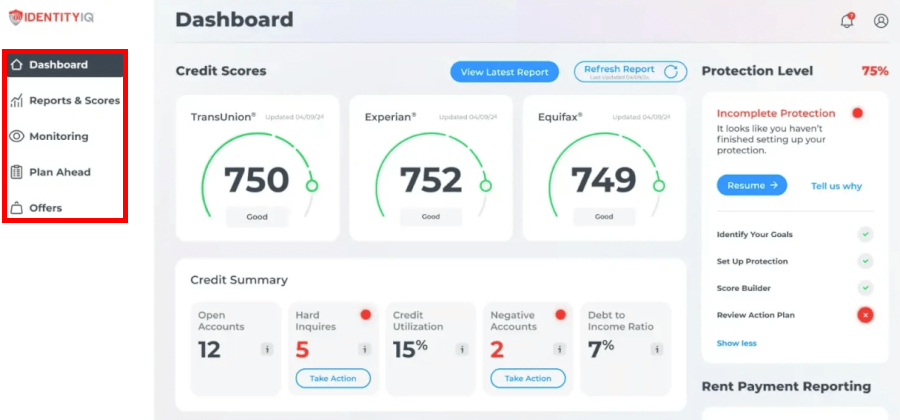
Their mobile app keeps you in the know with real-time alerts the moment something suspicious pops up. The new dashboard has a more modern look and feels easy to navigate, making it simple to check your status at a glance — see the screenshot below.
Lose your wallet? IdentityIQ’s got your back. Their lost wallet service helps cancel and replace everything important, fast. And if identity theft ever strikes, their US-based restoration pros are ready to step in and help you recover quickly.
IdentityIQ pros and cons
+ Pros
$1 million stolen funds reimbursement with all plans
AI-driven approvals and recommendations
Affordable integration with antivirus and VPN
Easy setup with out-of-the-box connectors
Monthly credit scores and reports
User-friendly system and organized interface
Family protection included
Three-bureau credit monitoring available
– Cons
Data sharing with third parties
Higher costs with extra charges for add-ons
No free trial or version is available
- Limited customer support options
6. IDShield — Family ID protection
| Starting price | $14.95/month |
| Supported platforms | Web, Android, and iOS |
| Three-bureau credit monitoring | Yes (Experian, TransUnion, and Equifax) |
| Identity theft insurance | $1M – $3M |
| Best deal | N/A |
IDShield keeps things simple and wallet-friendly, with family plans starting at just $29.95/month that cover up to 11 people. That’s right, nearly a dozen family members under one plan, making it a great pick for larger households looking to stay protected without overspending.
At the core, you get credit monitoring from TransUnion, with the option to add Experian and Equifax for full 3-bureau coverage. You’ll be alerted to any new credit inquiries or accounts that pop up in your name. Dark web monitoring watches for your sensitive info — like Social Security numbers and medical IDs — floating around online, and SSN tracking keeps a close eye on any suspicious use of your identity.
One standout feature? IDShield includes up to $3 million to cover legal fees and expenses if your identity is stolen. Plus, their team of licensed private investigators is ready to jump in and help restore your identity when you need it most.
On top of that, IDShield comes loaded with handy tools like VPN protection for safer browsing, malware defense to keep your devices squeaky clean, a password manager to lock down your logins, and parental controls to help keep the kids safe while they’re online.
There’s more under the hood, too — social media scans flag privacy risks, court record monitoring catches address or legal changes, and medical claim reports help spot health data misuse. You also get tools for managing your online rep, and if your wallet vanishes, IDShield helps you replace your cards in no time.
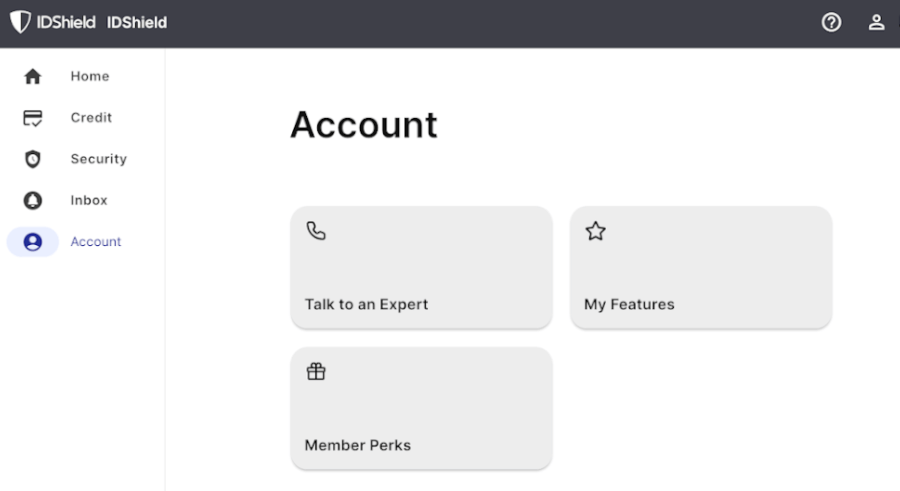
The initial setup might require creating several login profiles on third-party sites, but once that’s done, the interface is user-friendly and easy to navigate. Overall, IDShield provides a comprehensive and affordable solution for families wanting to protect their identities without breaking the bank.
IDShield pros and cons
+ Pros
Credit file and personal info web scanning
- Instant misuse alerts on all plans
- Identity theft recovery aid including lost wages
- Credit monitoring with one or three bureaus
- SSN tracking for unauthorized use
- Dark web checks for personal data leaks
- Financial account vigilance
- Complimentary Trend Micro security suite (VPN, antivirus, and password manager)
- Licensed private investigators for theft restoration
– Cons
- Confusing and cumbersome setup
- Basic plans cover only TransUnion
- No discounts for yearly plans
- Bare-bones password manager
2026 identity theft trends
Identity theft hits harder every year, with criminals using smarter tools to target your personal data. The numbers below show why you can’t afford to skip proactive monitoring and recovery support when picking a protection service.
- Reports hit record highs: The Federal Trade Commission (FTC) logged over 1.35 million identity theft complaints in 2025 — a nearly 20% jump over the 1.13 million reports filed in 2024.
- Billions in losses: Reported fraud losses reached a record nearly $16 billion in 2025, climbing roughly 25% from the $12.5 billion lost in 2024.
- Credit card fraud dominates: It remains the most common type of identity theft, accounting for nearly 600,000 reports and often tied to data breaches and stolen credentials.
- Synthetic identities on the rise: Fraudsters blend real and fake details to create “new” identities. This trend is accelerating with AI and continues to surge in 2026.
- AI-powered threats emerging: Deepfakes, voice cloning, and automated scams are gaining traction, making fast alerts and expert restoration even more critical.
These trends make one thing clear: strong three-bureau monitoring, dark web scans, and million-dollar insurance aren’t extras you can afford to ignore. They’re essentials for staying ahead.
How identity theft protection works
In today’s digital jungle, protecting your personal info is a must! Let’s break down how identity theft protection services work and what to keep an eye out for to stay one step ahead of the hackers.
What these services do
Your personal information can travel further online than you might think. Identity theft protection services help you keep tabs on it by monitoring accounts, spotting possible misuse, and alerting you to suspicious activity. If your identity is compromised, many providers also offer hands-on recovery support and insurance coverage.
Common types of identity theft they help guard against include:
- Credit card fraud: Unauthorized shopping sprees using your card details.
- Loan fraud: Scammers opening lines of credit or loans in your name.
- Medical identity theft: Using your details for medical care or prescriptions.
- Financial identity theft: Unauthorized access to your bank accounts and assets.
How monitoring works
These services monitor credit reports, public records, and dark web sources for signs that your personal information may be compromised. From unfamiliar loan applications to an exposed Social Security number, suspicious findings can trigger alerts by text, email, or mobile app.
Key monitoring features include:
- Tracking credit profiles and monthly scores across the three major bureaus (Experian, Equifax, and TransUnion).
- Running privacy scans to remove personal data from public directories.
- Offering added safeguards like antivirus software, password managers, card replacement assistance, and dedicated recovery experts.
How to choose a service
Picking the right identity theft protection service doesn’t have to feel like a chore. Before you pull out your wallet, run through this quick checklist to make sure a provider actually delivers where it counts:
- Check credit bureau coverage: One bureau isn’t enough. Pick a service that monitors all three major bureaus (Experian, Equifax, and TransUnion) so fraud can’t slip through the cracks.
- See what else is monitored: Look beyond credit files to make sure the service watches your Social Security number, bank accounts, home title, and dark web leaks.
- Read the insurance fine print: Most top services offer at least $1 million in identity theft insurance, but check whether it reimburses stolen funds on top of legal fees and lost wages.
- Verify 24/7 recovery support: If your identity gets stolen at 2 AM, you want real US-based fraud specialists who will handle calls, paperwork, and disputes with you, and not just send a generic how-to email.
- Look for a clean, easy-to-use app: If a dashboard feels like rocket science, you won’t use it. Stick with a provider that offers clear mobile alerts and one-tap credit locks.
- Check for built-in security extras: Getting a VPN, antivirus, and password manager bundled into your plan saves you money and helps block hackers before they steal your data.
- Compare discounts and guarantees: Always look for annual discounts and a 30- to 60-day money-back guarantee so you can test the dashboard risk-free—and check what the renewal price jumps to in year two.
How to choose a plan
The right identity theft protection plan depends on who you’re covering and how much monitoring you need. Whether you’re protecting just yourself or your whole family, the goal is to protect yourself against identity theft and fraud without paying for features you’ll never use.
Individual vs family plans
If you live alone, an individual plan covers all the essentials—dark web scans, credit alerts, and up to $1 million in insurance without inflating your monthly bill.
If you are protecting a household, a family plan gives you much better value per person. Look for plans that cover multiple adults and children under one roof and add family-specific tools like:
- Parental controls and cyberbullying alerts to keep kids safe online.
- Child SSN and credit monitoring to stop thieves from opening accounts in your child’s name.
- Sex offender registry alerts for added neighborhood peace of mind.
For example, Aura’s family plan covers up to five adults and unlimited kids, scaling identity theft insurance up to $5 million total ($1 million per adult).
Budget vs premium plans
Budget-friendly plans (typically $5 to $12/month with annual discounts) usually focus on core alerts, dark web monitoring, and single-bureau credit tracking. They work well if you mainly want early breach warnings and basic recovery support, though some entry-level tiers (like Identity Guard’s Value plan) skip credit monitoring completely.
Premium plans (typically $15 to $30/month) unlock full three-bureau credit monitoring (Experian, Equifax, and TransUnion), monthly credit scores, and bundled cybersecurity tools like a VPN, antivirus, and password manager. Always check renewal rates before signing up, as introductory discounts often climb after your first year.
What to do if your identity is stolen
Acting quickly can significantly reduce the damage and stress of identity theft.
Take immediate action
- Freeze your credit: Contact Equifax, Experian, and TransUnion to place free credit freezes and fraud alerts to block new unauthorized accounts.
- Notify affected institutions: Contact the specific banks or lenders involved to close fraudulent accounts and dispute charges.
- Report to the FTC: File a report at IdentityTheft.gov to generate an official recovery plan and Identity Theft Report.
- File a police report: Bring your FTC report and identification to local law enforcement to create an official paper trail for creditors.
Plan for long-term recovery
- Monitor your credit: Regularly review your credit reports to ensure no new fraudulent activity surfaces.
- Request written confirmation: Get written proof from creditors whenever bogus charges or accounts are cleared.
- Maintain a paper trail: Keep all reports, letters, and notes organized in a dedicated recovery file.
How to prevent identity theft
Even the best identity theft protection service works best when paired with smart daily habits. A few simple steps can dramatically shrink your risk:
- Use strong, unique passwords: Create complex passwords for every account and store them in a password manager so one data breach can’t unlock everything else.
- Turn on two-factor authentication: Add an extra layer of security to your email, banking, and social accounts using an authenticator app or security key.
- Freeze your credit proactively: Placing a free credit freeze at Equifax, Experian, and TransUnion stops scammers from opening loans or cards in your name, even if they have your SSN.
- Watch out for phishing scams: Never click suspicious links or share personal details over unexpected emails, texts, or phone calls.
- Limit what you share on social media: Avoid posting personal milestones, travel dates, or details like your birth date and hometown that thieves use to guess security questions.
- Keep your devices updated: Install software updates promptly and use a VPN on public Wi-Fi to block hackers from snooping on your connection.
Final verdict
Your personal information is worth protecting, and waiting until something goes wrong isn’t much of a strategy. The right identity theft protection service can help you spot trouble early with three-bureau credit monitoring, dark web scans, identity theft insurance, and extra privacy tools that keep your personal data safer.
For 2026, Aura is our top pick. It brings most of what you’d want under one roof: fast AI-powered fraud alerts, 24/7 identity theft recovery support, a VPN, antivirus software, and a password manager. Its family plan also includes up to $5 million in combined identity theft insurance ($1 million per adult).
Ready to try Aura? Take 68% off with the offer below:
Exclusive Aura Coupon:
Get 68% Off Aura subscription plans with the coupon below:
(Coupon is applied automatically; 60-day money-back guarantee.)
Identity theft protection FAQs
Aura is our top overall pick for 2026, combining fast AI-powered fraud alerts, three-bureau credit monitoring, and up to $5 million in family insurance ($1 million per adult). It also includes a VPN, antivirus software, and a password manager in one easy-to-use dashboard, making it the best balance of price and protection.
Yes, especially if you want early breach warnings and hands-on help fixing fraud without spending dozens of hours on the phone with banks and credit bureaus. While no service can stop every data breach, top providers catch suspicious credit activity fast and provide up to $1 million to $5 million in insurance to cover stolen funds, legal fees, and lost wages.
Freezing your credit at Equifax, Experian, and TransUnion is free and stops scammers from opening new credit accounts in your name, so you should do it regardless. However, a credit freeze won’t alert you if your Social Security number leaks on the dark web, someone drains your existing bank account, or a thief files a fake tax return, which is where paid monitoring and recovery insurance step in.
Expect to pay between $4.75 and $15/month for an individual plan with annual discounts, or $17 to $30/month for a family plan. Entry-level tiers like Coveron ($4.74/month) and LifeLock ($10.42/month) cover core monitoring, while full-featured bundles like Aura ($9/month with our 68% off coupon) include three-bureau credit tracking and extra device security tools.
Aura is the best choice for most families because it covers up to five adults and unlimited kids, includes $1 million in insurance per adult (up to $5 million total), and adds parental controls and cyberbullying alerts. If you have a very large household, IDShield is another strong option that covers up to 11 family members under one plan.
Your provider connects you with a dedicated recovery specialist who helps you freeze your credit, dispute fraudulent charges, close fake accounts, and file official reports. Services like Aura and LifeLock offer 24/7 US-based support, while IDShield assigns licensed private investigators to handle the restoration process for you.
Most major identity theft protection services (including Aura, LifeLock, Identity Guard, IdentityIQ, and IDShield) are built specifically for US residents because they rely on US Social Security numbers and domestic credit bureaus (Experian, Equifax, and TransUnion). If you live outside the US, look for global cybersecurity suites that focus on dark web email monitoring, password security, and VPN protection rather than US credit monitoring.

great read thanks again
Hi there,
Great article, I learnt a lot as I am not familiar with this tool. One remark, I am based in Europe and I think it would be nice to mention which ones are available for us. It seems that many are mainly US focused.
I am offshore also.