
Nowadays, giving out your real email address feels like giving a telemarketer your home keys. Every “free” app or “10% OFF” coupon wants your inbox access, and before you know it, you’re drowning in a flood of spam and data-mining trackers. Gone are the days of just typing “fake@email.com” — sites are smarter now and demand a verification click before they let you in.
That’s where disposable email services (aka burner aliases) save the day. They give you a temporary front-row seat to the content you want without letting the marketers into your private life. But since the market is flooded with junk services, we’ve done the deep dive to find the best temporary email providers that work in 2026.
Ready to see the top burner services that work in 2026?
Best disposable email services in 2026
- Burner Mail – A sleek browser extension that acts as a permanent one-click shield between your real inbox and every sketchy signup form.
- 10MinuteMail – The digital self-destruct button for when you need a verification code and want to vanish sixty seconds later.
- EmailOnDeck – A pro-grade burner that uses crypto-tier privacy to bypass even the toughest anti-disposable filters on the web.
- Maildrop – A minimalist, open-source inbox that’s always ready to catch junk mail so your actual account doesn’t have to.
1. Burner Mail – Best “one-click” option
| Based in | USA (privacy-focused, but under US jurisdiction) |
| Starting price | $2.99/month |
| Free tier | ✅ Up to 5 active burner addresses |
| Best for | Browser-heavy users who want one-click spam protection |
| Website | BurnerMail.io |
If you’ve ever felt a pang of regret while typing your real email into a sketchy 10% off pop-up, Burner Mail is here to take the hit for you. Think of it as a protective layer between your private life and the trackers of the world.
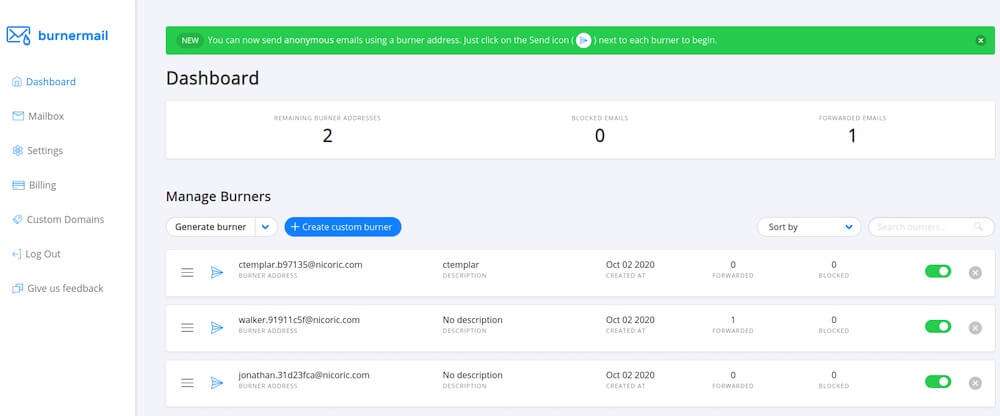
The service specializes in forwarding-style privacy: It generates a unique, anonymous email address for every site you visit, and any mail sent there gets zapped straight to your real inbox. You get the info you need, and the marketers get a “burner” address that you can “burn” the second they start getting annoying.
What’s new for 2026?
- The “initiate” power-up: Premium users can now start brand-new email threads from an alias, not just reply to incoming ones.
- Quantum-safe forwarding: Upgraded transport encryption protects your forwarded data from future supercomputer threats.
- AI spam-shield: A new 2026 filter that strips trackers before they ever hit your real inbox.
- Enhanced “burn” speeds: Deleting an address now instantly severs all data ties, ensuring zero residual tracking.
Burner Mail’s standout features
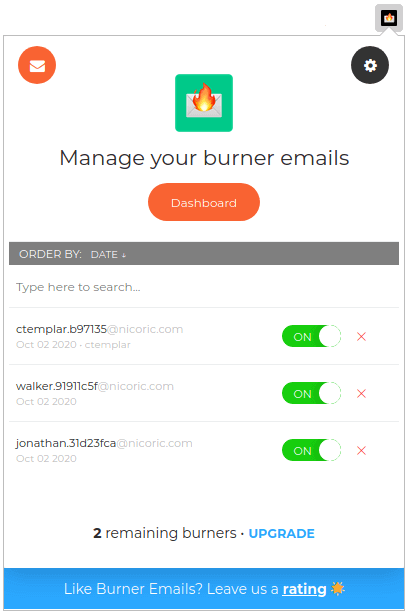
- The “burning envelope” icon: A browser extension (Chrome/Firefox) that puts a generation button directly into every email field you find online.
- Unlimited aliases: On the Premium plan, you can create a unique identity for every single website you visit.
- Custom domain support: Connect your own domain (@yourname.com) to manage professional-looking burner addresses.
- Multiple recipients: Forward mail from one burner address to several different real-world inboxes, which is perfect for shared family or team accounts.
While Burner Mail is a dream for Chrome and Firefox users, it still lacks a native extension for Safari. If you’re a Mac or iOS loyalist, you’ll find the experience a bit clunky. Also, because they focus on ease of use, they log basic metadata for “abuse prevention,” so it’s not 100% off-the-grid.
Burner Mail pros and cons
+ Pros
- Free and paid versions
- One-click generation via browser extensions
- Ability to send and reply using your burner address
- Browser extensions for Chrome and Firefox
- 100% ad-free experience, even on the free tier
- Supports 2FA
- Custom domain support
- Very generous annual plan discounts
– Cons
- Gathers some usage data
- No Safari support
2. 10MinuteMail – The digital self-destruct button

| Based in | USA |
| Starting price | 100% free (donations accepted) |
| Free tier | ✅ Full access to every feature |
| Best for | Instant, high-speed verification without any setup |
| Website | 10MinuteMail.com |
Sometimes you don’t need a long-term burner address that forwards to your inbox for months. Sometimes, you need an email address to exist for exactly as long as it takes to click a “Verify My Account” link, and then vanish forever.
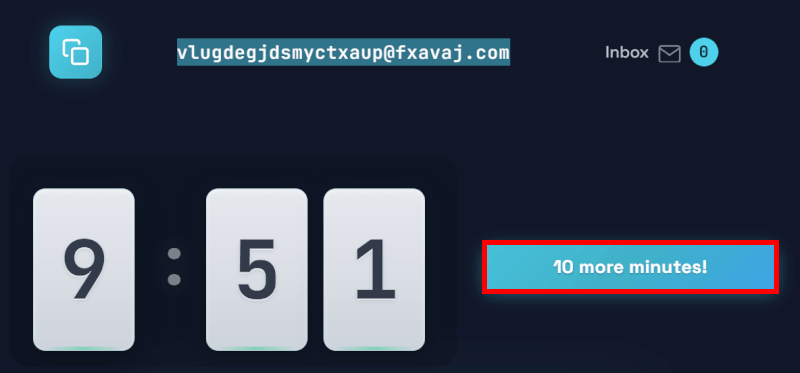
10MinuteMail is the minimalist’s dream. There are no extensions to install, no accounts to create, and no personal info to give up. You just land on the page, and a timer starts ticking down from 10 minutes. It’s the digital equivalent of a self-destructing message: Once that clock hits zero, the address and everything inside it are purged from the earth.
What’s new for 2026?
- The anti-detection refresh: In 2026, 10MinuteMail constantly rotates its domain extensions to stay one step ahead of websites that try to block “disposable” email providers.
- Mobile-first glow-up: The site has been optimized for 2026 mobile browsers, making it a breeze to grab a quick address while you’re signing up for a gym’s Wi-Fi or a one-time discount on your phone.
- Encrypted session handling: Even though it’s a free tool, they now use enhanced HTTPS protocols to ensure your 10-minute session isn’t being snooped on by anyone on your local network.
10MinuteMail’s standout features
- Super simple access: The second the page loads, your address is ready. Copy, paste, and you’re done.
- The “stay alive” button: If that verification email is taking its sweet time, you can just click “Get 10 more minutes” to reset the clock as many times as you need.
- Privacy by purge: Once you close that browser tab or the timer expires, the mailbox is wiped clean. No recovery, no trail, no spam.
- Built-in inbox: You don’t need to check your “real” mail. The messages show up right on the 10MinuteMail homepage in a neat little list.
On the downside, 10MinuteMail is strictly for receiving mail. You can’t use it to send an email, and if you accidentally close the tab before you get your verification code, that address is gone for good. It’s built for speed and anonymity, not for building a digital archive.
10MinuteMail pros and cons
+ Pros
- Completely free and requires zero registration
- Instant setup
- Simple to use
- No other user has access to your disposable email account
- High deliverability for those pesky “Verify your email” prompts
– Cons
- You cannot send or reply to emails
- Too time-sensitive
- It logs some usage data
3. EmailOnDeck – The pro-grade burner
| Based in | USA |
| Starting price | Free (Basic) / 0.000894 BTC (Pro) |
| Free tier | ✅ One active inbox with unlimited incoming mail |
| Best for | Users who need a middle ground between “instant” and “permanent” |
| Website | EmailOnDeck.com |
If 10MinuteMail is a quick tap and Burner Mail is a full setup, EmailOnDeck sits comfortably in the middle. It’s built for those times you need an address that lasts longer than ten minutes (maybe an hour, maybe an afternoon), to catch a slow verification link or a multi-step sign-up process.
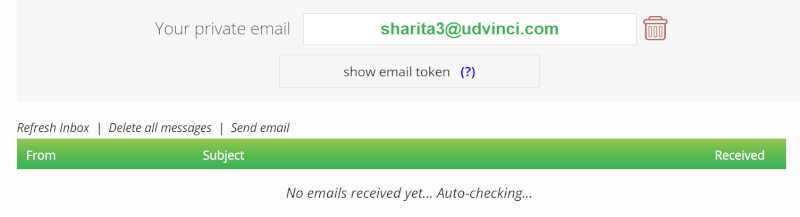
Getting your hands on an address is a two-click operation: Solve a CAPTCHA, hit “Get Email,” and you’re in. Your messages show up right in your browser, and the system automatically purges everything every few hours, leaving zero trace of your digital footprint.
What’s new for 2026?
- The crypto-exclusive club: In 2026, EmailOnDeck doubled down on privacy by sticking strictly to Bitcoin payments for its Pro tier. No credit cards, no names, no paper trails.
- Enhanced “hoop-jumping” tech: They’ve updated their domain rotation to bypass the most aggressive anti-disposable filters used by major social media and retail sites.
- Recovery token system: Pro users now get a unique “Recovery Token” that might help you reclaim an address if you accidentally close your tab — though in the world of burners, nothing is ever 100% guaranteed.
EmailOnDeck’s standout features
- The “burn now” button: Want to vanish instantly? Hit the big red button next to your address to wipe your inbox and release the soul of that email address into the void.
- Unlimited inbound: Unlike some free services that cap you at 10 emails, you can receive as many messages as you want as long as your session is active.
- Pro-level scaling: The Pro version is a beast, allowing you to manage up to 100 simultaneous accounts and send emails to anyone, not just other EmailOnDeck users.
- HTTPS/TLS secured: Even the free tier is wrapped in modern encryption, ensuring your temporary data isn’t being sniffed by anyone on your network.
If you want the Pro features, you’ll need to be comfortable with crypto. Because they price in BTC, the cost of a “private month” can fluctuate wildly depending on how the market is doing. Also, for free users, sending mail is restricted to other EmailOnDeck users only.
EmailOnDeck pros and cons
+ Pros
- Addresses last much longer than “10-minute” alternatives
- Fast and easy to get your new email address
- Access is secured with HTTPS and TLS
- Mailbox emptied every few hours
- Paid Pro version allows you to create and keep multiple simultaneous addresses
- Clean, ad-light interface
– Cons
- You can only send an email to other EmailOnDeck users
- Bitcoin pricing can lead to excessive costs when cryptocurrencies are rising
4. Maildrop – The public locker for your junk mail

| Based in | USA |
| Starting price | 100% free |
| Free tier | ✅ Open access to any @maildrop.cc address |
| Best for | One-off signups where you don’t care who sees the mail |
| Website | Maildrop.cc |
If 10MinuteMail is a self-destructing note, Maildrop is more like a public locker with no lock. It’s a “no-nonsense” service designed for total convenience. There are no signups, no passwords, and (refreshingly), no pretension of high security.
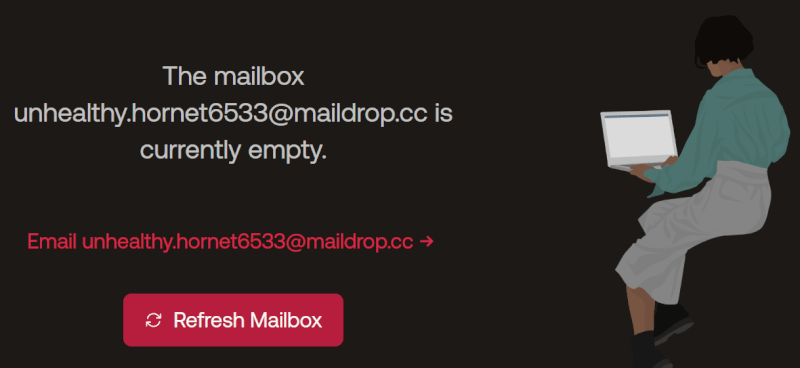
You just pick a name (like pizzalover@maildrop.cc), give it to that restaurant or coupon site, and come back later to see what arrived. It’s the digital equivalent of a dummy phone number for when you just need to get past a gatekeeper without giving away your real identity.
What’s new for 2026?
- Enhanced spam filtering: In 2026, Maildrop upgraded its “Heliodor” filter to be even more aggressive. If a message contains a virus, a malicious link, or massive attachments, it won’t even show up in your inbox.
- Modernized UI: The site has been cleaned up for better mobile viewing, making it much easier to check your “public locker” while on the go.
- The alias shield: Every Maildrop address now comes with a “Shadow Alias.” You can share the alias, and the mail will land in your chosen inbox, but no one can guess your actual Maildrop name from the alias.
Maildrop’s standout features
- Pick your own name: Unlike services that give you random gibberish, you can choose an easy-to-remember address. Want to use “catlitter”? It’s yours, but remember, anyone else who types catlitter can see it too.
- Permanent “temporary” addresses: Your Maildrop address stays active as long as it gets at least one message every 24 hours. It’s a throwaway that you can actually keep using for low-stakes accounts.
- The tracker stripper: Maildrop automatically clears out tracking pixels and attempts to sanitize HTML mail, so the sender doesn’t know when you’ve opened their junk.
- Strict minimalism: The system only holds 10 messages at a time and rejects all attachments. It’s built for text-based verification, nothing more.
Still, Maildrop is not for sensitive info. Since there are no passwords, anyone who guesses your inbox name can see your mail. It’s perfect for a “10% off boots” coupon, but a terrible idea for a bank reset or anything personal. Use it for the junk, and keep your little grey cells for the important stuff.
Maildrop pros and cons
+ Pros
- Completely free with zero registration required
- No CAPTCHAs, no timers, just type and go
- Built-in spam shield
- Address aliasing
- Permanent email addresses
– Cons
- No privacy with inbox
- Old messages may persist on the server for more than a day
- The system will block any mail with a file attached
Reclaiming your inbox in 2026
In 2026, your primary email address is your digital DNA. Handing it over to every random pop-up or gated PDF is an open invitation for trackers to follow you around the web. The trend of forced registration isn’t slowing down, but that doesn’t mean you have to play by their rules.
Whether you need a 10-minute hit-and-run verification or a long-term email alias that shields your real identity for years, the tools we’ve covered are your best line of defense. They are essential gear for anyone tired of a bloated, spam-filled inbox.
The bottom line for 2026:
- For sheer speed: Stick with 10MinuteMail.
- For long-term control: Go with Burner Mail.
- For pro-level anonymity: EmailOnDeck is your best bet.
For anything beyond spam avoidance, it is worth considering secure email services. Unlike disposable inboxes, they’re built for ongoing use and protect your messages with strong encryption, tighter privacy policies, and minimal data tracking. If you regularly handle sensitive conversations, switching to a secure email provider adds a much-needed layer of long-term privacy.
A standout option in this space is Proton Mail. It combines strong end-to-end encryption with a privacy-first design, ensuring your emails remain accessible only to you and your recipient. With a strict no-logs policy and secure infrastructure, it offers both privacy and security for users who want a dependable, long-term email solution.
And if you want to stay truly invisible, you need to mask your entire connection. Pairing a disposable email with a heavy-hitter like NordVPN ensures that even if a site gets your (temporary) address, they’ll never get your real location or data.
Temporary disposable email services FAQs
You can think of it as a digital shield. These services provide a middleman address that you can give to websites, apps, or newsletters. Instead of your real inbox getting hit with trackers and spam, the junk goes to the temporary mailbox. Once you’ve clicked your verification link or grabbed your discount code, you can “burn” the address and walk away.
In this day and age, your email is your digital Social Security number. Companies don’t just want it to send you mail; they want it to map your behavior across the web. Using a burner address breaks that tracking link and keeps your primary inbox clean, organized, and (most importantly) private.
100% yes. There is no law requiring you to provide your primary identity to a private website or app. In fact, privacy advocates and even some government consumer protection agencies recommend using aliases to prevent identity theft and data profiling. Your best email is for your friends and family, not for a random PDF download.
Never use a disposable email for anything critical. Since many of these inboxes are public or have no passwords, they aren’t meant for bank statements, medical records, or recovery emails. Use them for “low-stakes” signups like retail coupons, one-time forum access, or testing new apps.
For sensitive communication, encrypted email services are a much better choice. They protect your messages with end-to-end encryption, meaning only you and the intended recipient can read the content — not even the provider can access it.
It’s a constant cat-and-mouse game. Some sites use “blocklists” to filter out known burner domains. If your address gets rejected, just switch to a different provider from our list. Services like Burner Mail and EmailOnDeck frequently rotate their domains specifically to bypass these filters.
Absolutely. Most of the services we’ve ranked have mobile-friendly web interfaces or dedicated apps. Whether you’re signing up for a gym’s Wi-Fi or scanning a QR code at a restaurant, you can generate a burner address in seconds right from your browser.

Good