

Brave says its desktop browser used less CPU, memory, energy, and network bandwidth than Chrome, Edge, and Firefox in a new round of macOS testing, attributing much of the difference to its built-in ad and tracker blocking.
The benchmarks were conducted by Brave itself, and the browsers were tested with their default settings. This means Brave blocked advertising and tracking resources that competing browsers generally loaded, making the results more representative of their out-of-the-box browsing configurations than a direct comparison of browser engines.
Brave is a Chromium-based browser focused heavily on privacy protections, including native ad and tracker blocking, fingerprinting defenses, and protections against bounce tracking. It competes with Google Chrome, Microsoft Edge, Mozilla Firefox, and Apple’s Safari, although Safari was notably excluded from this study despite the testing being conducted on macOS.
Speed testing process
For the experiment, Brave used a Mac mini with an Apple M2 chip and 8GB of memory running macOS 26.5.1. The researchers tested the 50 most popular websites according to Brave Search statistics, repeating the experiment 10 times while randomizing browser order.
The system used a dedicated 50 Mbps Internet connection in London and fresh browser profiles for every run. Brave measured page-loading activity with Playwright, CPU and memory consumption with macOS process statistics, and power usage with Apple’s powermetrics utility.
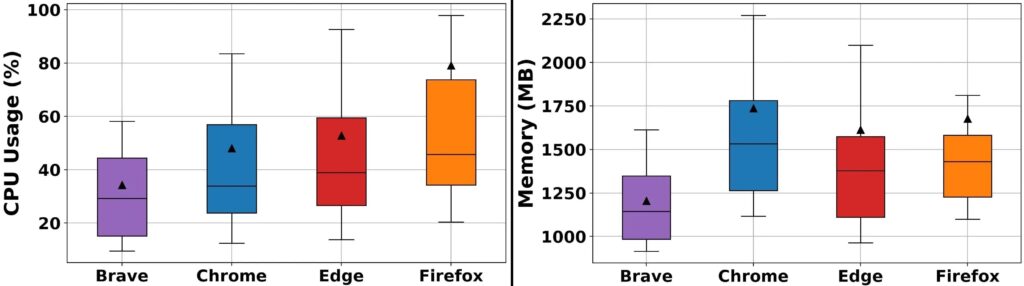
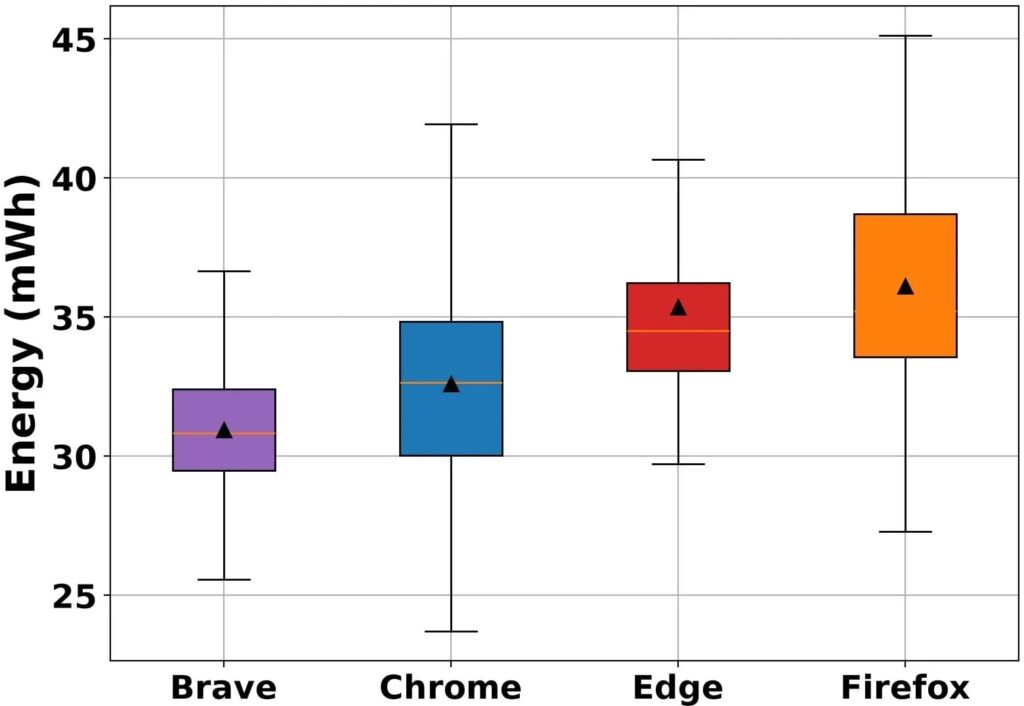
Across the tests, Brave reported using an average of 44% less CPU, 28% less memory, and 10% less energy than the three competing browsers combined. It also reported 20% faster page completion times, 26% less inbound traffic, and 39% less outbound traffic.
Average memory consumption was approximately 1.2GB for Brave, compared with 1.75GB for Chrome, 1.62GB for Edge, and 1.65GB for Firefox. Mean CPU utilization was around 33% for Brave, versus 47% for Chrome, 53% for Edge, and 78% for Firefox.
Brave
Brave recorded an average loadEventEnd time of roughly 4.4 seconds, compared with 5.1 seconds for Chrome, 5.3 seconds for Firefox, and 6 seconds for Edge. However, Largest Contentful Paint, a more user-visible measurement of when a page’s primary content appears, was effectively identical between Brave and Chrome at approximately 2.4 seconds. Edge and Firefox followed closely at around 2.5 seconds.
This suggests much of Brave’s advantage came after primary content had already rendered, as its blocker prevented advertisements, analytics scripts, tracking pixels, and other background resources from being downloaded or executed.
Synthetic tests also produced a more mixed picture. Brave, Chrome, and Edge were broadly comparable in Speedometer 3.1 and JetStream 2.2, while Brave scored somewhat lower in the graphics-focused MotionMark benchmark.
Brave
The findings therefore support Brave’s argument that blocking third-party content by default can substantially reduce browser resource consumption, but they do not establish that Brave’s underlying Chromium engine is inherently faster than its competitors.
The results arrive as Brave reports continued user growth. CEO Brendan Eich said earlier today that Brave reached 126.25 million monthly active users in August, up 3%, while peak daily active users approached 53 million. Brave Search also surpassed 2.5 billion monthly queries.



Leave a Reply