
GrapheneOS is working to integrate Rich Communication Services (RCS) into its default messaging app, enabling end-to-end encrypted communication with Google Messages and iOS users.
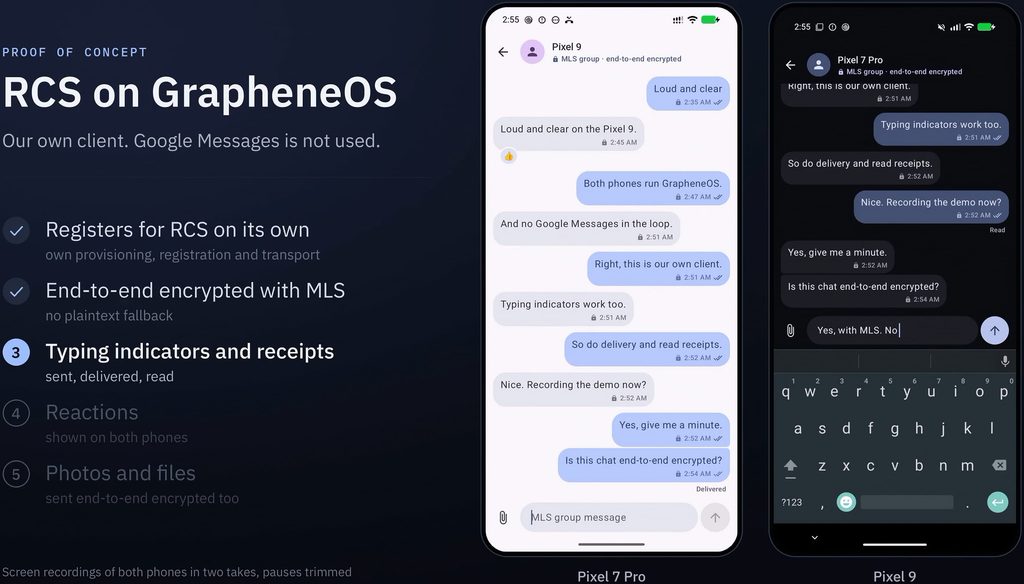
The project announced that it had developed a proof-of-concept RCS client, demonstrating several core features of the modern messaging standard.
GrapheneOS is an Android-based operating system focused on privacy and security, offering extensive exploit mitigations, application sandboxing, and an alternative approach to integrating Google services on mobile devices.
The project’s experimental RCS implementation already supports the following features:
- End-to-end encryption using the Messaging Layer Security (MLS) protocol
- Typing indicators
- Delivery and read receipts
- Message reactions
- Media and file sharing
GrapheneOS will use the experience gained from developing the prototype to incorporate these capabilities into its existing Messaging application.
The addition of RCS is primarily intended to enable encrypted communication with users of mainstream messaging apps without requiring contacts to install a dedicated, privacy-focused messenger.
GrapheneOS noted that the transition could also help secure automated messages currently delivered over SMS, as the industry gradually moves away from SMS and MMS.
Reducing Google dependencies
One limitation of the initial implementation is its reliance on sandboxed Google Play, as most mobile carriers delegate their RCS infrastructure to Google and rely on proprietary services.
However, users would no longer need to install Google Messages to access RCS functionality on GrapheneOS.
The project’s longer-term goal is to eliminate that dependency for carriers supporting standalone RCS implementations.
Regarding interoperability, GrapheneOS expects the full range of its RCS features to work when communicating with Google Messages users. In contrast, iPhone users will initially benefit from a more limited feature set.
The project attributes this discrepancy to Apple’s incomplete RCS implementation and the limited availability of MLS-based end-to-end encryption among iOS users.
The messaging application itself is expected to remain exclusive to GrapheneOS, as its RCS implementation requires underlying operating system changes that are unavailable on standard Android devices.
Hardening media handling
Responding to concerns about the additional attack surface introduced by RCS, GrapheneOS said it is also working to strengthen how its messaging app handles incoming media.
Automatically processing media attachments can expose devices to zero-click attacks exploiting vulnerabilities in media parsing components.
The developers explained that this risk already exists with conventional MMS messaging and is not specific to RCS.
Although audio and video processing already benefits from operating system-level sandboxing, GrapheneOS plans to separate automatic attachment retrieval from actual parsing.
This would allow incoming media files to be downloaded without automatically processing their contents, even for seemingly innocuous operations such as determining the duration of an audio or video clip.
The approach aims to reduce the attack surface exposed to unsolicited messages by avoiding unnecessary media processing before user interaction.
GrapheneOS also confirmed that it is implementing a message search feature in its default messaging application.
The project has not provided a timeline for releasing RCS support to users.



Leave a Reply