

Mozilla plans to change how it schedules Firefox security fixes to make it harder for attackers to turn newly published patches into working exploit chains using artificial intelligence.
The approach targets the “patch gap,” the period between a fix appearing in the browser’s code and that fix reaching most users. During this window, attackers can study the changes, reconstruct the underlying vulnerability, and exploit installations that remain unpatched.
Mozilla’s Bobby Holley said AI models are making this longstanding technique faster and more accessible. Mozilla has observed evidence that models such as GLM 5.3 can exploit some vulnerabilities by examining fixes for bugs originally discovered using more advanced models.
Firefox, Mozilla’s open-source web browser, uses multiple sandboxing layers to limit what compromised components can access. These boundaries generally mean attackers need to combine vulnerabilities in separate parts of the browser to achieve a broader compromise.
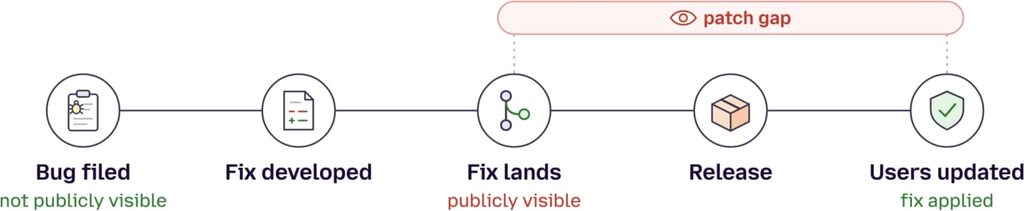
Separating the pieces of an attack
In a basic exploit chain, an attacker needs both a vulnerability in the renderer, which processes web content, and a way to escape its sandbox. Mozilla’s proposed defense is to schedule groups of fixes so that the patch gaps for these different layers do not overlap.
The goal is to prevent attackers from obtaining all the necessary pieces of an exploit chain by reverse-engineering patches exposed during the same window. They would instead need to independently discover at least one additional vulnerability that Mozilla’s AI-assisted security work had missed.
Mozilla said implementing the approach will require coordination across its engineering processes and may take time.

Faster fixes and fewer clues
Mozilla says Firefox developers have used early access to advanced models from Anthropic and OpenAI since February to find and repair subtle security flaws. The team has shipped more than seven times as many security fixes as during the corresponding period in 2025, according to Holley.
Alongside the planned scheduling changes, Mozilla says it has already introduced several measures to reduce exposure:
- Weekly builds: It halved the release cycle earlier this year so new builds reach users every week.
- Delayed test publication: Regression tests accompanying security fixes are kept confidential until the fix ships, after Mozilla found GLM 5.3 less effective at reconstructing exploits without them.
- Commit scanning: All incoming code changes are scanned for newly introduced bugs before they reach a release.
Some delay remains unavoidable because browser updates need testing across different hardware configurations, while users may postpone installing available fixes.
Mozilla also reaffirmed that Firefox will remain open source, arguing that withholding source code would offer limited protection as tools improve at reverse-engineering compiled software.



Leave a Reply