

Brave has expanded its “Shred” privacy feature to Android, bringing its one-tap, site-specific data deletion capability to a broader user base with the release of version 1.89.
The feature, introduced on iOS in 2024, is designed to disrupt first-party tracking by allowing users to selectively erase stored data without logging out of all websites.
The feature builds directly on the iOS version, maintaining parity in functionality while leveraging fewer platform restrictions on Android to expand data-clearing capabilities.
Shred enables users to instantly delete all data stored by a specific website, including cookies, local storage, and network-related caches. This per-site approach aligns with how browsers isolate storage, allowing users to remove tracking artifacts tied to a single domain without disrupting sessions on unrelated sites. Unlike traditional “clear browsing data” tools, which often log users out of all services, Shred isolates the cleanup process to a targeted scope, improving usability while preserving privacy.
Brave is a privacy-centric web browser developer known for integrating built-in ad blocking, anti-tracking protections, and privacy-preserving features across its desktop and mobile platforms. The company has positioned itself as an alternative to mainstream browsers by focusing on minimizing user data collection and offering granular privacy controls.
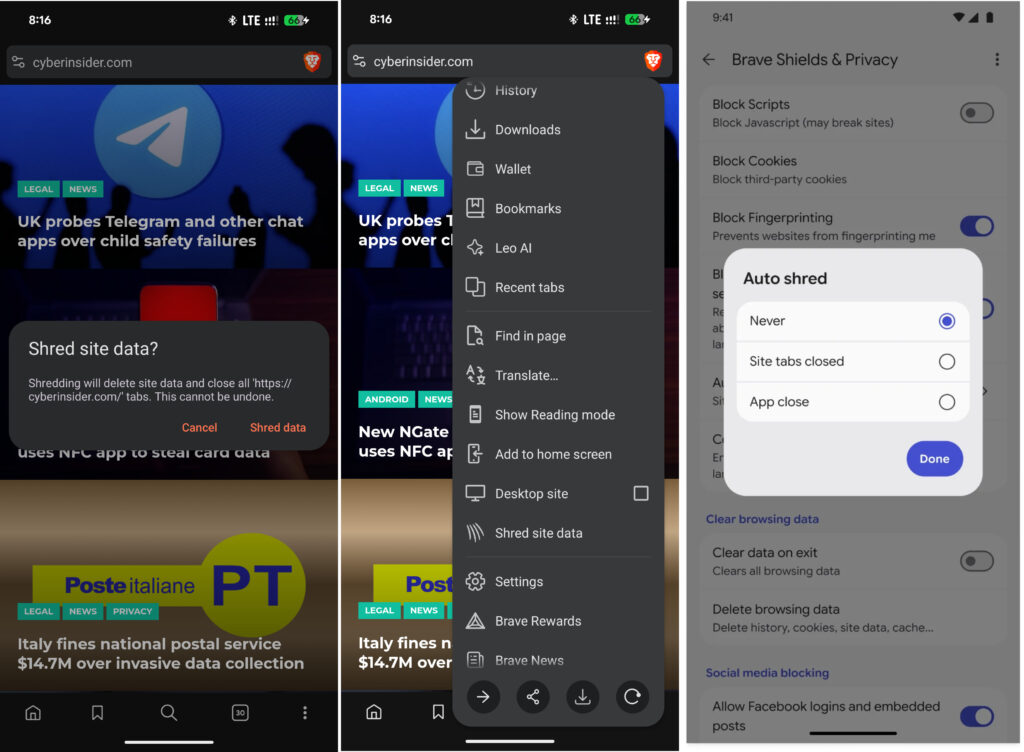
A key addition on Android is “Auto Shred,” which replaces the earlier “forget me when I close this site” feature. Auto Shred allows users to configure automatic deletion of site data either when all tabs associated with a site are closed or when the browser restarts. A 30-second delay is built into the process, giving users a window to restore accidentally closed tabs before data is permanently erased. Users of the previous feature will have their preferences automatically migrated to the new system.
Users can trigger manual shredding through multiple entry points, including the tab switcher, contextual menu, or the Brave Shields panel. When activated, all tabs associated with the selected site are closed, and the corresponding local data is wiped from the device.
The feature specifically targets first-party tracking techniques, which are often used by websites to monitor repeat visits, enforce article limits, or share user activity with partners through server-side mechanisms. By removing stored identifiers, Shred makes it significantly harder for sites to link sessions over time or build persistent user profiles.
On Android, Brave notes it has greater control over browser storage compared to iOS, allowing for more comprehensive deletion of site-accessible data. However, local browsing history remains untouched, as it is not exposed to websites and therefore not part of the tracking surface addressed by Shred.



Leave a Reply