

JPMorgan Chase says attackers targeted third-party vendors and may have accessed marketing data containing some customers’ names and email addresses.
Visa and Mastercard also disclosed incidents involving service providers after the n0n extortion group posted data it allegedly stole from the three companies on November 16.
In its November 19 announcement, Chase said the attack caused no disruption to its services and was unrelated to the banking outage some customers experienced earlier that week. The bank said it would contact affected customers directly where appropriate and offer support, including free credit monitoring.
JPMorgan Chase, the largest US bank, did not name the vendors or say how many customers were affected. However, the leaked records appeared to contain about 16,000 customer email addresses tied to Chase’s invitation-only Reserve credit card program, along with some phone numbers and what it described as Chase account IDs. The leaked data appears to include 124 bank employee email addresses and more than 16,000 customer email addresses, but CyberInsider could not independently verify the data’s authenticity.
Visa stated that the claims concerned a service provider in the Asia-Pacific region. Visa said its systems were unaffected and the incident did not expose payment data such as card numbers.
Mastercard said a provider incident exposed a limited number of email addresses belonging to cardholders enrolled in a benefit program. The company said it had contained the exposure and that customers could continue to use their cards.
n0n claimed the Qubole cloud intrusion
On November 11, n0n claimed responsibility for a supply-chain attack involving Qubole, a cloud data processing platform. The group claimed it had taken nearly a petabyte of data from Qubole and its customers, but that figure remains unverified.
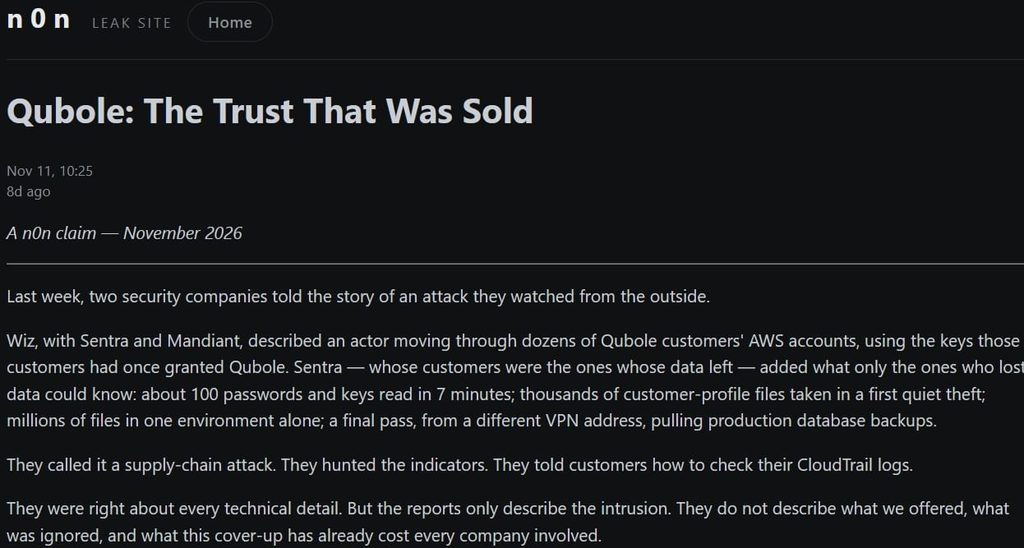
In a November 9 report, Wiz researchers said their investigation with Sentra and Mandiant traced activity between October 14 and 26 to credentials from an AWS account associated with Qubole. The attacker used those credentials to take on roles customers had granted to the vendor, including roles that appeared to be dormant. The attacker collected secrets and downloaded data from Amazon S3 storage. Sentra observed no changes to or deletion of customer data during the theft it documented.
Contact details associated with a premium card program could help scammers tailor emails, texts, or calls to cardholders. Customers who receive a breach notice or a credit-monitoring offer can verify it through their bank’s official app or by calling the number on the back of their card.



Leave a Reply