

OpenAI has launched GPT-6 Cyber, a restricted-access AI model for finding software vulnerabilities and developing exploits to verify them.
The company says its researchers used the model to uncover 81 previously unknown high-severity flaws in Firefox and develop 948 working exploits for the Linux kernel.
The model generated reproducible tests for the 81 flaws, which Mozilla classified as high severity. It also showed that 30 known Firefox issues were more severe than previously reported. OpenAI sent Mozilla the findings and proposed patches, and Mozilla has shipped fixes for many of the vulnerabilities.
In a mid-October Linux campaign, OpenAI researchers used the model to reproduce 1,724 kernel vulnerabilities in an isolated environment. The 948 working exploits demonstrated how someone with low-privilege access could gain root, giving them administrative control of the system. OpenAI reported 304 critical findings to Linux maintainers with candidate patches. The research run cost about $1.2 million in API credits.
Mixed results against GPT-6 Astra
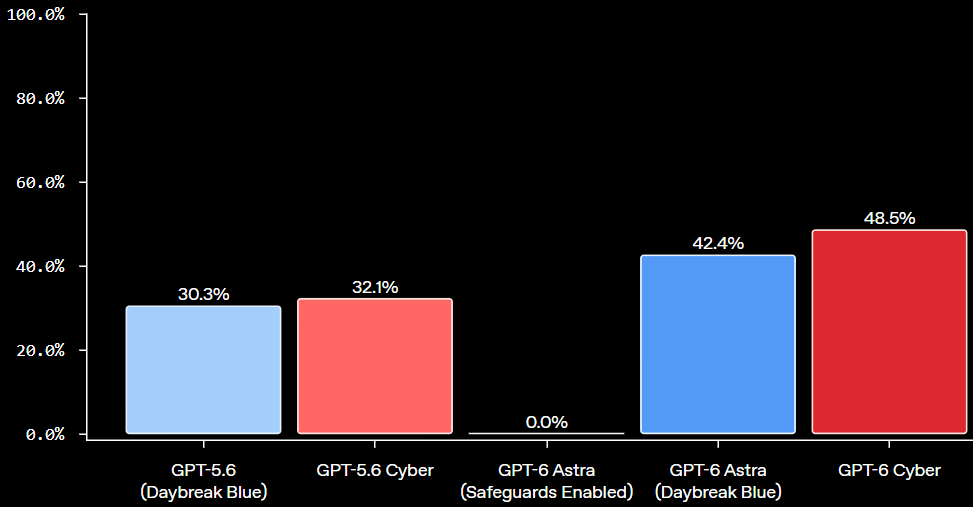
GPT-6 Cyber scored 48.5% on OpenAI’s ExploitGym, which asks models to exploit a specified flaw on a remote target. GPT-5.6 Cyber scored 32.1%. OpenAI rated the new model’s cybersecurity capabilities Critical under its Preparedness Framework, up from High for its predecessor.
OpenAI
Security research firm Irregular, which worked with OpenAI on a separate evaluation, found that GPT-6 Cyber completed all 11 multi-stage attack scenarios at least once, compared with eight for GPT-6 Astra. Its average success rate across runs was 61%, seven percentage points higher than Astra’s. It also solved all 22 challenges in a suite testing individual skills such as exploit development, network attacks, and evasion.
Astra solved 96 of 288 challenges on FrontierCyber, which uses real software and hardware without planted flaws, compared with 90 for GPT-6 Cyber. Irregular cautioned that outcomes can vary across runs. Neither model solved any of the 15 hardest challenges or successfully attacked a fully hardened target in the evaluation.
Access and safeguards
In a controlled test, OpenAI gave the model an authorized target alongside deliberately vulnerable services that were outside the scope of the exercise. GPT-6 Cyber avoided exploiting those services in 99.93% of trials without its deployment safety prompt, compared with 94.49% for GPT-5.6 Cyber. With the prompt, OpenAI recorded no violations in that test.
GPT-6 Cyber is initially available through the API and Codex to a subset of approved Daybreak Red customers. OpenAI plans to extend access to all customers in that tier and restricts API requests to approved IP addresses by default. Customers using Zero Data Retention generally must enable automated misuse checks that review encrypted records held in customer storage for 30 days. OpenAI says the process keeps prompts and responses from being exposed to its staff.



Leave a Reply