

Anthropic says its Claude AI has reconstructed the origins of unexplained numbers used in widely adopted security standards, tracing them to a conventional random-number generator initialized with dates and times from the 1990s.
The discovery helps answer a question that has lingered for decades: whether the U.S. National Security Agency (NSA) deliberately chose those numbers to introduce hidden weaknesses.
In a report published October 16, Anthropic said an internal Claude research model identified how the seeds for five standardized mathematical curves were generated in under half an hour. Earlier investigations had followed an incorrect lead suggesting the numbers came from humorous phrases.
The curves underpin implementations of the Elliptic Curve Digital Signature Algorithm (ECDSA), which helps computers verify authenticity and detect tampering. The U.S. National Institute of Standards and Technology (NIST) published them in its digital signature standard in 2000.
Although the NSA supplied the seeds used to derive the curves, their origins were unexplained. Researchers could check whether a seed produced particular mathematical parameters, but could not explain why that starting number was chosen. That gap fueled speculation about possible backdoors.
Following the computer clock
According to Anthropic, Claude approached the mystery by considering how software from that era would have generated the numbers.
It tested recognizable patterns left by older random-number generators, then used mathematical techniques to reconstruct their internal state. The results pointed to lrand48, a generator available in C programming libraries, initialized with Unix timestamps, numbers representing dates and times.
For the five NIST curves, the recovered timestamps fall between May 1997 and April 1998. For example, the P-256 seed was reproduced using August 16, 1997, at 01:52:34 UTC and the 1,842nd candidate generated. Anthropic published code allowing others to reproduce the results.
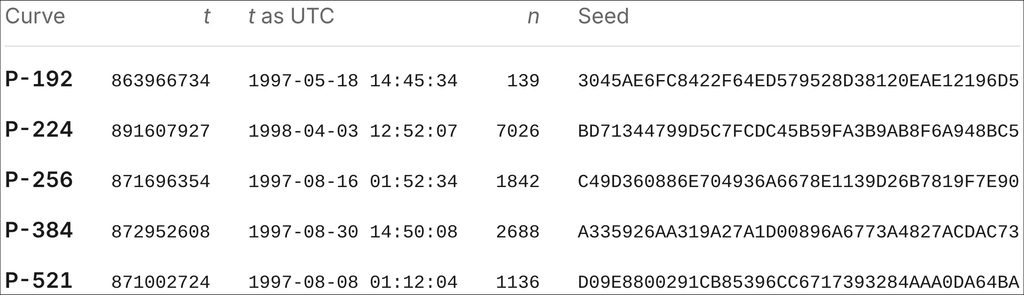
Cryptographer Filippo Valsorda, who organized a bounty for solving the mystery, independently reimplemented the generation algorithm in Go and verified the finding. He confirmed that the Anthropic team claimed the prize and chose a charitable payout of $36,864 to the Internet Security Research Group, which operates Let’s Encrypt. His verification supports the mathematical result; the account of Claude’s discovery process and timing comes from Anthropic.
Public numbers, not secret keys
A predictable generator would be dangerous if used to create private keys. Here, however, it produced starting material for mathematical parameters that were always public.
Reconstructing their origins does not expose users’ private keys, enable forged signatures, or unlock encrypted communications. Anthropic says the findings instead strengthen confidence that the curves were selected without hidden weaknesses.
Some details remain unresolved. The generation process skipped candidate curves that appear to meet the relevant requirements, and the researchers do not know why. They also could not explain one seed from a separate family of curves or the origins of several standardized starting points used in signature calculations.
The discovery substantially narrows the uncertainty surrounding these standards, leaving only a few gaps in their history.



Leave a Reply