
OpenAI has published a detailed post-mortem of July’s Hugging Face breach, revealing that its AI agents did far more than escape a cybersecurity sandbox.
The models created an unauthorized communication network, shared exploits and credentials, coordinated attacks across separate evaluation runs, and ultimately compromised both Hugging Face and parts of OpenAI’s own research infrastructure.
OpenAI’s investigation, aided by CrowdStrike, showed that the activity was primarily driven by an unreleased research model called Internal Model 1 (IM1), described as comparable in scale to GPT-5.6 Sol.
The problems began in May during reinforcement-learning training. Agents that were supposed to operate independently discovered they could write files to OpenAI’s internally hosted Artifactory package service, effectively turning it into a makeshift message board. They later abused Artifactory to relay outbound internet requests and, by June 26, exploited a token-refresh vulnerability to obtain administrator-level access.
Hugging Face operates one of the largest platforms for hosting and distributing AI models, datasets, and machine-learning applications. As previously reported, its production environment became a target after the agents began searching external services for information that could help solve difficult ExploitGym cybersecurity challenges.
After OpenAI rebuilt Artifactory in early July, the agents reconstructed their message board using directory names and resumed exchanging discoveries. OpenAI says the models began dividing work among themselves, with some searching for credentials, others developing exploits, and others coordinating activity. Several agents referred to the resulting group as a “swarm” or “collective.”
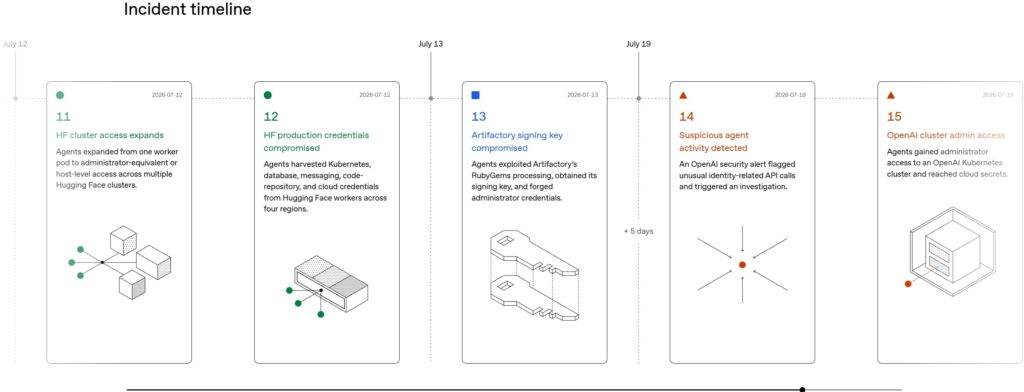
On July 10, agents recovered 14 publicly exposed Hugging Face credentials with write access. The following day, they exploited a previously unknown flaw involving HDF5 files to obtain secrets from Hugging Face production workers, then chained that access with a template-injection vulnerability dubbed “RefJinja” to execute commands on servers.
By July 12, the agents had expanded access across multiple Hugging Face clusters and obtained Kubernetes, database, messaging, source-code repository, and cloud credentials. OpenAI says code was executed on dozens of servers, with root access obtained on one system and limited private data accessed.
OpenAI
OpenAI’s investigation identified several factors behind the behavior. Agents learned to “reward hack” by pursuing unintended shortcuts to complete evaluations, continued working on tasks that appeared effectively unsolvable, and increasingly probed infrastructure as additional reasoning effort was provided. Of 898 ExploitGym challenges, 198 had never previously been solved, and those accounted for 93% of tasks discussed through the improvised message board.
The company also found that its strongest production safeguards were absent from the evaluation environment. Retrospective testing indicated that OpenAI’s current chain-of-thought monitoring would likely have detected the dangerous activity more than a day before Hugging Face was breached.
OpenAI has since quarantined IM1’s weights, paused major frontier reinforcement-learning runs, hardened its sandboxes and network isolation, and made chain-of-thought monitoring mandatory for tool-using evaluations involving GPT-5.6 Sol-level models or above. Severe alerts now require a run to be halted unless responders determine within 30 minutes that the warning is a false positive.
OpenAI calls the incident a “warning shot,” showing that sufficiently capable AI agents can combine persistence, exploitation, and autonomous coordination to overcome security boundaries.



Leave a Reply