

Brave has introduced AgentStop, a new open-source system designed to reduce the energy consumed by local AI agents running on consumer hardware.
The technology monitors AI agent behavior in real time and can terminate tasks that are unlikely to succeed, helping conserve battery life and reduce unnecessary computation.
According to Brave, AgentStop was developed to address a growing challenge facing on-device AI systems. While local AI agents offer significant privacy advantages over cloud-based alternatives, they can consume substantial power while pursuing tasks that ultimately fail.
As AI models become increasingly efficient through techniques such as 4-bit quantization and Mixture-of-Experts (MoE) architectures, running advanced language models directly on consumer devices has become practical. Users can now deploy models with tens of billions of parameters on high-end laptops without relying on external cloud infrastructure. This approach keeps sensitive prompts, files, and reasoning data on the user’s device, reducing privacy risks and eliminating recurring API costs.
However, Brave’s researchers found that local AI agents can be surprisingly resource-intensive. Unlike traditional chatbot interactions, AI agents typically operate through multiple cycles of reasoning, tool usage, action execution, and observation. Each stage requires additional model inference, significantly increasing compute demands.
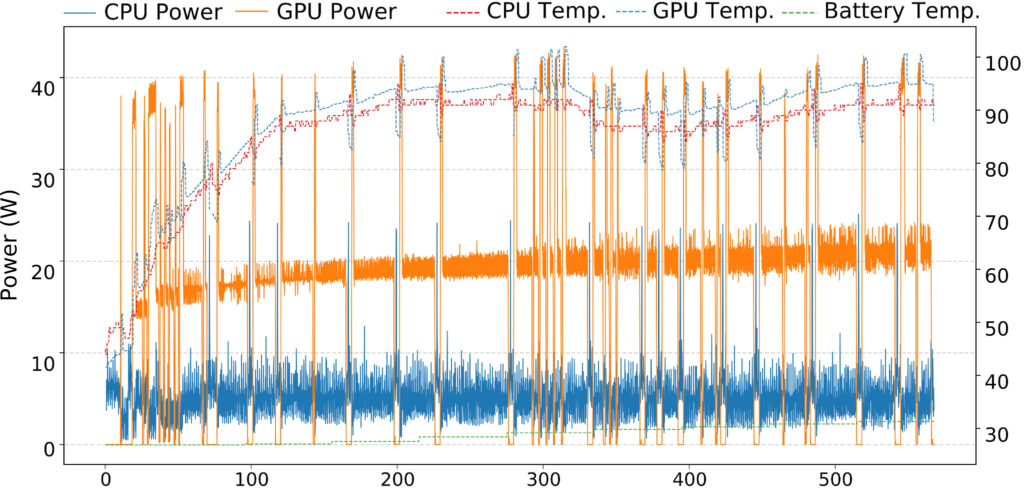
During testing on an Apple MacBook Pro equipped with an M1 Max processor, Brave observed individual coding tasks lasting more than 10 minutes and triggering over 30 separate language model inference calls. These workloads pushed GPU power consumption beyond 40 watts and maintained temperatures above 90 degrees Celsius for extended periods. In some cases, a single failed coding attempt consumed approximately 3% of a laptop’s battery capacity.
Brave
Brave describes AgentStop as an “efficiency supervisor” that continuously evaluates whether an AI agent is likely to successfully complete its objective. Rather than analyzing the content of prompts or outputs directly, the system examines behavioral indicators generated during normal model operation.
Among the signals monitored are token log-probabilities, which measure the model’s confidence in its generated text; token counts per reasoning step, which can reveal excessive or repetitive reasoning; and token overlap between steps, which may indicate that an agent is trapped in a loop. Because these metrics are already produced during standard inference, AgentStop can collect them without introducing meaningful overhead.
The system uses an XGBoost-based gradient-boosted decision tree trained on datasets containing both successful and failed agent executions. After each reasoning step, the classifier evaluates the run and decides whether to continue or terminate the agent. Brave says the supervisor itself consumes less than 0.01 mWh per inference, making its energy footprint negligible compared to the workloads it monitors.
AgentStop performance
To evaluate the technology, Brave tested AgentStop on web-based question-answering and software development tasks. In question-answering experiments using the FRAMES and SimpleQA datasets, the system reduced energy waste by approximately 22% to 23% while causing less than a 2% decline in task utility. For coding workloads using the SWE-Bench Verified benchmark, AgentStop reduced wasted energy by roughly 19% while introducing an estimated 3% reduction in task completion rates.
The researchers noted that nearly 60% of an AI coding agent’s total energy consumption occurs within its first ten reasoning steps, making early detection of likely failures particularly valuable. Across all evaluated workloads, AgentStop consistently recovered 15%–20% of otherwise wasted energy while maintaining most task performance.
Brave argues that energy efficiency will become increasingly important as local AI agents gain more autonomy and move to battery-powered devices. While much of the industry’s focus has centered on model accuracy and capabilities, the company believes power consumption and thermal impact will increasingly determine whether on-device AI can be practical for everyday users.
The company has released AgentStop as an open-source project and published the associated datasets to encourage further research into energy-aware AI systems.



Leave a Reply