

Brave has reduced the memory footprint of its built-in adblock engine by 75%, thanks to a major internal redesign that re-architects how filtering data is stored and accessed.
The update, now live in Brave v1.85, translates into memory savings of around 45 MB by default, with even greater reductions for users who enable additional filter lists.
At the heart of this performance leap is the migration of Brave’s Rust-based adblock engine to use FlatBuffers, a compact, zero-copy binary serialization format originally developed by Google. Designed for memory-constrained environments like games and mobile apps, FlatBuffers allow programs to access serialized data structures directly, without unpacking or parsing them, yielding substantial efficiency gains.
Brave’s previous architecture relied heavily on conventional heap-allocated Rust structures like Vec, HashMap, and standard structs to store over 100,000 adblock rules by default. By switching to FlatBuffers, the team replaced these with a tightly packed format that minimizes overhead and dramatically lowers runtime memory requirements. The transition also introduces zero-copy access patterns, reducing CPU workload and improving responsiveness during browsing sessions.
Brave Software Inc., the company behind the privacy-centric browser, currently serves over 100 million users across desktop and mobile platforms. Known for embedding privacy protections like tracker blocking and anti-fingerprinting directly into the browser, Brave’s architecture contrasts with that of most mainstream browsers, which rely on extension APIs to enable adblocking. This design not only circumvents limitations imposed by Google’s controversial Manifest V3 but also allows for deeper system-level optimizations like the one announced this week.
Additional engineering improvements included in this release, and some arriving in the upcoming v1.86, extend beyond FlatBuffers integration. These enhancements include:
- A 19% drop in memory allocations and a 15% speedup in adblock list compilation thanks to stack-allocated vectors.
- A 13% performance boost in filter matching achieved through regex tokenization.
- Memory sharing between multiple instances of the adblock engine on desktop, saving about 2 MB.
- A 30% reduction in the internal memory usage of adblock-related resource storage.
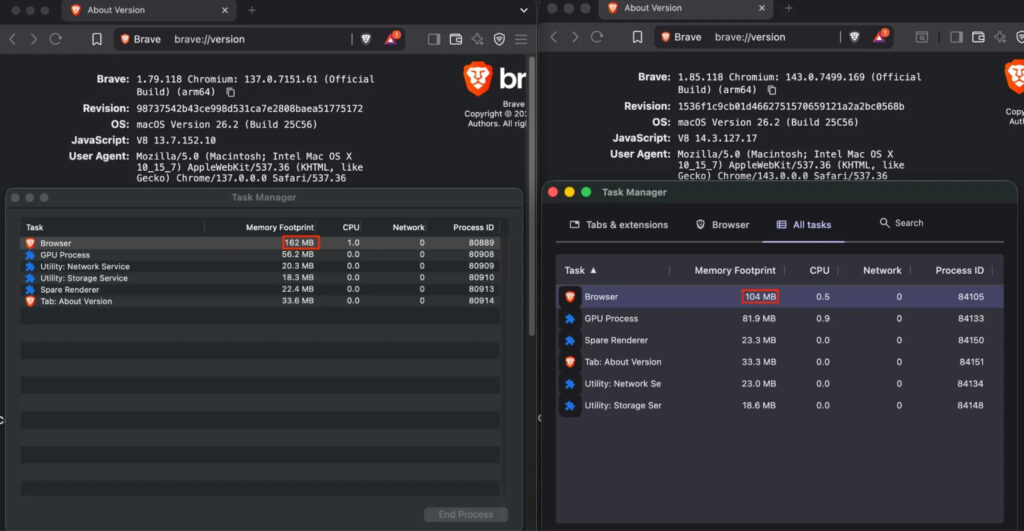
A side-by-side comparison between versions 1.79 and 1.85 of Brave shows memory usage dropping from 162 MB to just 104 MB in typical scenarios. This is particularly beneficial for mobile users and those on older hardware, where every megabyte counts for performance and battery longevity.
Unlike third-party adblock extensions, Brave’s integrated solution avoids the overhead imposed by browser sandboxing and API constraints. This allows for optimizations that extension developers cannot implement, especially as Chromium-based browsers shift to the more restrictive Manifest V3 standard that limits traditional adblocking capabilities.
To benefit from these changes, users simply need to update to Brave version 1.85. For those running large sets of custom filter lists, the memory savings may be even more significant.



Leave a Reply