

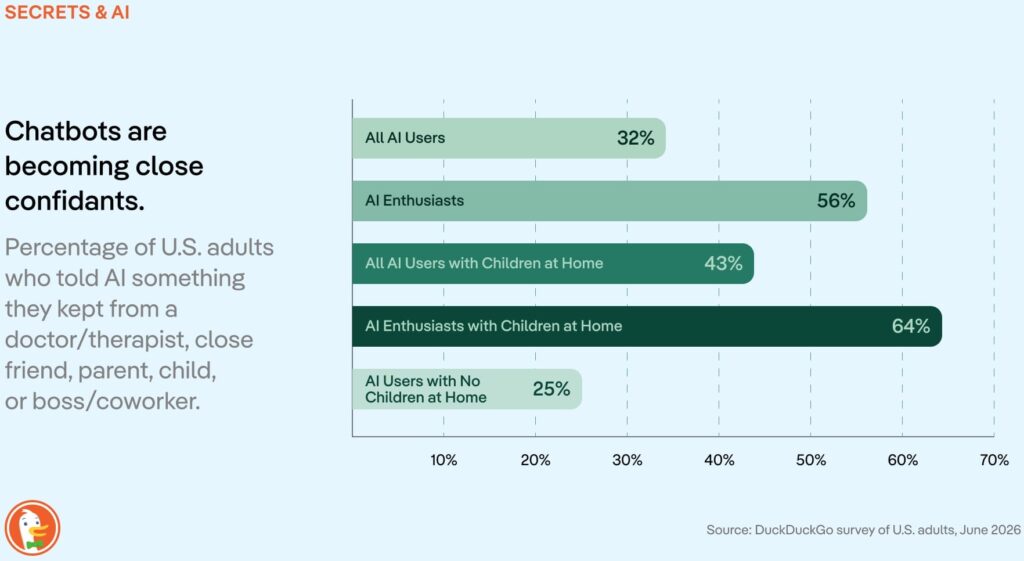
A DuckDuckGo survey of nearly 2,000 US adults found that 32% of people who use AI chatbots have shared information they withheld from friends, relatives, colleagues, or medical professionals.
The figure rises to 56% among respondents who describe themselves as AI enthusiasts.
DuckDuckGo commissioned and conducted the research, collecting responses from 1,944 US adults between June 17 and June 27, 2026, through the PureSpectrum online panel. DuckDuckGo said the survey’s full-sample margin of error is approximately ±2.2 percentage points at the 95% confidence level.
DuckDuckGo is a privacy-focused technology company best known for its search engine and browser. It also operates Duck.ai, a service that provides access to AI models from multiple providers while positioning itself as a more privacy-conscious alternative to conventional chatbot platforms.
The survey results show that parents appear particularly likely to disclose sensitive information to chatbots. Among AI-using parents or guardians with children at home, 43% said they had told an AI something they had never shared with a doctor, therapist, close friend, parent, or child. The rate fell to 25% among AI users without children at home.
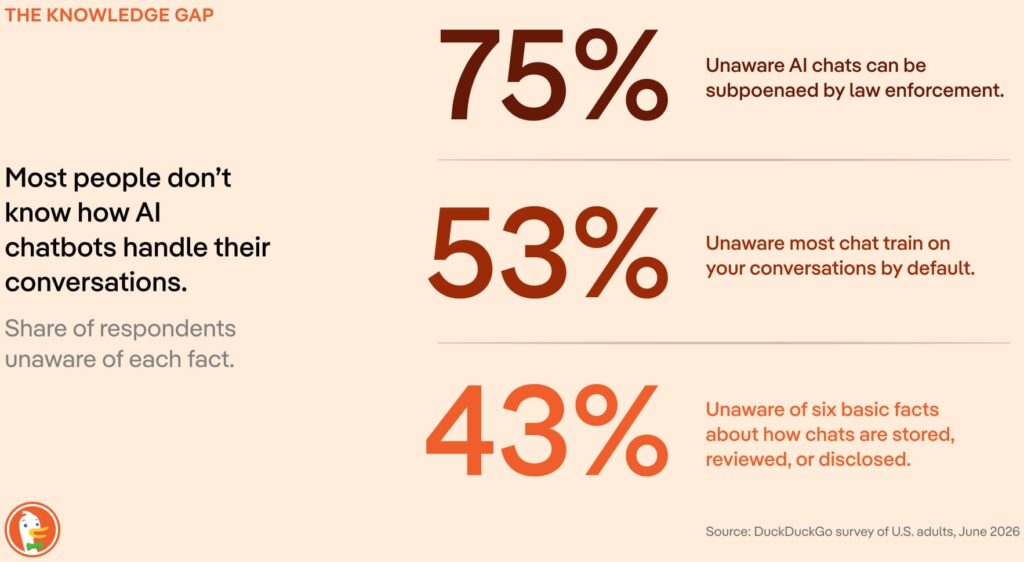
Respondents were also questioned about whether employers may access enterprise AI accounts, human reviewers can see conversations, privacy controls differ between providers, chats can surface in litigation, and free and paid accounts may have different data-handling policies. Overall, 43% were unaware of all six practices examined by the survey.
The survey suggests many users do not fully understand the privacy implications of AI conversations. DuckDuckGo found that 53% of respondents either did not know or were unsure that conversations may be used for AI training. In comparison, only 25% knew chatbot records can potentially be subpoenaed by courts or law enforcement.
When told how chatbot data may be handled, 58% said they were uncomfortable with conversations being used for AI training, including 30% who described themselves as “very uncomfortable.” Only 14% said they mostly or completely trusted large AI companies to protect their data, while 39% reported no trust at all.
The findings are especially relevant because chatbot prompts can contain substantially more personal context than conventional search queries, including health concerns, relationships, work matters, and detailed descriptions of users’ circumstances.
People using AI for sensitive discussions should review each provider’s retention and training settings, disable model-training use where possible, avoid entering information that could identify themselves or others, and assume conversations may be stored or reviewed unless the service explicitly guarantees otherwise.



Leave a Reply