
Proton has announced a major cryptographic upgrade for Proton Drive that significantly improves the performance of its end-to-end encrypted cloud storage platform.
The update makes encrypted file uploads up to 4x faster, while a broader overhaul of Drive's underlying architecture delivers upload speeds up to 3x faster and download speeds up to 2x faster across supported platforms.
In an announcement published today, Proton engineer Jonathan Villemaire-Krajden detailed a new encryption implementation based on recent updates to the OpenPGP standard, which Proton Drive uses to protect stored files.
Proton Drive stores files using a structure that breaks content into encrypted blocks, each tied to a cryptographic key stored within a file node. Previously, file uploads relied on a version 3 Public-Key Encrypted Session Key (PKESK) packet and a version 1 Symmetrically Encrypted Integrity Protected Data (SEIPD) packet. The new implementation upgrades these to v6 PKESK and v2 SEIPD packets.
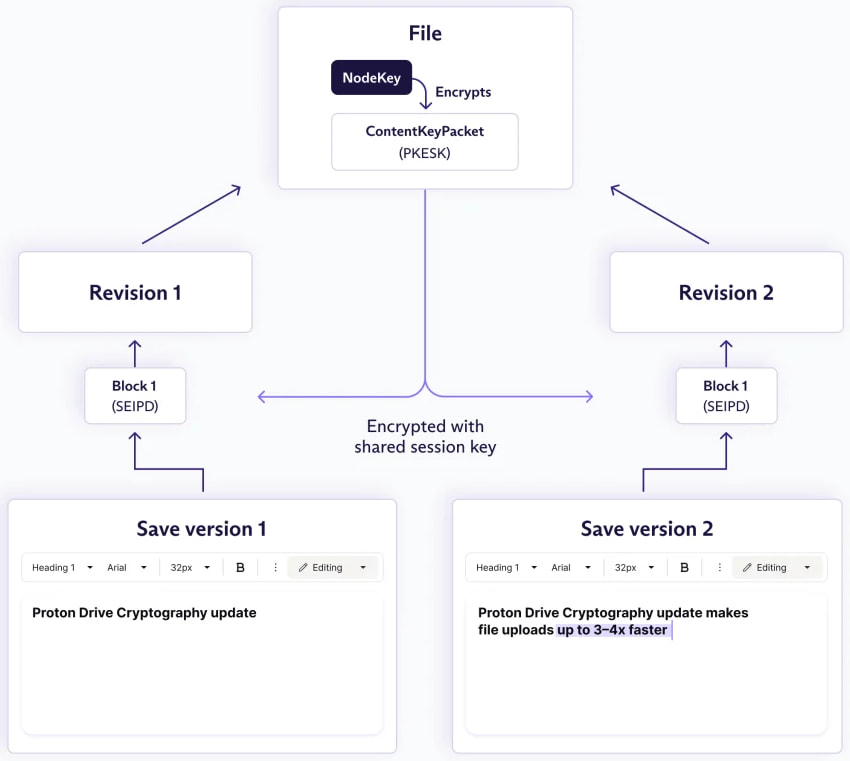
The most significant performance improvement comes from adopting AES-GCM for content encryption. Proton says the algorithm can leverage hardware-accelerated encryption on most modern processors, reducing the computational overhead of encrypting data before upload.
According to benchmarks shared by the company, encrypting a 4 MB file on mobile devices reduced the time from approximately 97 milliseconds to 32 milliseconds. On higher-end processors, the same operation fell from 12 milliseconds to just 3 milliseconds. Larger workloads saw similar gains, with encryption of an HD movie or roughly 1,000 high-resolution photos decreasing from about 90 seconds to 30 seconds on mobile devices and from around 12 seconds to 3 seconds on desktop systems.
Proton describes the improvement as “up to 4x faster,” which translates to a 300% increase in encryption throughput or a 75% reduction in processing time.
The company notes that the change introduces compatibility requirements for file revisions. Because Proton Drive reuses session keys across file versions, all revisions must use the same encryption scheme as the original upload. Older clients that do not support the new packet versions may be unable to modify files created after the upgrade, necessitating client updates.
In a separate announcement, Proton's Anant Vijay Singh revealed that the company has also rebuilt Proton Drive around a shared software development kit (SDK) that now powers uploads, downloads, encryption, synchronization, and other core functions across Windows, macOS, Android, iOS, and web applications.
The SDK consolidation has enabled broader performance improvements beyond the cryptographic upgrade, including upload speeds up to 3x faster, download speeds up to 2x faster, faster photo loading, and smoother navigation through large photo libraries. Proton says the shared codebase will also simplify future feature development and integrations across its ecosystem.
The company added that the SDK already powers Proton Drive integration with its Lumo AI assistant and will serve as the foundation for the long-awaited Linux client currently under development.



I didn’t read this article because I have had Proton for years and their customer is the absolute worst! Idk why they always get such high ratings. I almost NEVER get my issues revolved. Save your money and go somewhere else!! Do NOT believe the hype about them- I’ve spent 7 days now asking a very simple question about being double billed. Still, no resolution. No answer. I’ve had them NEVER get back to me on my questions, on multiple occasions. Don’t throw your money away. They’re a headache!
Agree!
And their VPN service sucks big time after the latest upgrades.
I will not renew my subscription and move to Mullvad.