

ETH Zurich researchers have demonstrated what they describe as the world’s first generation of certifiably perfect random numbers using a quantum experiment based on entangled superconducting qubits.
The breakthrough could strengthen future encryption systems, digital identity protections, and quantum-secure communications by eliminating subtle biases found in conventional random number generators.
The experiment by ETH Zurich’s Department of Physics amplified imperfect randomness into mathematically certifiable perfect randomness using a high-precision Bell test, a quantum physics experiment used to verify entanglement between particles.
Random number generation is a core component of modern cybersecurity. Encryption protocols, authentication systems, blockchain technologies, and secure communications all rely on random values to generate cryptographic keys. However, researchers note that even advanced hardware random number generators are not truly perfect. Small physical imperfections and statistical biases can make certain outputs appear more frequently than others, potentially weakening cryptographic systems.
ETH Zurich’s approach seeks to overcome that limitation by leveraging quantum mechanics. The experiment used two superconducting quantum chips connected through a 30-meter cryogenically cooled link that allowed microwave photons to travel between them. The photons created quantum entanglement between the qubits, enabling measurements performed on one qubit to instantly influence the state of the other.
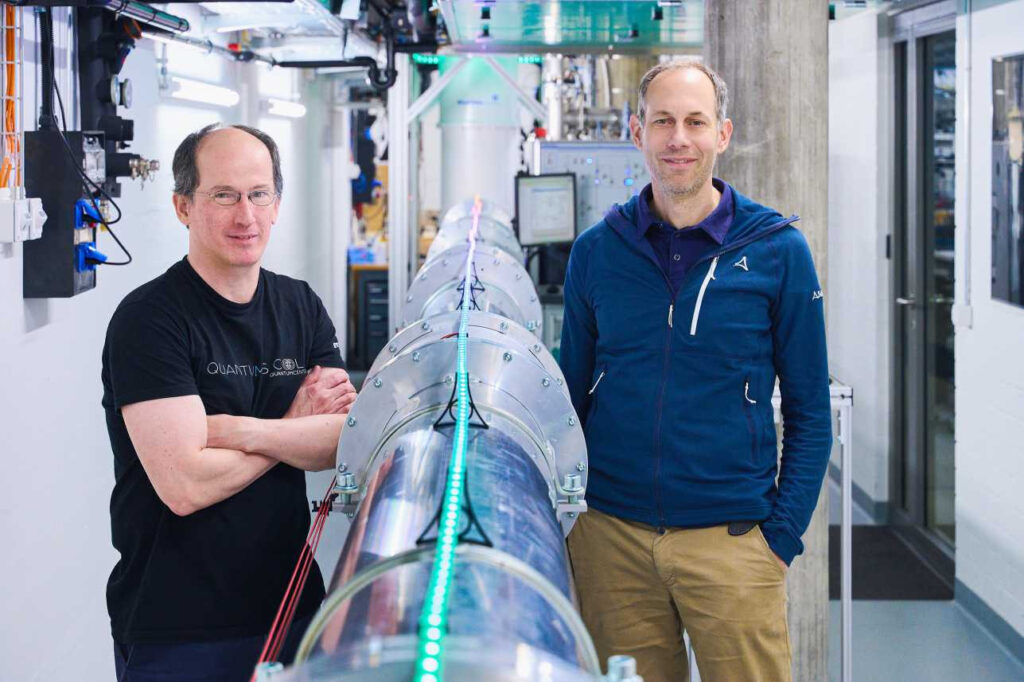
ETH Zurich
The 30-meter separation ensured that no information could be exchanged between the qubits during measurements, even at the speed of light. Preventing communication between the systems was essential for maintaining the integrity of the Bell test and proving the measurements were genuinely unpredictable.
Wallraff’s team used an intentionally imperfect random number generator to select the measurement basis for each qubit. Renner’s group then applied a randomness amplification algorithm to process the outputs into a sequence of certified random bits.
According to Renner, the resulting numbers are not merely statistically random but provably random under the laws of physics. The researchers argue that the generated sequences would remain unpredictable regardless of future analytical methods or computational advances.
The researchers compare the potential importance of certified randomness to the role atomic clocks play in timekeeping. A certified random number source could serve as a trusted foundation for cryptographic systems and public digital infrastructure.
Potential applications extend beyond encryption. Public randomness services could support digital lotteries, blockchain consensus mechanisms, election auditing systems, and zero-trust authentication frameworks. In quantum-secure communication networks, guaranteed randomness may become increasingly important as organizations prepare for cryptographic threats posed by future quantum computers.
The findings also address a long-standing cybersecurity challenge: cryptographic systems are often compromised not because encryption algorithms are weak, but because the random numbers used to generate keys are flawed or predictable.
While the ETH Zurich experiment remains a laboratory demonstration, researchers believe the technology could eventually form the basis for commercial high-assurance randomness services.



Leave a Reply