

Apple has provided US law enforcement with the real identity behind an anonymized iCloud email address generated using its “Hide My Email” feature, according to newly unsealed court documents.
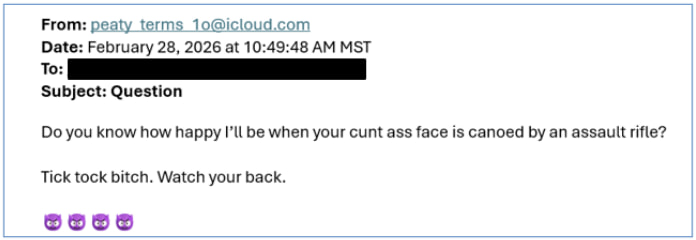
The disclosure was revealed through a federal affidavit first reported by 404 Media, based on court records. The documents detail an FBI investigation into a threatening email sent on February 28, 2026, to Alexis Wilkins, identified in the affidavit as the girlfriend of FBI Director Kash Patel.
According to the affidavit, Wilkins received a message from the address peaty_terms_1o@icloud.com, an alias generated through Apple’s Hide My Email feature. The email contained explicit violent threats and was quickly forwarded to law enforcement the same day. Investigators then sought assistance from Apple to identify the sender behind the anonymized address.
CourtWatch
Apple responded by providing subscriber data linking the alias to a primary Apple ID registered under the name Alden Ruml, with the associated email address alden.ruml@icloud.com. The records also revealed that the account had generated 134 anonymized email aliases using the Hide My Email service, highlighting the scale at which the feature can be used for compartmentalized communications.
Further technical data shared by Apple included device associations tied to the account, such as an iPhone 17 Pro, an iPad Mini, and an Apple Watch Ultra 3. These details helped investigators build attribution, alongside logs and metadata typically retained by Apple services, such as IP addresses and account activity history.
Law enforcement agents later interviewed Ruml in Cambridge, Massachusetts, where he admitted to sending the threatening message after reading a news article about FBI resources being used to provide security for Wilkins. He reportedly claimed he did not intend to carry out any violence. The affidavit notes that a grand jury indicted Ruml on March 12, 2026, for transmitting a threat in interstate commerce.
Apple’s Hide My Email feature is part of its iCloud+ subscription service and is marketed as a privacy tool that allows users to generate random email addresses that forward to their real inbox. The feature is commonly used to avoid spam, protect personal email addresses during sign-ups, or maintain anonymity in online interactions.
While the company emphasizes privacy in its marketing, the affidavit shows that it can still access and disclose identifying account information when compelled by a valid legal process. In this case, Hide My Email's anonymization did not prevent Apple from mapping the alias back to the originating account. Although Hide My Email obscures a user’s real address from third parties, Apple retains the underlying linkage necessary to route emails, making it accessible under lawful requests.
Users seeking stronger anonymity should understand that such features are designed to protect against commercial tracking and spam, not to guarantee immunity from law enforcement identification.



Leave a Reply