

VPN provider Surfshark has rolled out post-quantum encryption support for its WireGuard protocol, marking a significant step toward future-proofing user privacy against the looming threat of quantum computing.
The new feature, now live across Surfshark’s apps, integrates quantum-resistant cryptographic algorithms into the handshake process of WireGuard, a modern VPN protocol favored for its speed and security. With this move, Surfshark aims to protect user data from potential “Harvest Now, Decrypt Later” (HNDL) attacks, where threat actors collect encrypted data today to decrypt it once quantum computing becomes powerful enough to break classical encryption methods.
Surfshark is a privacy-focused VPN provider, a very popular choice in the consumer space. It offers services such as a no-logs policy, RAM-only servers, and multi-hop VPN routes. With this latest move, it becomes the third major VPN provider to adopt quantum-safe encryption, after NordVPN and ExpressVPN, which made similar announcements in October 2024 and January 2025, respectively.
The implementation is part of a broader cybersecurity industry initiative to prepare for the so-called “quantum threat,” a scenario in which quantum computers, once sufficiently advanced, could render current public-key encryption schemes obsolete.
While large-scale quantum computers are not yet commercially viable, governments and tech giants are investing heavily in their development. Entities such as Google, IBM, and Chinese state-funded labs are actively racing toward quantum advantage. Meanwhile, cybersecurity experts warn that adversaries may already be stockpiling encrypted data for future decryption.
Surfshark’s post-quantum enhancement specifically enhances the WireGuard protocol, which originally uses the Noise Protocol Framework for its cryptographic handshake. The upgrade replaces or augments these mechanisms with quantum-resistant key exchange algorithms, likely based on lattice-based cryptography, although Surfshark has not yet disclosed the precise technical implementation. Lattice-based schemes, favored by NIST in its post-quantum cryptography standardization process, are resistant to known quantum attacks like Shor’s algorithm.
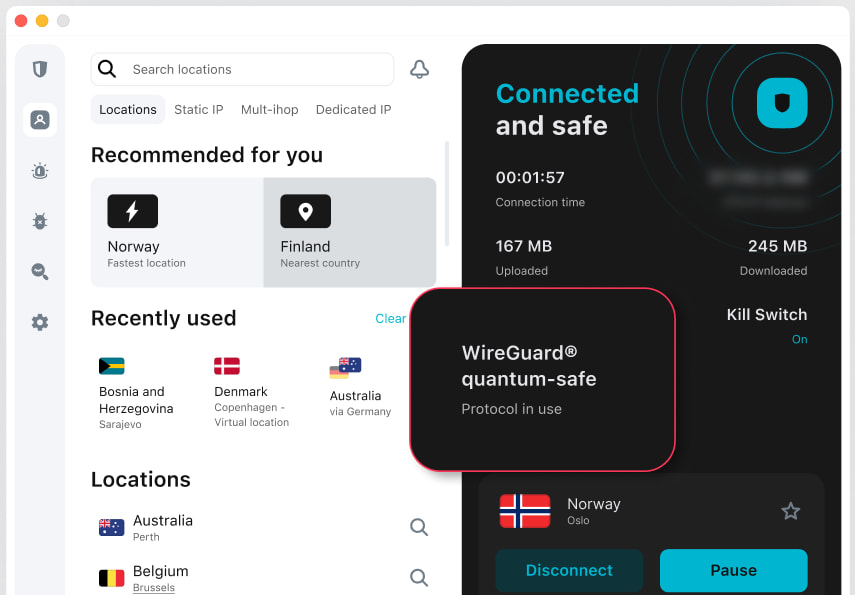
To enable post-quantum protection, users simply need to:
- Open the Surfshark app
- Navigate to VPN Settings > Protocol
- Select WireGuard as the protocol
Once this is done, the VPN tunnel established via WireGuard will automatically include quantum-resistant encryption in the handshake phase, securing the initial key exchange from future compromise.



Leave a Reply