

Mozilla has introduced a free, built-in VPN feature in Firefox 149, offering users up to 50GB of protected browsing traffic per month directly within the browser.
The new capability was touted as coming last week, but it has now landed with the release of Firefox version 149.0, announced earlier today. According to Mozilla, the VPN is being deployed through a progressive rollout, initially targeting users in the United States, the United Kingdom, Germany, and France. Eligible users will see a prompt in the browser toolbar inviting them to enable the feature after signing into a Mozilla account.
Technically, the built-in VPN operates by routing Firefox browser traffic through a secure proxy server, masking the user’s IP address and apparent location. Unlike traditional VPN services that encrypt and route all system traffic, this implementation is limited strictly to activity within the Firefox browser. Mozilla emphasizes that this design keeps the feature lightweight and easy to enable, while still providing meaningful privacy protection for common browsing scenarios such as using public Wi-Fi or accessing sensitive information.
The feature includes a monthly data cap of 50GB, with in-browser notifications alerting users as they approach the limit. Users can toggle the VPN ‘on’ or ‘off’ at any time and configure exceptions for specific websites that should bypass the proxy. Firefox allows up to five domains to be excluded simultaneously through its privacy settings panel.
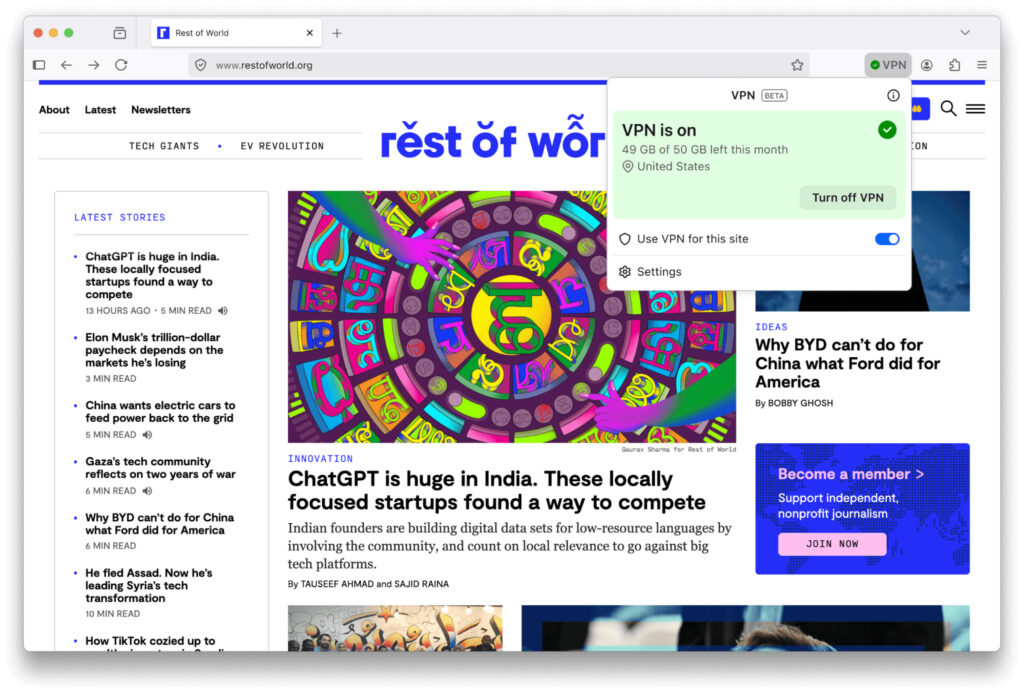
Mozilla states that certain internal services are excluded from VPN routing to ensure proper functionality, such as account authentication and public Wi-Fi login flows. The company also notes that while it collects limited technical and usage data, such as connection status or aggregate data consumption, it does not log browsing activity, visited websites, or the contents of user communications.
Mozilla, the non-profit organization behind Firefox, has long positioned itself as a privacy-focused alternative to Chromium-based browsers. Its existing Mozilla VPN product, a paid subscription service, provides full-device protection across applications. The new built-in VPN is positioned as a complementary, entry-level option that increases accessibility to privacy features without requiring payment or additional software installation.
In addition to the VPN, Firefox 149 introduces several other updates, including a Split View feature for side-by-side tab comparison, improved PDF performance via hardware acceleration, and enhanced protection against malicious notification spam by automatically revoking permissions for flagged sites. The release also strengthens defense-in-depth against potential exploits by tightening JavaScript execution requirements in the browser’s parent process. Finally, Mozilla engineers squashed several bugs in this release, including 19 high-severity flaws.
While the built-in VPN lowers the barrier to entry for privacy protection, users should be aware that other applications and system-level connections remain exposed. Those requiring broader protection will still need a full-device VPN solution.



Interesting to see how will competitors will respond!