

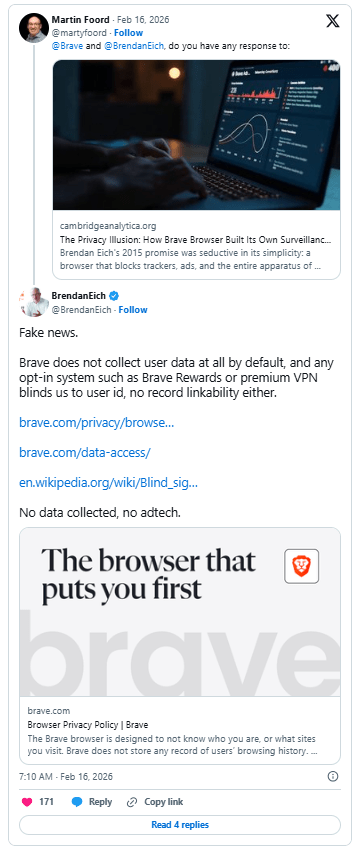
Brave co-founder and CEO Brendan Eich has dismissed allegations that the privacy-focused browser secretly tracks users, calling the claims “fake news.”
The denial follows the publication of a report by Cambridge Analytica accusing Brave of building, through its Brave Ads platform, what it describes as a sophisticated behavioral profiling system. The article by Nicolas Menier alleges that while Brave blocks third-party trackers, it replaces them with its own on-device data collection mechanisms that monitor user attention, browsing patterns, and ad engagement, later converting that information into anonymized tokens for advertising purposes.
Responding directly to the accusations on X, Eich rejected the claims outright. “Brave does not collect user data at all by default, and any opt-in system, such as Brave Rewards or premium VPN, blinds us to user id, no record linkability either.” He linked to Brave’s privacy documentation, data access policy, and technical explanations of blind signature cryptography, which the company says ensures that ad confirmations cannot be tied back to individual users.
Brave Software, founded in 2015 by Eich, who also co-founded Mozilla and created JavaScript, positions itself as a privacy-first alternative to Google Chrome and Microsoft Edge. The browser blocks third-party trackers and ads out of the box and currently claims over 100 million monthly active users. Its primary revenue source is Brave Ads, an optional advertising system that users must explicitly enable through the Brave Rewards program.
According to Brave’s published technical materials, ad matching occurs locally on the user’s device. The browser downloads an ad catalog and selects relevant ads based on interest signals stored on the device. When a user views an ad and qualifies for a reward payout in Basic Attention Token (BAT), the confirmation process uses blind signatures to validate the event without revealing browsing history or identity to Brave’s servers. The company has repeatedly stated that it does not build centralized browsing profiles and cannot link ad activity to specific individuals.
Cambridge Analytica challenges that framing, arguing that on-device behavioral analysis still constitutes tracking, even if raw data never leaves the device. It claims that Brave’s system collects granular engagement metrics and that tokenized reporting could, in theory, enable indirect profiling. It also raises concerns about Brave’s expanding ecosystem, including Brave Search and AI integrations, suggesting broader visibility into user behavior.
Eich maintains that its architecture was specifically designed to avoid the data harvesting practices commonly associated with traditional adtech platforms. Unlike Google’s model, which relies on server-side data aggregation tied to user accounts and identifiers, Brave argues that its system prevents user identification and record linkability altogether.
For users, the practical distinction is that Brave Rewards and Brave Ads are disabled by default. Those who prefer a tracker-blocking browser without advertising components can use Brave with Rewards turned off, in which case no ad-related data processing occurs. Users can also review Brave’s privacy documentation and open-source codebase to assess how the system functions.



I can’t believe anyone would print a word Cambridge Analytica issues, after its proven political interference in South Africa (the “white monopoly capital campaign”).
Oh my! Privacy Guides has gone full blown censorship! Someone posted about this article and the referenced Cambridge article and after a few hours and many comments they just deleted the entire thread!
Wow. Privacy Guides has hit a new low. Money be flowing behind the scenes there to protect their pet projects.
Sad, really.
The folks at Privacy Guides turn themselves into pretzels pushing this browser even though it has had numerous nasty incidents thru the years, always for some reason making excuses for the inexcusable. Gotta wonder what the ties are to that group. Brings its own set of questionable actions & agendas tied to this “privacy” browser
The CEO screaming “fake news” really sums it all up and tells you exactly who they are
Golden rule: Always follow their actions, not their words
If any other browser had “opt-in” privacy nightmare switches PG would be going scorched earth, 20 page bashing threads. Yet, with Brave… crickets. Or even far worse, excuses. Already seeing them line up with their sad excuses for this latest Brave atrocity upon privacy. The question is … why?
As you say, the Brave CEO has certainly shown exactly who he is, and it is ugly. Yet, from the PG team, Brave always get a pass. Again, one must ask, why.
The fact Brave is coming out with a “clean” paid for version should clue folks in they have always been a privacy nightmare using user data for profit.
You know… exactly as their past history literally tells us over & over again.
Good day.
What browser do you recommend?