
The security policy for New York City’s 2026 mayoral inauguration has raised eyebrows after explicitly banning Raspberry Pi and Flipper Zero devices, placing them alongside explosives, drones, and weapons on the event’s official list of prohibited items.
The updated item list, published on the official inauguration website, marks an unusual departure from traditional security protocols typically focused on categories of threat rather than specific consumer electronics.
The devices in question — Raspberry Pi, a versatile, credit card-sized single-board computer — and Flipper Zero, a multi-tool for hardware penetration testing, are widely used across industries and communities. Raspberry Pi has become a cornerstone in education, DIY projects, journalism tools, and digital accessibility, while Flipper Zero, although controversial, is legally sold and marketed as a platform for ethical hacking, testing, and research.
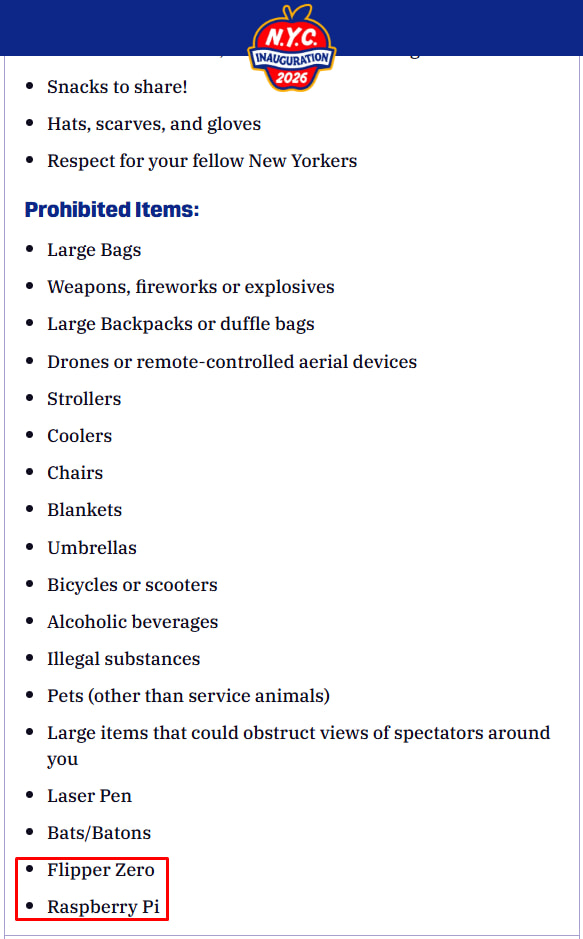
The ban appears to stem from concerns about unauthorized signal interference, data interception, or other forms of electronic disruption. However, the policy offers no technical justification, risk categorization, or even a general ban on “radio-frequency testing devices” or “electronic intrusion tools.” Instead, it simply singles out two named products, without clarifying what specific threat they pose in the context of a public outdoor gathering.
This lack of specificity is troubling, particularly because more powerful and multifunctional devices like smartphones and laptops, fully capable of executing complex attacks, are not restricted. The discrepancy has drawn criticism that the policy prioritizes perception over actual risk mitigation.
Flipper Zero’s reputation has been complicated by widespread misuse, often amplified on platforms like YouTube. Users have demonstrated how the device can be repurposed to clone RFID badges, jam signals, and manipulate wireless infrastructure, sometimes irresponsibly, for entertainment or clicks. While these behaviors have fueled public concern, they do not represent Flipper’s intended use, and the device remains legal for purchase and use in the United States, provided it’s not employed in criminal activity. It’s worth noting that the same functionalities can be replicated using a variety of microcontrollers, SDR tools, or even phones with specialized apps.
By banning Flipper Zero by name, the city risks stigmatizing an entire category of lawful cybersecurity tools and, more broadly, the culture of digital tinkering and education that surrounds them. Raspberry Pi’s inclusion is even more perplexing, given its ubiquity in classrooms and maker spaces, although it too has been implicated in cybercrime operations.
The city’s newly elected mayor has yet to directly address the backlash or provide a rationale for these specific bans. According to outreach attempts by concerned parties, the press contacts listed for the transition team have acknowledged the concerns but have not yet offered an official comment or revision.



Leave a Reply