

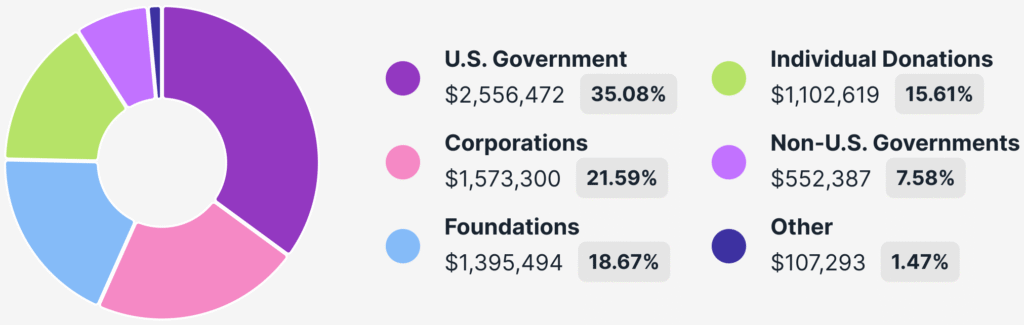
The US government contributed over $2.5 million to the Tor Project in its 2023–2024 fiscal year, marking a continued but reduced financial relationship with the privacy-focused nonprofit.
The funds represent 35% of Tor’s $7.28 million in reported revenue, according to newly released financial disclosures.
The funding, primarily sourced through the US State Department’s Bureau of Democracy, Human Rights, and Labor (DRL), supports multiple high-impact projects aimed at strengthening internet freedom, especially in regions experiencing heavy censorship. The largest single contributor was DRL, providing $2.12 million. These funds were allocated across several major initiatives, including expanding Tor access in China, Hong Kong, and Tibet; developing a Tor-based VPN client for Android; combating malicious Tor relays; and migrating core network infrastructure to a more secure Rust-based implementation (Arti).
The Tor Project also received $340,681 via the Open Technology Fund for projects like establishing onion services for USAGM-affiliated media, providing support for users in Turkmenistan, and maintaining the Tails operating system. Smaller grants came through partnerships with the International Republican Institute ($80,029) and the National Science Foundation in collaboration with Georgetown University ($14,715), the latter supporting simulation research via the Shadow Simulator.
Despite ongoing US government involvement, the Tor Project emphasized its progress in diversifying funding sources. In 2021–2022, government funds made up over 53% of total revenue, but in 2023–2024, that number dropped to just over 35%. Corporate and nonprofit contributions led by groups like OpenSats, Mullvad, and Proton now account for over 21%, while individual donations contributed over $1.1 million, representing 15.6% of the total. Non-US government funding came primarily from Sweden’s Sida agency.
The Tor Project, a nonprofit 501(c)(3) founded in 2006, maintains the Tor anonymity network and its surrounding ecosystem of tools, including the Tor Browser and Onion Services. Its mission is to provide private, uncensored access to the internet, particularly in repressive environments. While Tor’s roots lie in US Naval Research Laboratory work, the organization today operates independently, guided by a social contract and open-source development model.
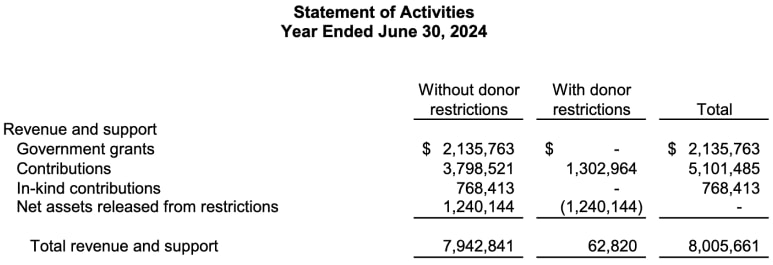
In-kind community contributions also played a substantial role in 2023–2024, valued at over $768,000. These include tens of thousands of hours of development, server hosting, and translation work, though the report noted that time and costs from relay operators remain undercounted.
Tor’s operating expenses totaled $7.34 million according to its IRS Form 990, with 84% spent on program services, 10% on administration, and 6% on fundraising. A separate audit listed total expenditures at $8.1 million, incorporating in-kind donations.
The figures were published alongside the audited financial statements and federal filings, fulfilling legal requirements and aligning with the project’s broader commitment to transparency. Despite staff capacity delays in posting the accompanying blog, Tor emphasized that financial documents had been available for some time.
The funding details were accompanied by direct links to project repositories and descriptions of ongoing development work, underlining Tor’s effort to demystify its funding model and assert autonomy in how projects are defined and executed.



Leave a Reply