

Based on our latest tests, we’ve compiled this Incogni review to help you determine if this data removal service is worth your time and money.
If you’ve ever Googled yourself and found your home address, phone number, and relatives’ names staring back at you, you know that sinking feeling of digital exposure. In a world where your personal data is traded like loose change, the promise of a set-and-forget privacy tool like Incogni can sound almost too good to be true.
I’ve spent the past three years testing personal data removal services the unglamorous way: Submitting real opt-out requests, tracking broker listings over time, checking whether removed profiles quietly reappear, and comparing results across the same set of sites. In other words, I don’t just take these tools at their word. I verify whether they actually keep yours.
We compiled this review not only by testing out the service and verifying the results, but we also looked at other Incogni reviews online, such as on Reddit and other user forums.
| Starting price | $6.79/month (billed annually at $81.50) |
| Broker coverage | 420+ (2,400+ with custom removals) |
| Core advantage | Fully automated, set-and-forget removal system |
| Trust signal | Deloitte audited for privacy and removal accuracy |
| Refund policy | 30-day money-back guarantee |
| Support | 24/7 email and phone support (with premium only) |
| Best deal | 55% Off Coupon > |
Putting Incogni through months of testing in 2025 and 2026, I kept my expectations locked down tight. Monitoring which listings dropped off, how quickly removals were processed, and whether my data stayed gone didn’t just catch me off guard. It changed how I think about what modern privacy tools can (and can’t) realistically keep under wraps.
The quick verdict: Is it worth it?
The short answer: Absolutely. In 2026, trying to guard your privacy manually is like trying to empty the ocean with a leaky spoon.
After living with the service for months, my Incogni review verdict is clear: It’s easily one of the most efficient and “budget-friendly” data removal services on the market. And if you snag the annual plan, you’re looking at $6.79/month.
Why it’s a standout:
- The “heavy lifting”: It automates data removals across 420+ data brokers. Doing this yourself would require the patience of a saint and the free time of a retired billionaire.
- Spam slasher: If your phone vibrates more than a beehive with spam calls and junk marketing, this is your new best friend.
- Verified peace of mind: This isn’t some “trust me, bro” operation. Incogni is Deloitte-verified and fully compliant with General Data Protection Regulation (GDPR) and California Consumer Privacy Act (CCPA) privacy laws.
The magic isn’t in the first request – it’s in what happens after. Incogni keeps returning every 60 days to make sure your details don’t sneak back onto people-search sites.
Exclusive Incogni Deal:
Incogni is giving CyberInsider readers an exclusive 55% off deal with the coupon below:
(Coupon is applied automatically; 30-day money-back guarantee.)
Incogni pros and cons
+ Pros
- Covers over 420 active data brokers globally
- Targets over 2,000 data sources via custom requests
- Recurring follow-ups without any effort on your part
- Suppression lists block future data resales
- Helps cut down spam and scam risks
- Strengthens identity security across regions
- Clean, intuitive Incogni dashboard
- Family-focused plans protect multiple household members
- Works across the US, the UK, Canada, EU
- 24/7 live chat customer support available
- Deloitte audited removal request process
– Cons
- No visual proof of completed removals
- Custom removal requests and live phone support locked to higher tiers
- No dedicated mobile app yet
Incogni feature summary: The “search and destroy” toolkit
Incogni doesn’t just ask nicely for your data back; it uses legal frameworks like GDPR, CCPA, and PIPEDA to force brokers’ hands. Here’s the tech under the hood:
- The automated “sledgehammer”: Incogni automatically identifies brokers likely to have your data and blasts out removal requests to 420+ platforms simultaneously. No manual clicking required.
- The persistence engine: Incogni performs recurring rescans every 60–90 days to ensure deleted profiles stay dead.
- Unlimited custom removals: Found your info on a weird, niche site not on their list? If you’re on the Unlimited tier, you can flag it, and their team will manually hunt it down for you.
- Legal compliance: Because they are part of the Surfshark privacy family, they have the legal infrastructure to handle complex opt-outs that smaller “free” tools simply can’t touch.
- The Deloitte-verified dashboard: You get a clean, bird’s-eye view of “Sent,” “In Progress,” and “Completed” requests. While they don’t provide screenshots, their process is independently audited by Deloitte to ensure those “Completed” statuses are 100% legit.
- Risk mitigation scoring: Incogni categorizes brokers by sensitivity levels (Social, Financial, Recruitment, etc.), so you can see exactly which parts of your life were most exposed.
The takeaway? Incogni takes the grind out of privacy. No flashy screenshots, but Deloitte-audited automation and relentless follow-ups make it a smart, low-effort way to get your data off the market.
My hands-on experience: How I put Incogni to the test
To find out if you can truly disappear online, I had to be the guinea pig. I spent two months deep-diving into the platform (four weeks on the Standard plan and another four weeks testing the Unlimited one) to see if the extra cost actually buys you more privacy.
I didn’t just watch a progress bar move; I benchmarked Incogni against heavy hitters like DeleteMe, Optery, and Privacy Bee to see who actually has the fastest “search and destroy” reflex.
My testing protocol:
- Real data only: I fed Incogni my actual breadcrumbs: Full name, DOB, three email addresses, phone number, and two physical addresses. If a broker had it, I wanted it gone.
- The weekly stakeout: I logged into the dashboard every Sunday to track the “In Progress” vs “Completed” count.
- Manual spot-checks: I didn’t just take Incogni’s word for it. I manually Googled myself on notorious people-search sites like Spokeo and Whitepages to verify if the profiles were actually nuked.
- The 60-day “zombie” watch: I documented the entire timeline to see how long it took for data to resurface (and how fast Incogni caught it).
The verdict criteria: I graded the service on five key pillars: Removal speed, broker reach, UI/UX simplicity, notification transparency, and the all-important bang-for-your-buck factor.
I signed up as a regular, anonymous customer. No “reviewer” perks, no “pro” accounts, and zero contact with their PR team. This is exactly what you will experience when you start your own cleanup.
Under the hood: What is Incogni and how it battles data brokers?
If the name sounds familiar, there’s a reason. Incogni was launched in 2022 by the privacy veterans at Surfshark (the same crew behind one of the world’s best VPNs). By now, it evolved from a niche add-on into a powerhouse standalone service, often bundled into the Surfshark One+ and NordVPN ecosystems.
But what is it actually doing behind the scenes?
Simply put, Incogni identifies, tracks, and legally compels data brokers, those shadow companies that package your home address, phone number, and relatives’ names into tidy profiles for sale, to hit the delete button.
| Incogni plans | Standard | Unlimited | Family | Family Unlimited |
| Data broker coverage | 420+ top-tier brokers | 2,400+ (standard and custom) | 420+ top-tier brokers | 2,400+ (standard and custom) |
| Custom requests | ❌ | ✅ Unlimited | ❌ | ✅ Unlimited |
| Best for | Casual users and spam reduction | High-profile individuals | Households (up to 5 members) | Privacy-conscious families and niche site removals |
The “gold standard” of trust: The Deloitte audit
In an industry that usually asks you to “just trust us,” Incogni did something radical. They opened their doors to Deloitte for an independent third-party audit. This verified that Incogni actually does what it says: It securely handles your data and relentlessly pursues brokers until they comply. In 2026, this remains one of the strongest reasons to choose them over “fly-by-night” competitors.
The three types of “digital trash” Incogni cleans up:
- Public people-finders: The “Whitepages” clones where anyone with $20 can find your floor plan and cell number.
- Private data brokers: Marketing and risk-assessment databases that operate in the dark, selling your info to advertisers and insurance companies.
- Niche aggregators: Specialized business and property directories (these are the “stubborn” sites that usually require an Unlimited plan to tackle).
The legal “big stick”: GDPR, CCPA, and beyond
Incogni doesn’t just ask nicely. It uses the law as a sledgehammer. By acting as your authorized agent, it leverages frameworks like the CCPA (California), GDPR (Europe), and PIPEDA (Canada) to force brokers into compliance. If a broker ignores a request, they risk massive legal fines, which is why they tend to listen when Incogni knocks.
Zero to invisible: The 10-minute setup and dashboard tour
If you’re worried that reclaiming your privacy is a part-time job, take a breath. I timed the entire onboarding process, and it took me exactly 8 minutes and 42 seconds from landing on the homepage to sending my first wave of “nuke” requests.
Incogni is built for the “set-it-and-forget-it” crowd, but there are a few things you need to know about the sign-up flow to make sure you’re getting the most out of your 2026 subscription.
The onboarding
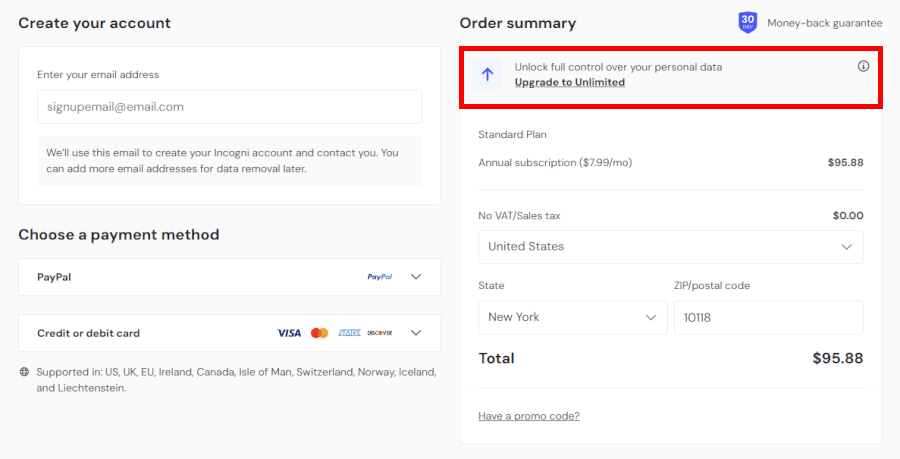
The process is straightforward: Pick your plan, verify your email, and then (the most important part) sign the authorization form:
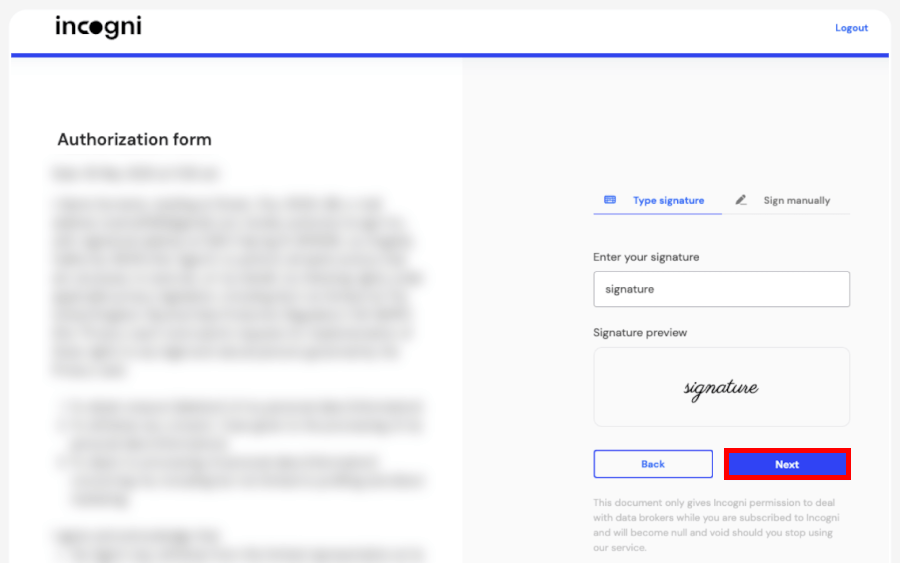
Think of this as giving Incogni a “Limited Power of Attorney.” Without this signed digital consent, data brokers can (and will) ignore removal requests. By signing, you’re making your opt-out requests legally binding under CCPA or GDPR frameworks.
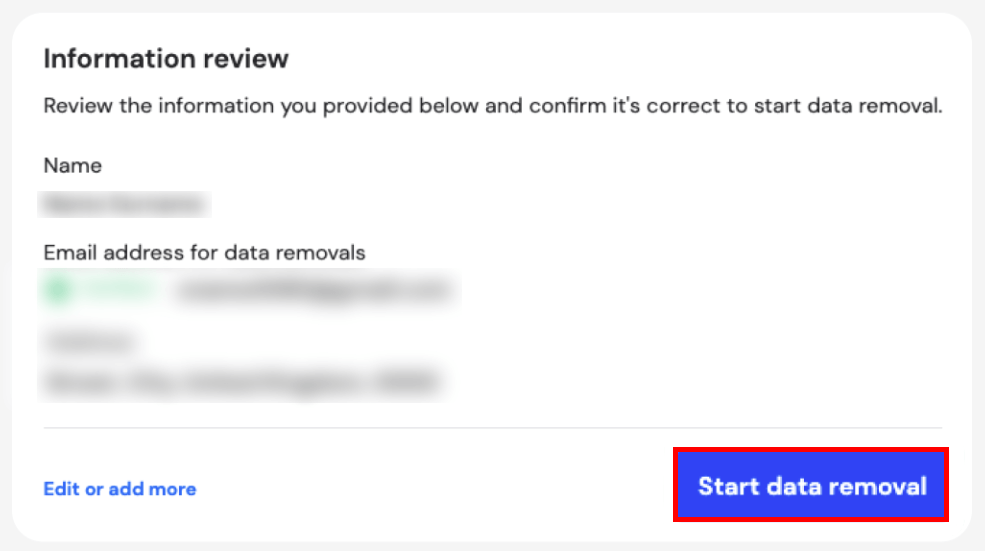
To hunt down your data effectively, you need to be honest with the algorithm. I provided my full legal name, DOB, and my primary phone number. Don’t stop at one email. Incogni lets you add up to three email addresses and three physical addresses. Use them! The more “breadcrumbs” you provide, the more hidden data broker profiles Incogni can find and destroy.
The dashboard
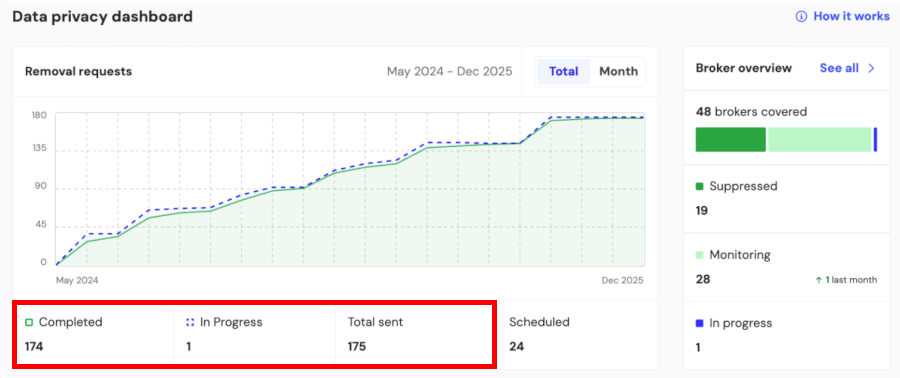
Once the initial scan is done, you’re dropped into a dashboard that is refreshingly free of clutter. Instead of scary red warning lights, you get a calm, tile-based view of your digital cleanup:
- The “war room” stats: You’ll see real-time counters for Requests Sent, In Progress, and Completed Removals.
- The “suppressed” win: This is my favorite metric. It shows you how many brokers have been told never to add you back.
- The “hours saved” counter: This is a bit of a dopamine hit. It calculates how much of your life you just bought back by not doing this manually (for me, it estimated over 100 hours of paperwork saved).
One of the slickest features I noticed during my hands-on testing is the Email Shadowing. Usually, when you opt out of a site, the broker floods your inbox with “Are you sure?” emails. Incogni intercepts almost all of that noise, routing the confirmation junk to their own servers so your inbox stays pristine.
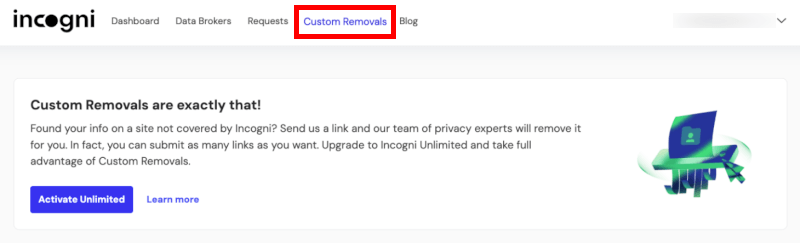
If you’re a data nerd, you can click into any individual broker (like Whitepages or Acxiom) to see the exact stage of your request. It’s transparent, it’s fast, and it actually makes “disappearing” feel satisfying.
The 30-day roadmap: What actually happens to your data?
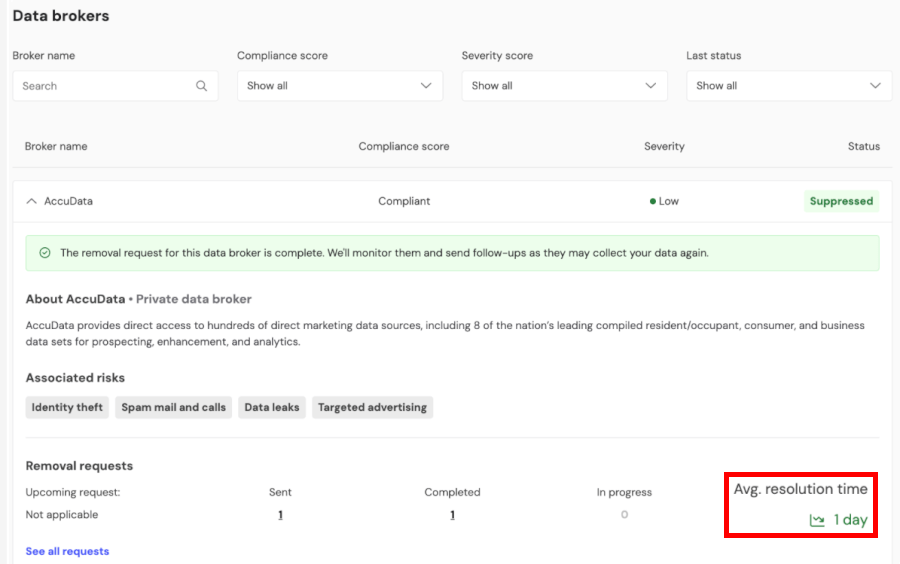
Here is the realistic timeline you can expect based on my hands-on analysis and broader industry benchmarks.
Week 1: The quick wins and fast fades
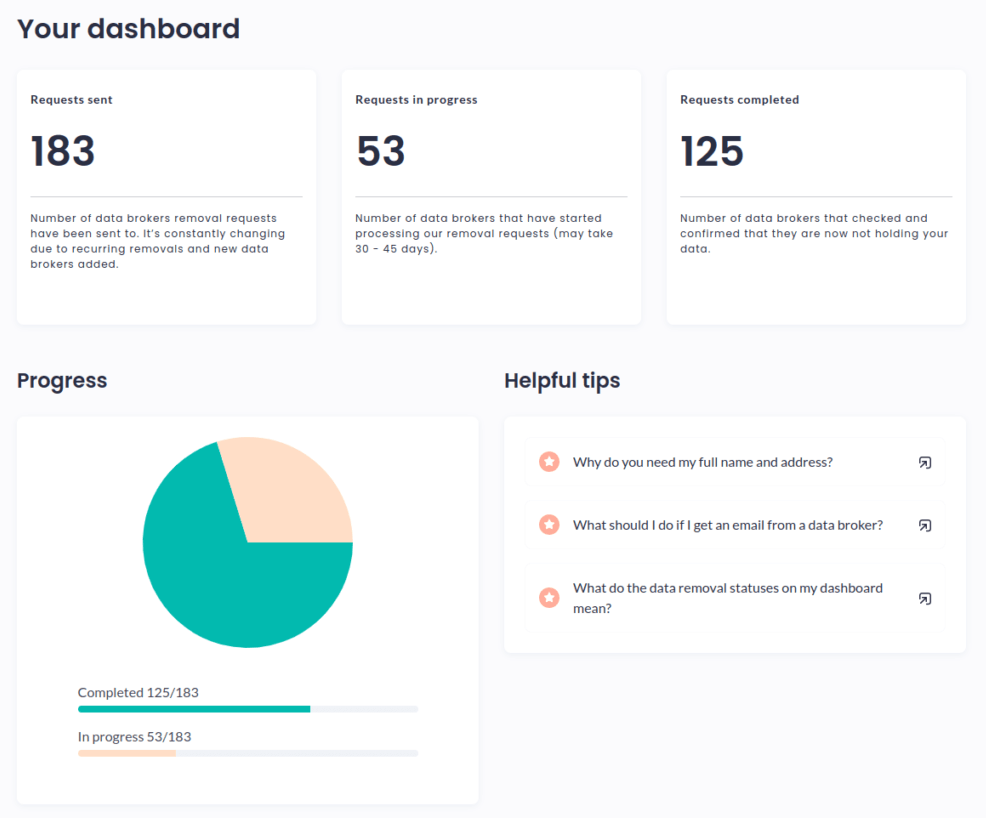
Within the first seven days, the dashboard is a hive of activity. My experience saw nearly 190 requests blasted out almost instantly. By day seven, roughly half were already marked as “Completed” or “Suppressed.”
When I did a manual “gut check” on a few major people-search sites, my home address and phone number had already vanished from the most visible spots. Industry data suggests that Incogni’s “Week 1” velocity often outperforms competitors like Kanary or Onerep, which sometimes take weeks just to get their initial batches moving.
Week 2: The “slow burn” begins
After the first wave of easy wins, the pace slows down. This is where Incogni earns its keep. By Week 2, the service is grinding through the “stubborn” brokers, the ones that use complex legal loopholes to delay removals. I saw about two dozen more completions here, mostly shifting toward suppression lists (where brokers flag your name as “off-limits” for future scraping).
Weeks 3–4: The “legal deadline” finish line
By the end of the first month, the bulk of the “Big 400” brokers have been dealt with. The remaining stragglers are usually niche marketing databases or private entities that legally have 30 to 45 days to respond under CCPA or GDPR.
The 30-day “big picture”
By day 30, my “Hours Saved” metric hit a staggering 287 hours. Could I have done this myself? Maybe, if I wanted to spend every waking hour for three months fighting with customer service bots. Instead, Incogni did the heavy lifting while I actually lived my life.
Incogni reports, maintenance, and living off-grid
Once the initial dust settles, Incogni shifts from a “search and destroy” mission into a permanent security guard for your identity. It’s arguably the most hands-off personal data removal service on the market in 2026.
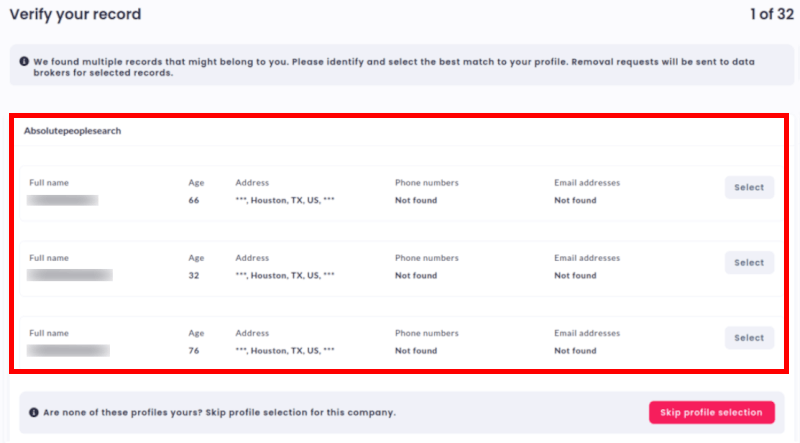
Here is what your ongoing “maintenance” looks like at a glance:
| Feature | Frequency | What it does |
| ✅ Automated rescans | Every 60–90 days | Checks to see if brokers “re-scraped” your data |
| ✅ Progress reports | Monthly (via email) | A summary of new removals and hours saved |
| ✅ Broker suppression | Permanent | Keeps your name on “Do Not Sell” lists |
| ✅ Inbox shielding | Real-time | Intercepts broker spam so your inbox stays clean |
The maintenance experience: Privacy monitoring on autopilot
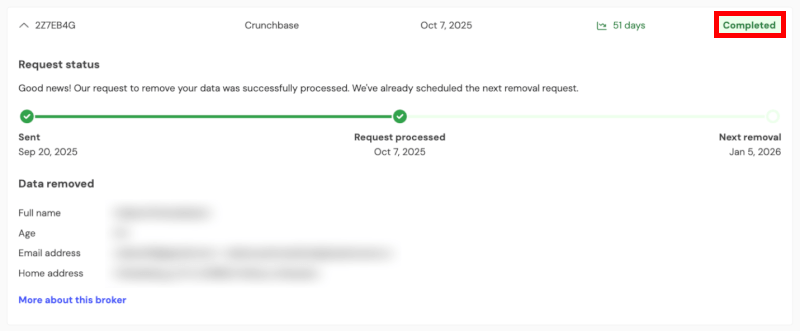
The dashboard remains the star of the show. Instead of making you hunt for info, it uses color-coded indicators (Green = Done, Yellow = In Progress) that let you audit your privacy in about 30 seconds.
You’ll get a monthly “privacy digest” email that breaks down:
- The total kill count: How many requests are now fully resolved.
- The “hours saved” perk: A reminder of how much manual labor you avoided.
- New broker additions: If Incogni adds a new broker to their database, they’ll automatically send them a removal request without you lifting a finger.
The “zombie data” problem: Why recurring protection matters
Data brokers are persistent. They often “accidentally” rediscover your info through third-party marketing lists. Incogni counters this with automated cycles. By circling back every 60 days for public sites and 90 days for private brokers, they ensure your digital footprint stays small.
Can you verify the results yourself?
- For people-search sites: Yes. You can (and should) occasionally Google yourself to see if you’ve vanished from Whitepages or Spokeo.
- For marketing brokers: You’ll have to trust the Deloitte-audited reports. Since these brokers don’t have public-facing websites, Incogni’s internal tracking is the only window you have.
The hit list: What kind of data (and which sites) does Incogni scrub?
A common mistake people make when looking for an Incogni review is thinking it’s a “magic eraser” for the entire internet. It isn’t. Incogni is a precision tool designed to hit identifiable personal information (PII) held by professional data harvesters.
If it’s on a broker’s shelf, Incogni wants to break it. Here’s the specific hit list:
- The big identifiers: Your full legal name (and those annoying aliases), current and past home addresses, and every phone number you’ve ever used.
- Digital breadcrumbs: Primary and secondary email addresses and your DOB.
- The “shadow” profile: Demographic data and interest tags that ad-tech companies use to pigeonhole you for marketing.
Who is Incogni fighting?
The “Standard” plan covers a massive database of 420+ global brokers, but not all brokers are created equal. They generally fall into these five categories:
| Category | Real-world examples | Why it matters |
| People-search sites | Whitepages, Spokeo, and MyLife | These are the ones your stalker-ish ex or a nosy neighbor uses |
| Ad-tech aggregators | Marketing/profile databases | These guys sell your private info to advertisers (and keep your phone ringing with spam) |
| Risk and profiling | Insurance and financial scorers | They can impact your “risk score” for everything from car insurance to loans |
| Background checkers | Tenant and employment screens | Crucial to clear out before you apply for a new job or apartment |
| Location/property | Real estate and deed records | Brokers that specialize in exactly how much your house is worth |
The “reality check”: What Incogni can’t do
I always tell my friends: Incogni is a data removal service, not a reputation management firm. It’s important to know the limits so you aren’t disappointed:
- Social media: It won’t delete that embarrassing tweet from 2012 or your Facebook profile. You still own those.
- The news: If you were mentioned in a local newspaper article or a blog post, Incogni has no legal “delete” button for those.
- Government records: It cannot scrub official court documents or public marriage licenses. Those are legally required to be public.
- Self-controlled content: If it’s on a site you have a login for, you’re the one who has to hit delete.
The “Unlimited” advantage: While the 420+ brokers on the Standard Plan cover about 90% of the “exposed” internet, the Unlimited Plan is where you go if you want to target the 2,000+ niche sites that aren’t on the general list.
The “proof” problem: Can you trust the numbers?
Here’s the uncomfortable truth: with most data removal services, you’re essentially paying for a “trust me, bro” promise. You see a dashboard move from 0 to 100, but how do you know a request was actually sent?
The Deloitte audit: A privacy industry first
Incogni solved this “trust gap” by becoming the first service in the game to be verified by a Big Four auditor. This isn’t just marketing fluff; Deloitte’s independent review put their internal gears under a microscope.
What Deloitte confirmed:
- Real action: They actually send data removal requests to every broker on their list.
- Clean hands: Incogni does not resell your data (a common fear with “free” tools).
- No conflict: They have zero affiliations with the data brokers they’re fighting.
- The “stalker” follow-up: Their 60 and 90-day re-scan cycles are legitimate and automated.
So, is the reporting enough?
The Incogni dashboard strikes a balance between “useful info” and “information overload.” You get a monthly email that takes about 30 seconds to scan – perfect for the average person who just wants the spam calls to stop.
However, if you’re a “power user” who wants to see the raw legal correspondence or downloadable logs of every interaction, you might find the reporting a bit light. You have to trust the “Completed” status. However, for 99% of us, the Deloitte stamp of approval provides more peace of mind than a thousand raw log files ever could.
Plans and pricing: Getting the best bang for your buck
Let’s talk numbers. Privacy shouldn’t be a luxury, and in 2026, Incogni remains one of the most aggressively priced data removal services on the market. While prices can shift with seasonal promos, here is the breakdown of how to spend your money wisely.
| Plan | Monthly cost (billed annually) | Custom removals? | Best for… |
| Standard | $6.79/month | ❌ | Individuals and spam control |
| Unlimited | $12.74/month | ✅ (unlimited) | High-profile and niche sites |
| Family | $13.59/month | ❌ | Households (up to 5 members) |
| Family Unlimited | $19.54/month | ✅ (unlimited) | Full house with custom needs |
The Standard plan is the “sweet spot” for about 90% of the people I talk to. It’s designed for individuals who are simply fed up with the phone ringing off the hook and want their home address scrubbed from the “big 400” broker sites. At $6.79/month (billed annually), it’s cheaper than a basic Netflix subscription and arguably much more productive for your mental health. It handles heavy hitters like Whitepages and Spokeo on total autopilot, making it the perfect entry point for digital cleanup.
If you have a spouse, roommates, or teenagers whose data is already circulating, the family-focused plan is the ultimate “household hero” move. This tier allows you to protect up to five family members under one roof. When you do the math and split that cost five ways, the per-user price drops to literal pocket change. This is easily the most cost-effective way to shield your entire inner circle from identity theft risks without managing five separate accounts.
For high-profile individuals or anyone being targeted by niche “dark web” style brokers, the Unlimited plan is the necessary upgrade. The real edge here is the unlimited custom removal requests feature. If you stumble upon your info in an obscure directory that isn’t on the standard list, you can flag it for a human agent to hunt down manually. This plan also unlocks priority phone support, which is an absolute godsend if you’re navigating a specific privacy crisis and need to speak to a real person immediately.
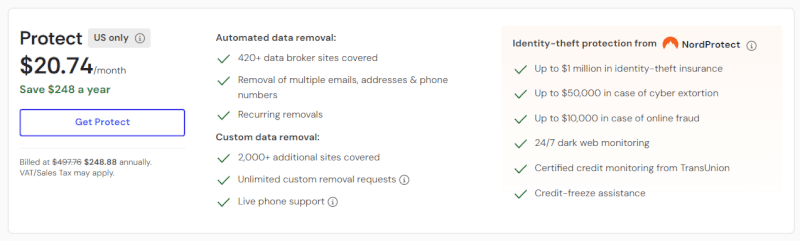
If you’re already in the market for a VPN or Antivirus, stop right there and look at the Surfshark One+ Bundle. In 2026, bundling the Incogni engine into your security suite is often cheaper than buying a standalone removal service. You get the VPN, the Antivirus, and the full power of Incogni all within a single dashboard. It’s the ultimate “Privacy All-Star” move for your budget, providing a 360-degree shield for less than the cost of a couple of movie tickets.
The irony check: How does Incogni handle your data?
It’s the question everyone asks: Why should I hand over my phone number and address to another company when my whole goal is to stop companies from having them? It feels a bit like giving a thief your house keys to help you change the locks.
However, Incogni’s business model is the polar opposite of a data broker’s. While brokers monetize your personal details, Incogni weaponizes them. They use your details as a legal “search warrant” to find and destroy your profiles on shady data broker databases. Here is how they keep that removal process secure.
The “identify and destroy” policy
Incogni follows a strict “minimal data” rule. They only ask for the essentials (name, DOB, address, and email) because that is the bare minimum required to make a legally binding removal request under GDPR or CCPA. They aren’t building a lifestyle profile on you; they’re building a legal case against the brokers.
Plus, thanks to their AES-256-GCM encryption (the same military-grade standard banks use), your data is scrambled both while it sits on their servers and while it’s in transit.
The Deloitte safety stamp
If you don’t want to take their word for it, take Deloitte’s. As we mentioned, their independent audit verified that Incogni has zero broker affiliations and (most importantly) does not sell or share your data for profit. This isn’t a “free” service that pays its bills by selling your habits out the back door; you are the customer, not the product.
The 12-month “clean slate” rule
Incogni doesn’t want to keep your data forever. If you cancel your subscription, they purge your records within 12 months. And if you’re a “delete it now” kind of person, you can simply request an immediate wipe of your account data. Even when they contact those “bad guy” brokers, the interaction is framed as a legal threat. They aren’t “introducing” you to brokers; they are wielding privacy laws to demand your digital eviction.
Getting help: Support, availability, and the “escape” clause
Even with the best automation, you might occasionally need a human in your corner. I put Incogni’s support team through the wringer, and the results were impressively consistent. Whether you’re a solo user or managing a full household, here is how the support tiers stack up:
| Feature | Standard plan | Unlimited and Family plans |
| ✅ 24/7 live chat | Included (under 5 minute response) | Included (priority routing) |
| ✅ Email ticketing | Standard response | VIP priority response |
| ✅ Knowledge base | Full access | Full access |
| ✅ Phone support | ❌ Not available | ✅ Live support included |
| ✅ Custom removal help | ❌ Not available | ✅ Human-assisted service |
My experience with the 24/7 live chat was a standout; agents typically jumped into the conversation in under three minutes and actually answered my questions without leaning on canned scripts. If you’re more of a DIY type, their self-help library is surprisingly deep.
It is worth noting that while Incogni is a global player (covering the US, UK, Canada, and the EU),some “extra” perks like identity theft insurance are currently limited to US residents.
Finally, let’s talk about the “no-hassle breakup.” There is nothing I hate more than a service that makes you call a “retention specialist” to cancel.
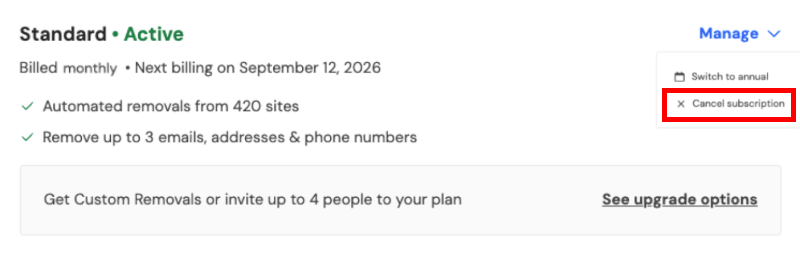
Incogni avoids the drama entirely. You can cancel directly from your dashboard with a single click. There are no guilt trips and no hoops to jump through; your protection stays active until your current billing cycle ends. It’s a refreshingly honest way to handle a subscription, backed by a 30-day money-back guarantee that actually means something.
Incogni vs the world: How it stacks up
When you start looking into data removal services, the first thing you realize is just how many data brokers are actually trading your life for profit. With thousands of data broker companies operating in the shadows, choosing the right service is the difference between a clean slate and a wasted subscription.
| Feature | Incogni | DeleteMe | Optery |
| Data broker coverage | 420+ (2,400+ on Unlimited) | 180+ (750 with custom requests) | 370+ |
| First-week speed | Fastest | Moderate | Slower |
| Deloitte audited? | ✅ Yes | ❌ No | ❌ No |
| Free scan? | ✅ Yes | ❌ No | ✅ Yes |
Incogni vs DeleteMe: Pure speed vs deep detail
DeleteMe is the “grandaddy” of the space, but Incogni often wins on raw velocity. In my testing, Incogni hit nearly three times the number of first-week removals. While DeleteMe gives you slightly more human-vetted reports, Incogni’s relentless automation and suppression cycles make it the superior set-and-forget choice for people who don’t want to read a 20-page PDF every month.
Incogni vs Optery: Automation vs the free scan
Optery is famous for its free scan that shows you exactly which brokers have your data, complete with screenshots. It’s a great reality check tool. However, when it comes to actually fixing the problem, Incogni’s removal engine is significantly more aggressive. While Optery provides great visibility, Incogni’s automated opt-out process cleared almost 100 profiles in the same timeframe that other services were still “processing” their first dozen.
In 2026, third-party accountability is the ultimate tie-breaker. While competitors like DeleteMe and Optery offer great tools, only Incogni has essentially “shown its receipts” via a Deloitte independent audit. For anyone skeptical about handing over sensitive info, Incogni’s verified “no data resale” and “zero broker affiliation” claims make it the most trustworthy data removal service on the market.
Final thoughts: My privacy, one year later
Living with Incogni for a year has fundamentally changed my digital life. The constant “scam likely” calls have slowed to a trickle, and my home address is no longer a public Google result. While it won’t erase a news article or your embarrassing high school tweets, it is a master at nuking the data brokers who profit from your private life.
Who is this for? Honestly, anyone who is tired of being a product. It’s a must-buy for professionals in sensitive fields (like law or healthcare), anyone dealing with harassment, or the privacy-conscious user who values their time more than the cost of a couple of coffees. If you have hundreds of hours to spare, you could do this manually, but why would you?
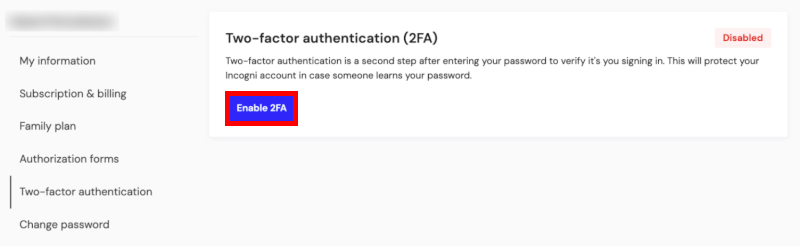
Start with an Incogni annual plan to lock in the $6.79/month rate. You’ll see the biggest “search and destroy” wins in the first 30 days, which perfectly aligns with their money-back guarantee. For the ultimate shield, pair it with a reputable VPN and 2FA to keep your accounts as locked down as your data.
Bottom line: For the price of a streaming sub, you’re hiring a legal team to scrub your footprint while you sleep. In an age of AI-driven data scraping, that’s not just a deal – it’s essential digital self-defense.
Don’t subscribe before checking these Incogni discounts:
Exclusive Incogni Deal:
Incogni is giving CyberInsider readers an exclusive 55% off deal with the coupon below:
(Coupon is applied automatically; 30-day money-back guarantee.)
More expert guides from CyberInsider:
- Best Data Removal Services
- DeleteMe Review
- Privacy Bee Review
- Privacy Bee vs Incogni
- Incogni vs Optery
- Optery vs DeleteMe
- How to Delete Your Digital Footprint
- How to Delete Yourself from the Internet
- How to Massively Reduce Junk Email and Spam
- How to Not Get Doxxed
- How to Opt Out of Whitepages
- How to Stop Spam Calls and Robocalls
Incogni FAQs
Does Incogni actually remove my personal info from Google Search?
Not directly. Neither Incogni nor its competitors can “delete” a Google search result themselves. However, by removing your profile from the source (the data broker), those Google links eventually lead to dead pages and disappear from search results. It’s like cutting off the water to a fountain; eventually, the fountain stops spraying.
How long does it take to see real results?
You’ll see “quick wins” on your dashboard within the first 24 to 48 hours. However, legally, many data brokers have 30 to 45 days to comply with a data removal request under laws like the CCPA or GDPR. For a full “digital scrub,” expect a 4–6 week window.
Is Incogni safe to use?
It feels weird giving your data to a company to help you delete your data, but Incogni is arguably the safest choice in 2026. They are independently audited by Deloitte, use AES-256 encryption, and have a strict “No Data Resale” policy. Unlike “free” tools, you are the customer, not the product.
What happens if I cancel my subscription?
Your data doesn’t immediately reappear, but the protection stops. Data broker companies are “re-scrapers – they constantly pull new info from public records. If you aren’t using Incogni’s recurring 60-90 day removal cycles, your profiles will likely “zombie” back to life within 3 to 6 months.
How does Incogni compare to DeleteMe or Optery?
Incogni is the “automation king.” Meanwhile, DeleteMe offers more human-led reporting, and Optery provides better visual “screenshots” of your data. Incogni typically wins on speed-per-dollar. It’s the best choice for users who want a hands-off, “set-and-forget” solution.

Will this product cover landline phone numbers (non-SMS Text) for spam/scams?
Hi Richard, yes it will.
Most of my spam are political texts. I receive 20-30 per day. Will Incogni block these even though I have occasionally contributed to some campaigns?
My son is married and lives in another sate, can I include them in my Family Plan?
Hi Dale, I believe so, but that would be a good question for Incogni.
Now that Ingocni (and Surfshark) are part of Nord Security, you’d think the pricing pages would be the same across all three sites. It ain’t so. I just dropped my Surfshark account for technical reasons and went with NordVPN (I already has NordPass).
On the Nord site, there isn’t a Family Plan or Unlimited options. Only the very basic, one user plan matches pricing/plans on the Incogni site. I didn’t bother Looking at Surfshark since it was mentioned ‘bundling’ in the article.
Can multiple email addresses be provided? Nowadays, people use multiple email addresses precisely to protect their privacy. Without providing several email addresses, I assume it will be difficult to find all of a person’s entries.
Hey,
Yes, both multiple e-mail addresses and physical addresses are supported with all plans.
Can you compare deleteme with Incogni?
Yep, we have a comparison guide here:
https://cyberinsider.com/data-removal/incogni-vs-deleteme/