
The Optery vs Incogni comparison boils down to three things: pricing, global reach, and how clearly each service shows its removal results.
They may be chasing the same data brokers, but their approaches couldn’t be much more different. One prioritizes simplicity, predictable pricing, and independent oversight. The other gives you a detailed visual record of your exposed information, but you’ll need a pricier subscription to access its full scanning potential.
| Optery | Incogni | |
|---|---|---|
| Website | Optery.com | Incogni.com |
| Availability | The US | The US, Canada, the UK, the Isle of Man, Switzerland, Norway, Iceland, Liechtenstein, and all of the EU |
| Coverage | 625+ (with top tier plan) | 420+ (across all plans) |
| Support | Live chat, email, social media, and knowledge base | 24/7 live chat, email, and detailed knowledge base |
| Starting price | $3.25/month | $6.79/month |
| Annual Price | From $39 to $249 | $81.50 |
| Best Deal | N/A | 58% Off Coupon > |
Provider backgrounds
When comparing Optery vs Incogni, trust and proof of results matter. Both services automate data removal, but they take different approaches to showing what they do.
Optery focuses on visual transparency, giving users screenshots of their exposed profiles.
Incogni, backed by Surfshark, relies on independent verification. A recent Deloitte audit confirmed that it targets over 420 data brokers, has processed 245 million removal requests, resubmits requests every 60–90 days, and has no financial ties to the data broker industry.
Optery overview

Optery helps protect your online privacy by finding and removing personal information from data brokers and people-search sites. Founded in 2020 by data management expert Lawrence Gentilello, the service scans for exposed personally identifiable information (PII), including your home address, phone number, and age, helping reduce risks such as phishing, identity theft, and stalking.
Optery is based in California and falls under US jurisdiction. The US is also part of the Five Eyes (FVEY) intelligence alliance, which privacy-conscious users may want to consider. Optery has received several industry awards, including multiple PCMag Editors’ Choice awards and CNET’s Best Overall Data Removal Service of 2026. Surfshark has acquired the company, but Optery continues to operate as a separate brand alongside Incogni.
The main drawback is that coverage depends on your subscription tier. Lower plans scan fewer sites, while the Ultimate plan unlocks the full network of over 625 default sites, the Expanded Reach tool, and human-assisted custom removal requests.
Optery pros and cons
Pros
30-day money-back guarantee
Covers up to 625+ data brokers on the top-tier plan
Intuitive and easy-to-use interface
Strong security
DIY opt-out guides
Before-and-after screenshot proof
- Free exposure scanning
Cons
Full broker network is locked behind tiers
Premium price tag
- Limited free tier
Incogni overview

Incogni, headquartered in the Netherlands, operates outside the FVEY intelligence alliance. It takes the manual work out of personal data removal by automating opt-out requests across a wide network of data brokers, including marketing firms, recruitment platforms, financial databases, public records, and people-search sites. Instead of submitting requests one by one, Incogni handles the process for you.
For extra help, Incogni’s premium plans include unlimited custom removal requests. You can turn to a human privacy specialist to handle stubborn listings and cases that standard automation may not resolve. It’s a useful option if you need more hands-on help beyond routine automated removals.
For businesses, teams, and professionals in high-risk roles, there’s also Ironwall by Incogni. Designed for people such as judges, social workers, healthcare workers, and corporate executives, it goes beyond standard automation. Dedicated privacy experts manually track down exposures, escalate difficult cases, and work to remove information at the source, including through law enforcement when necessary.
Incogni pros and cons
+ Pros
- Checks 420+ brokers on every plan
- 3,000+ additional niche sites via custom requests
- Independently audited and verified by Deloitte
- Fully automated set-and-forget system
- Unlimited custom removal requests on higher tiers
- Fast removals backed by recurring legal requests
- Delivers data removal updates every 30 days
- A single membership plan covers 34 global countries
- Round-the-clock customer live chat support
– Cons
- Dashboard lacks deep, granular broker data logs
- No phone support line
- No free trial option
Core features
Now let’s get into the features and see where Optery and Incogni really differ, starting with where you can use each service.
Availability
| Incogni | Optery |
| ✅United States of America (50 States) ✅European Union ✅United Kingdom of Great Britain and Northern Ireland ✅Canada ️✅Isle of Man ️✅Switzerland ✅Norway ️✅Iceland ️✅Liechtenstein | ✅United States of America (50 States) ❌European Union (Limited) ❌United Kingdom of Great Britain and Northern Ireland (Limited) ❌Canada ️❌Isle of Man ️❌Switzerland ️❌Norway ️❌Iceland ️❌Liechtenstein |
Optery is currently available only to US residents. It focuses on the US market and works within domestic privacy frameworks, including the California Consumer Privacy Act (CCPA).
Incogni reaches much further. Besides the US, it serves users in Canada, the UK, the Isle of Man, Switzerland, Norway, Iceland, Liechtenstein, and across the European Union. Its wider reach means it can handle removal requests under privacy laws such as the GDPR, UK GDPR, and Canada’s PIPEDA.
Automated data removal
Automation makes data removal much easier, turning a tedious manual task into something you can largely leave running in the background. Both Optery and Incogni rely on automated removals, but they go about it in different ways.
Optery scans hundreds of people-search sites for your personal information, submits opt-out requests, and keeps checking for new exposures. One of its biggest advantages is transparency: its reports include before-and-after screenshots, so you can see where your information appeared and whether it was removed.

Incogni takes a broader approach, targeting both public data brokers, such as people-search sites, and private brokers, including marketing firms and risk mitigation databases. Since private brokers don’t always make their databases publicly searchable, Incogni uses algorithms and minimal personal identifiers to send proactive removal requests.
Incogni’s process is also independently assessed by Deloitte. The audit verified that Incogni resubmits removal requests every 60–90 days and tracks their progress.
Data broker coverage
Both Optery and Incogni cover hundreds of sites, but there are some important differences in what you get with each plan.
| Incogni | Optery |
| ✅People search sites ✅Marketing data brokers ✅Risk mitigation brokers ️✅Recruitment data brokers ️✅Financial information brokers | ✅People search sites ✅Marketing data brokers ❌Risk mitigation brokers ❌Recruitment data brokers ❌Financial information brokers |
Optery covers over 625 data brokers, but access depends on your subscription. Its entry-level Core plan automates opt-outs for roughly 111 brokers, while full automated coverage requires the top-tier plan. Its network focuses mainly on consumer-facing people-search sites and marketing platforms.
Incogni covers over 420 data brokers on every plan, without locking its core network behind higher-priced tiers. It also targets more specialized databases, including risk mitigation, recruitment, and financial information brokers.
Ease of use
Both Optery and Incogni keep things simple, with clean dashboards that are easy to navigate, even if you’re not particularly tech-savvy.

Optery has a visual dashboard that makes tracking data removal straightforward. You can quickly see active exposures and check removal progress without digging through menus. Even free users can preview where their personal information appears and follow manual opt-out guides if they prefer to handle removals themselves.
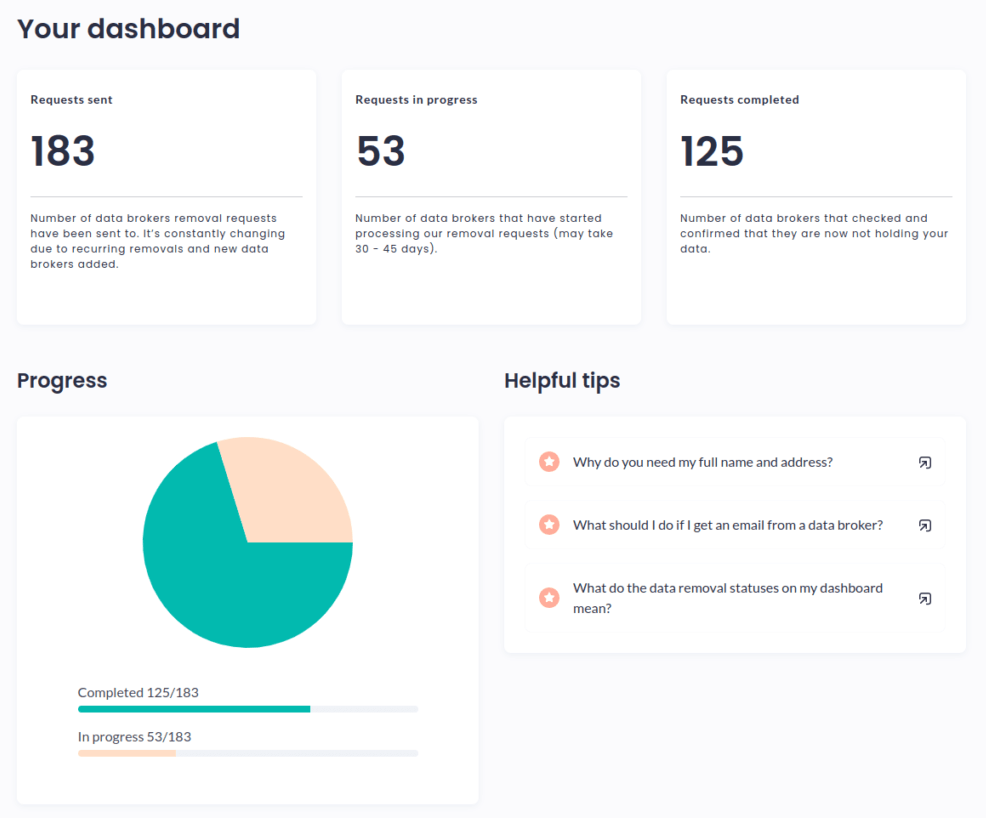
Incogni takes a similarly simple approach, showing your overall removal progress right on the main screen. Its dashboard separates information into two sections, “Data Brokers” and “Requests,” so you can check individual brokers, see when requests were sent, and track their status.
Custom removal requests
Sometimes your personal information turns up on smaller, niche sites that standard automated scans miss. That’s where custom removal requests come in. Both Optery and Incogni offer this option, but access and coverage differ.
Optery reserves custom removal requests for its top-tier Ultimate plan. It extends the standard network to roughly 600 additional sites, bringing coverage to over 640 domains. Requests are unlimited, but there’s a catch: you must keep an active Ultimate subscription for 30 days before submitting your first request.
Incogni makes custom removals more accessible through its Unlimited plan, with no waiting period. You can submit requests as soon as you sign up, targeting more than 3,420 sites in total. That includes 420+ automated data brokers and another 3,000+ custom domains where Incogni has previously secured removals.
Incogni also costs roughly half as much as Optery’s Ultimate plan, making it a more affordable way to access custom removal requests from day one.
Progress reporting
When it comes to tracking removal progress, Optery puts visual proof front and center. Its detailed reports include actual before-and-after screenshots of your exposed profiles, uploaded directly to your dashboard. So you don’t have to take its word for it. You can see where your personal information appeared and check whether it’s been removed.

Optery has also introduced an AI-generated reporting feature. However, this involves sharing data with a third party through its partnership with OpenAI. If privacy is your top concern, you may prefer to leave this optional feature turned off.
Incogni takes a more streamlined approach. Rather than showing detailed screenshots, it provides clear, text-based progress updates in your dashboard. You can follow the removal timeline and see which requests have been sent, are pending, or are completed. It’s less visual than Optery, but suits users who prefer a hands-off process without digging through individual reports.
How long until you see real results?
Incogni starts automated requests as soon as you complete your profile setup. Some removals happen within hours, while others take weeks. You can generally expect your first completed removals within 1–2 weeks, with more substantial progress around the 30-day mark. Its dashboard also shows average resolution times per broker, and recurring requests are sent every 60–90 days to help prevent your data from reappearing.
Optery launches automated opt-outs once you activate a paid plan. Profiles may start disappearing within a week, and users can expect to remove over 55% of their web exposures within the first 30 days. Some brokers take several months, but monthly rescans help catch and remove information that resurfaces.
Pricing and billing
A cheaper plan isn’t always the better deal, especially when data broker coverage is limited. Optery and Incogni structure their plans differently, so let’s see what your subscription really gets you.
| Optery | Incogni | |
| Free scan option | ✅ Ongoing free scans | ❌ |
| Month-to-month option | ✅ Available on all tiers | ✅ Available on all tiers |
| Starting cost (monthly) | $3.25/month (Core) | 15.98/month (Standard) |
| Top tier cost (annual) | $20.70/month (Ultimate) | $12.74/month (Unlimited) |
| Custom audits | ❌ Ultimate tier only | ❌ Ultimate tier only |
| Best deal | N/A | 58% Off Coupon > |
Optery uses tiered pricing, with data broker coverage increasing as you move up the plans. The entry-level Core plan is affordable but automates opt-outs for only 150+ brokers. To unlock the full network of 380+ default sites, or up to 625+ with Expanded Reach, and access custom removal requests, you’ll need the more expensive Ultimate plan.
| Duration | Free | Core | Extended | Ultimate |
| 1-year | / | $3.25/month | $12.42/month | $20.70/month |
| 1-month | / | $3.99/month | $14.99/month | $24.99/month |
Incogni keeps things simpler with a flat-rate approach. Every paying user gets access to its full network of 420+ data brokers, without having to upgrade for broader automated coverage. If you need to go further, the Unlimited plan adds a web-wide Exposure Scanner that searches for your personal information across 3,000+ additional niche websites.
| Duration | Standard | Unlimited | Family | Family Unlimited |
|---|---|---|---|---|
| 1-year | $6.79/month | $12.74/month | $13.59/month | $19.54/month |
| 1-month | $15.98/month | $29.98/month | $31.98/month | $45.98/month |
Use our special Incogni discount to enjoy 58% off and get full data removal protection for less:
Exclusive Incogni Coupon
Incogni is giving CyberInsider readers an exclusive 58% off deal with the coupon below:
(Coupon is applied automatically; 30-day money-back guarantee.)
Security and privacy
A data removal service needs access to quite a bit of personal information to do its job. That makes security and privacy just as important as broker coverage. Both Optery and Incogni take steps to protect your data, but they approach transparency a little differently.
Optery emphasizes user control and privacy. The company says it has no financial ties to data brokers and doesn’t monetize your personal information. You can also access your account data or request its deletion, giving you more control over what information Optery retains.
Incogni adds another layer of transparency through independent auditing. It commissioned Deloitte, one of the Big Four auditing firms, to review its security and operations. The resulting Assurance Report covers its work across 420+ data brokers, recurring removal requests every 60–90 days, its lack of financial ties to the data broker industry, and more than 245 million removal requests processed.
Customer support
When we tested customer support for both services, we were pleasantly surprised to find that both teams are fast, knowledgeable, and easy to reach.
| Incogni | Optery |
| ✅24/7 Live support ✅Live chat ️✅Social media ️✅Web form ️✅Knowledge base / FAQs | ✅24/7 Live support ✅Live chat ️✅Social media ️✅Web form ️✅Knowledge base / FAQs |
When we tried Incogni’s 24/7 live chat, the support agents were friendly and quickly helped us with our dashboard questions. Its knowledge base also has plenty of detailed guides, and our test email received a helpful response in well under 24 hours.
Optery impressed us just as much. An automated chatbot greets you first to handle basic questions, but you can bypass it with a single click and connect with a real agent. Its FAQ center is also well-organized and easy to search, making it simple to find answers on your own.
The final verdic
Choosing between Optery vs Incogni comes down to your priorities: visual removal proof or broad, affordable coverage. Both help clean up your digital footprint but take different approaches.
Here’s how they compare:
- Core features: Incogni wins availability (34 countries vs US-only), automation, broker reach (420+ upfront vs. tiered plans), custom requests, pricing, and security audits; Optery wins reporting with screenshot proof, while ease of use and support are a tie.
- Pricing and billing: Incogni‘s flat-rate pricing avoids locking core coverage behind paywalls.
- Security and privacy: Incogni is backed by an independent Deloitte audit report.
- Customer support: Tie. Both provide fast, knowledgeable support and 24/7 live chat.
The bottom line
If you want hands-off data removal, broad international coverage, independent Deloitte auditing, and instant custom requests, Incogni is the stronger choice. Optery is a better fit for US users who want a free exposure scanner and detailed screenshots showing where their personal information appears and gets removed.
Optery vs Incogni FAQs
Does Optery or Incogni cover more countries?
Incogni features far better international coverage, protecting users across 34 global countries including the US, Canada, UK, and the EU while strictly enforcing legal removals under GDPR, UK GDPR, and PIPEDA frameworks. Conversely, Optery focuses almost exclusively on the domestic US market, operating within domestic privacy guidelines like the CCPA.
Is Optery or Incogni more user-friendly?
Both platforms feature incredibly simple, modern user interfaces that are easy to navigate even with zero technical background. Optery keeps users informed by placing visual, before-and-after screenshots directly onto your dashboard, while Incogni offers a clean, streamlined dashboard that maps out text-based removal timelines and progress logs step-by-step.
Which service offers better value for money?
Incogni delivers significantly better long-term value because it never locks its core features behind premium pricing models. Every subscriber gets full access to their entire 420+ automated data broker network upfront, whereas Optery restricts its maximum automated reach and instant custom requests to its priciest subscription tier.
Are data removal services worth the price?
Yes, automated data privacy platforms are absolutely worth the investment to protect your personal identity and save hundreds of hours of manual labor. Instead of tracking down compliance forms yourself, platforms like Incogni and Optery run continuously in the background, aggressively submitting opt-out requests on your behalf and running routine maintenance scans to ensure your data stays scrubbed for good.
Both platforms launch automated deletion requests immediately, but final speeds depend on how quickly individual data brokers comply. You will typically see your first profile removals disappear within 1 to 2 weeks, with major progress (over 55% of your exposures wiped out) showing up right around the 30-day mark.
Yes, data brokers constantly scrape new public records and re-list information they previously deleted. To combat this, both services run continuous background maintenance: Incogni automatically force-submits recurring removal requests every 60 to 90 days, while Optery executes ongoing monthly rescans to catch and re-scrub any resurfaced data.

My compliments and thanks to Sead Fadilpasic for a deeply comprehensive and detailed comparison of both companies. I am impressed by his level of analyses, leaving no stone unturned. When it’s time to choose, I will certainly have a clear understanding of what each one offers.